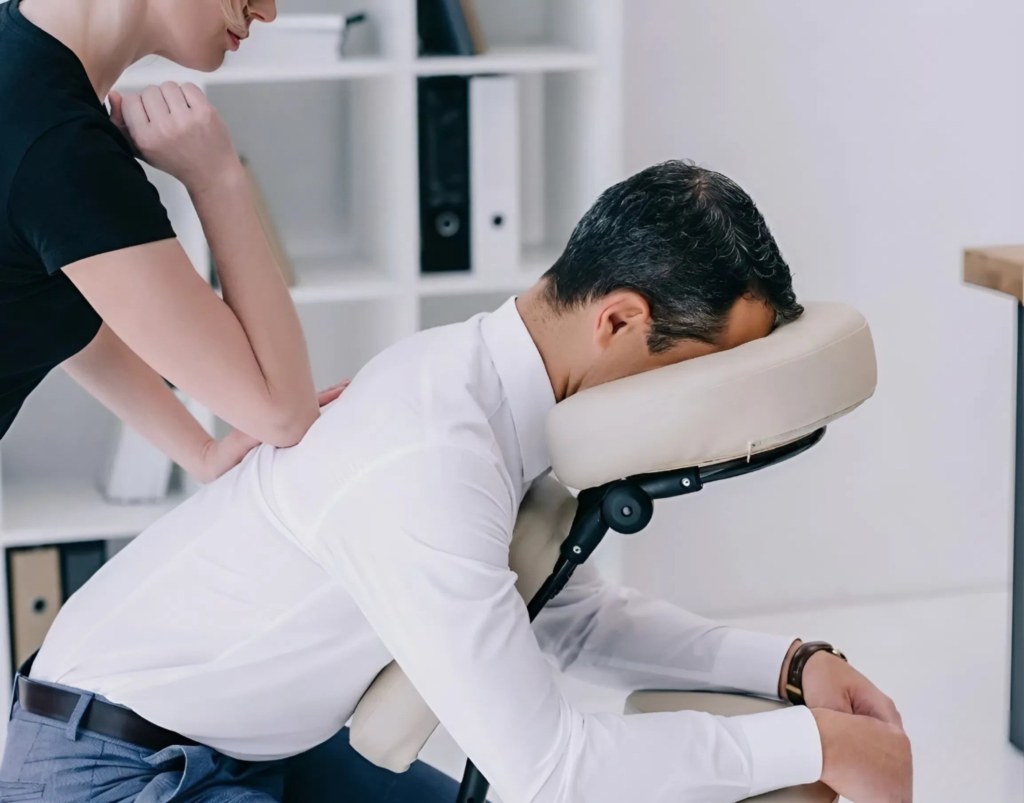

Booking a corporate massage services program is the easy part. Proving that it’s actually working six or twelve months later is where most businesses get stuck. Attendance sheets and a few positive comments after a single session tell you staff enjoyed the day — they don’t tell you whether stress levels are dropping, whether absenteeism is improving, or whether the program is worth renewing at its current scope.
This article sets out the metrics, review cadence, and practical tracking methods that let HR teams and business owners measure long-term success with real data, rather than relying on gut feel or a single satisfied comment in the lunchroom. It’s written for anyone who has to justify a wellbeing line item at budget time — HR managers, office managers, and business owners who want a repeatable way to show whether the investment is paying off.
Why measuring long-term success matters
Workplace wellbeing has shifted from a discretionary perk to a genuine risk-management issue. Safe Work Australia’s most recent work health and safety data shows mental health conditions now make up roughly one in eight serious workers’ compensation claims nationally, with recovery times running well beyond the average for physical injuries. Figures like these change year to year, so it’s worth checking the current release before quoting them internally.
A workplace massage program is one of several tools businesses use to respond to this shift — alongside employee assistance programs, flexible work policies and manager training. Psychosocial hazards are now treated with the same seriousness as physical safety risks under most state work health and safety codes of practice, which means wellbeing initiatives are increasingly viewed as part of a broader risk-management strategy rather than a standalone perk. Like any of those initiatives, a program only earns its place in the budget if someone can show, with evidence, what it’s actually delivering over time.
Set clear objectives before you measure anything
It’s hard to measure success against a goal that was never defined. Before building a tracking system, agree internally on why the business introduced corporate massage services in the first place — the answer shapes which metrics actually matter.
Common goals for a corporate massage services program
- Reducing day-to-day stress and muscular tension in desk-based roles
- Lowering short-term absenteeism linked to fatigue or minor musculoskeletal complaints
- Strengthening retention by demonstrating a visible investment in staff wellbeing
- Supporting a broader employee value proposition used in recruitment
A program aimed at recruitment marketing is measured differently to one aimed at reducing sick leave. Naming the primary goal up front avoids chasing metrics that sound impressive but don’t answer the question the business actually cares about.
Key metrics to track over time
Participation and engagement rates
The most basic — and most revealing — metric is whether staff keep showing up. Track the proportion of eligible employees booking a session at each visit, and watch the trend across several months rather than a single date. A steady or growing participation rate suggests the program has genuinely embedded itself into the workplace routine; a slow decline is an early warning sign worth investigating before renewal.
Absenteeism and sick leave trends
Compare short-term sick leave data from the months before a recurring corporate massage services program started against the months after, ideally over a full year to smooth out seasonal effects such as winter flu. Be cautious about attributing every change entirely to the massage program — other factors, including flexible work changes or a quiet business period, can move the same numbers. Treat this as one data point among several, not a single proof of causation.
Staff feedback and satisfaction scores
A short, consistent pulse survey after each session — the same handful of questions every time — builds a trend line that’s far more useful than one-off comments. Ask about perceived stress relief, likelihood of recommending the session to a colleague, and preferred session format. Reviewing these scores quarterly shows whether satisfaction is holding steady, improving, or fading as the novelty wears off.
Retention and turnover signals
Workplace wellbeing perks rarely show up as the sole reason someone stays in a role, but they do surface in exit interviews and engagement surveys. If your business already runs an annual engagement survey, add a specific question about wellbeing benefits and track the score alongside overall retention figures year on year.
Return on investment: a simple, honest view
Building a full financial model isn’t necessary to get a useful ROI picture. Start with the direct cost of the program over a year, then estimate the value of any measurable reduction in absenteeism or turnover. As a general industry reference point, a widely cited PwC analysis commissioned by beyondblue found that, on average, Australian businesses saw a return of roughly $2.30 for every $1 spent on effective workplace mental health actions. That figure covers a broad range of mental health initiatives, not massage specifically, and results vary significantly by industry and organization — so use it as context, not a guarantee, and build your own figure from your own participation and absence data wherever possible.
Pulling these together into a single reference makes quarterly reviews faster to prepare:
| Metric | What it shows | Suggested review frequency |
| Participation rate | Whether staff are still engaging with each visit | Every session |
| Feedback score | Perceived stress relief and satisfaction | Every session, reviewed quarterly |
| Absenteeism trend | Short-term sick leave movement over time | Quarterly, confirmed annually |
| Retention signal | Mentions of wellbeing perks in surveys or exit interviews | Annually |
| Cost-benefit view | Program cost against estimated savings | Annually |
How often to review your program
A quarterly light-touch review — participation rate, feedback scores, any scheduling issues — keeps the program on track without creating extra admin work. An annual deeper review is where absenteeism trends, retention signals and overall cost-benefit get pulled together into a single picture for budget renewal conversations. Reviewing only once a year risks missing a decline in participation until it’s already become a pattern.
What good progress looks like after twelve months
Results vary by workplace, so treat the following as general markers rather than promised outcomes. After a year of consistent sessions, a healthy program usually shows a participation rate that has held steady or grown rather than declined, feedback scores that remain positive without a clear downward trend, no unexplained spike in short-term sick leave, and at least a handful of unprompted mentions of the program in engagement surveys or exit interviews. None of these on their own proves the program caused the result — but together, over a full year, they build a reasonably solid case for renewal.
Practical tools and methods for tracking results
Most of this data already exists somewhere in the business. HR information systems typically hold absenteeism and turnover records; a simple recurring survey tool covers feedback; and a well-organized provider can supply session-by-session attendance reports as part of an ongoing corporate wellness program. Keeping all of this in one shared spreadsheet, updated after each visit, makes the quarterly and annual reviews far quicker to prepare.
A simple approach that works for most businesses is one tab for session dates and participation numbers, one for pulse-survey averages, and one for absenteeism figures pulled from the HR system each quarter. None of this needs to be sophisticated — the value comes from updating it consistently, not from the tool itself. Whoever owns the wellbeing budget should also own the tracking, so the data feeds directly into the renewal conversation rather than sitting unused until someone asks for evidence at the last minute.
Signs your program needs adjusting
- Participation rates falling steadily over two or more consecutive bookings
- Feedback scores flattening or declining despite no change in format
- One office or team consistently opting out compared to others
- No detectable movement in absenteeism or engagement scores after a full year
Any of these signals is worth a conversation with your provider before the next renewal — sometimes the fix is as simple as switching part of the schedule from desk massage to a different format, adjusting session length, or changing the day of the week sessions run.
How Corporate Care Therapies supports measurable outcomes
Corporate Care Therapies has delivered corporate massage services to Australian businesses for over 20 years, and provides attendance and booking reports alongside every ongoing program so HR teams have the underlying data ready for their own reviews. Further reading on how workplaces are approaching this is available on the Corporate Care Therapies blog, including Massage at Work: why Australian businesses are prioritising workplace wellness in 2026 and how Corporate Care Therapies helps businesses create healthier and happier workplaces.
Summary
Proving the long-term value of a corporate massage services program comes down to a handful of habits: agree on the goal before you start measuring, track participation and feedback consistently rather than anecdotally, compare absenteeism data over a full year to account for seasonal noise, and review the whole picture at least quarterly. None of this requires a complex system — a shared spreadsheet, a short recurring survey, and a provider willing to supply attendance data will cover most of what a business needs to make an informed renewal decision.
Want reporting built into your corporate massage services program from day one? Contact Corporate Care Therapies to discuss a booking and attendance report tailored to how your business tracks wellbeing outcomes.