Australian workplaces are under mounting pressure. According to the Australian Chiropractors Association’s 2024 national survey, 86.7% of workers have experienced a musculoskeletal disorder or injury either at work or due to their workspace – with 89% of desk-based workers reporting at least one such condition. The cost of inaction is real: SafeWork NSW puts the average serious musculoskeletal claim at $64,759 per worker, with a loss of around 20 weeks of productive work time (SafeWork NSW, MSD Prevention Plan 2024–2026).
For HR managers and business leaders looking to do something meaningful about workplace wellness, on-site massage is one of the most practical and immediate options available. But one question comes up repeatedly in early conversations: what’s the difference between corporate chair massage and desk massage – and which one is right for my office?
This guide breaks down both formats, compares them honestly, and helps you make the decision that fits your office layout, team size, and wellness goals.
What Is Corporate Chair Massage?
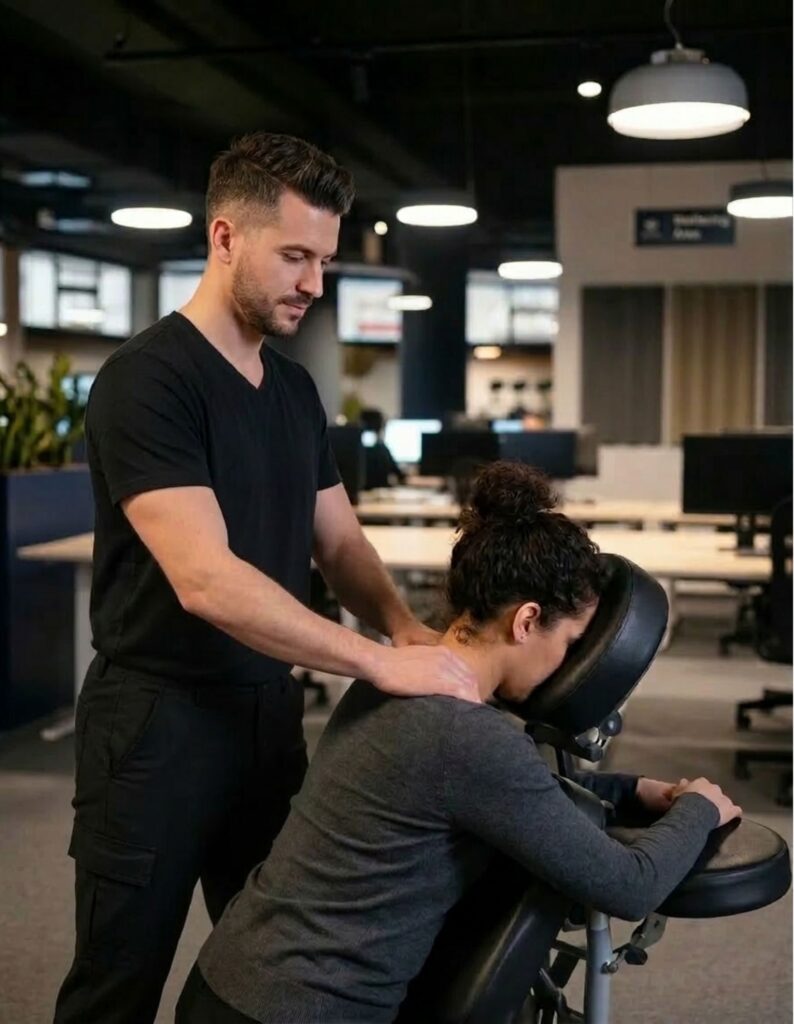
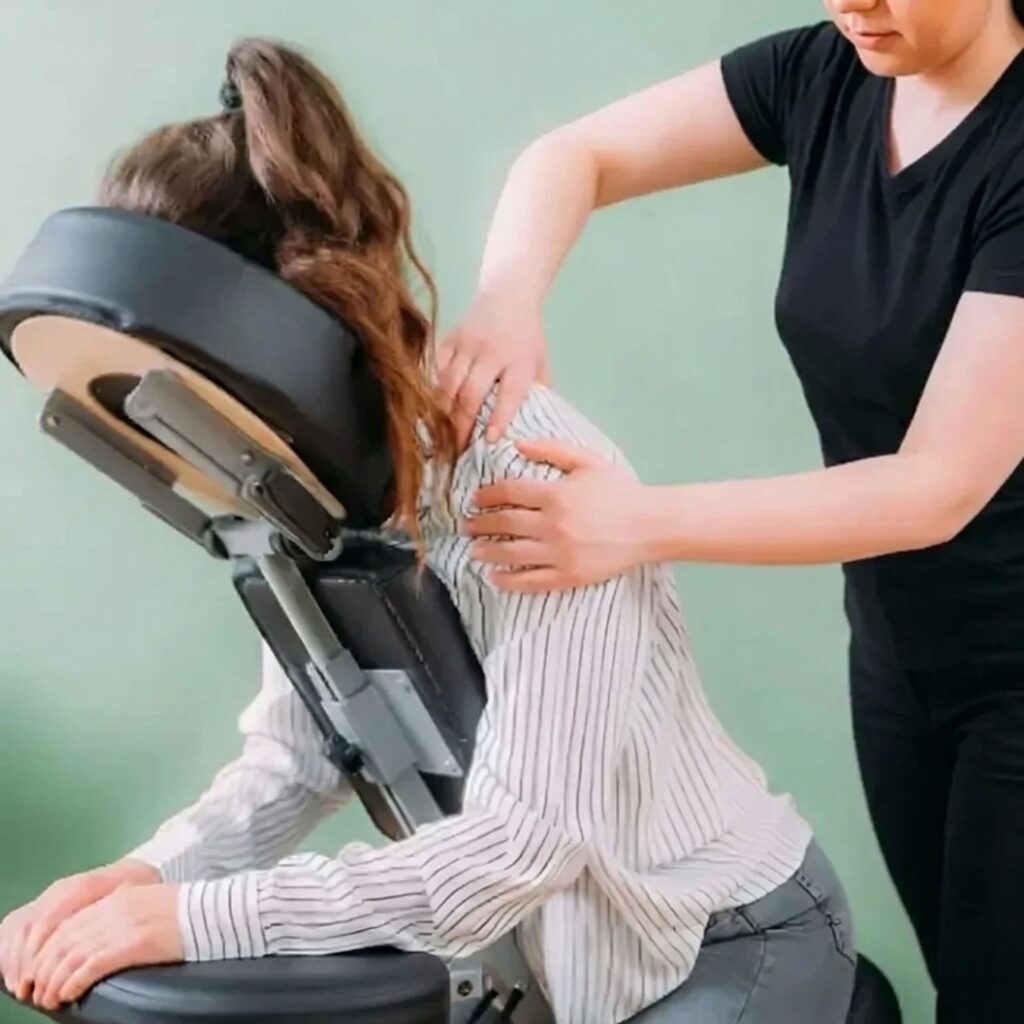
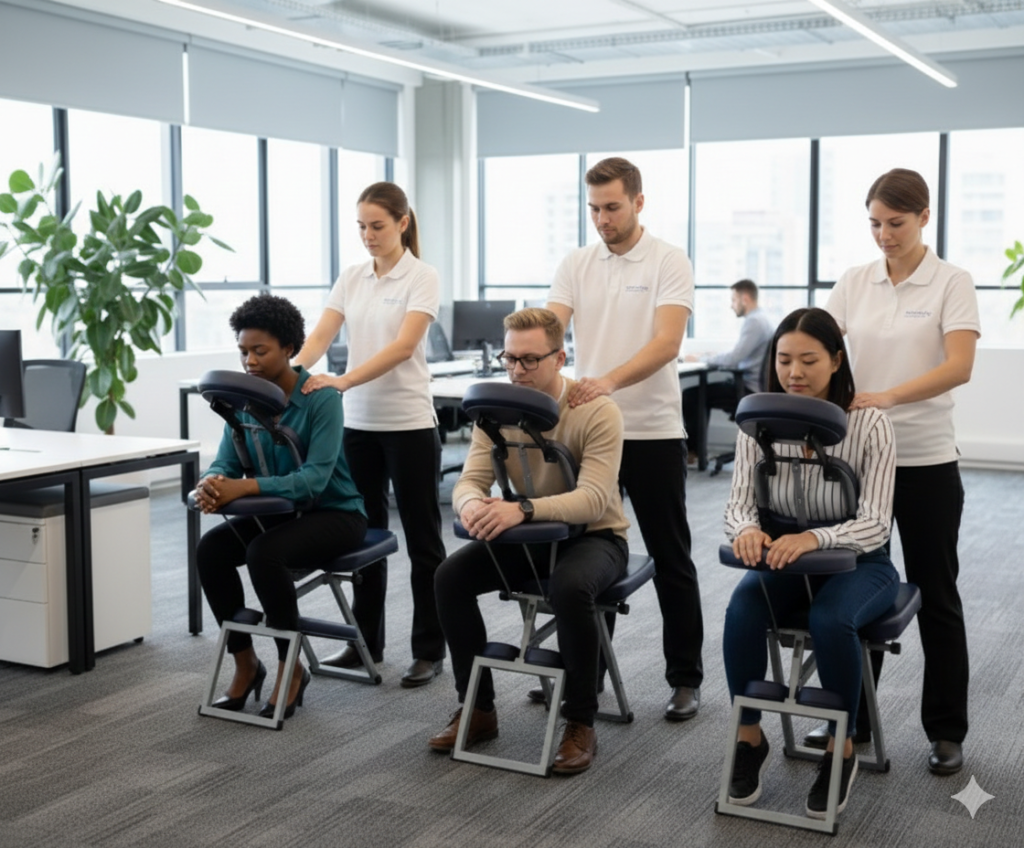
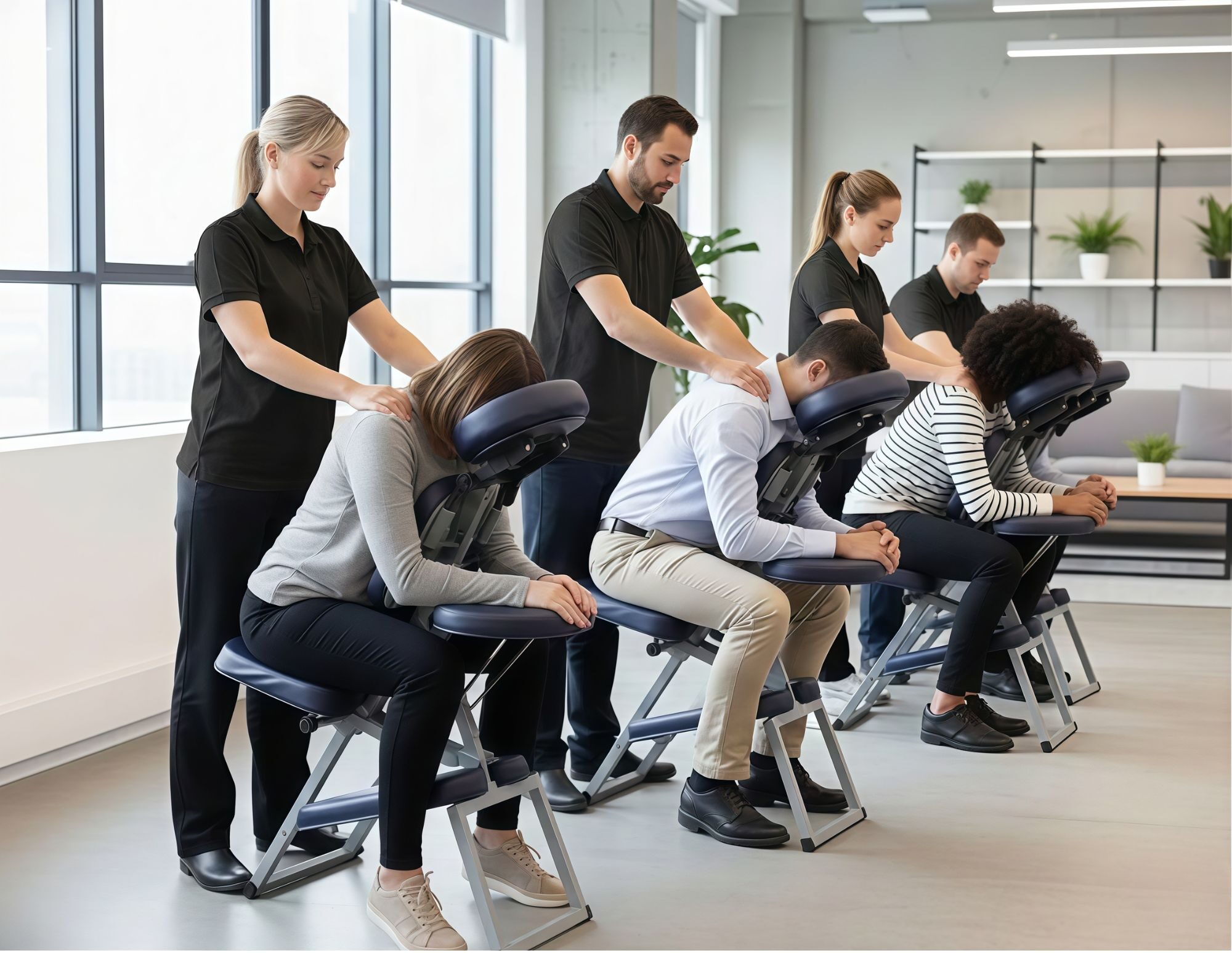
Corporate chair massage is the most widely recognized format of workplace massage in Australia. A qualified therapist brings a portable, ergonomic massage chair to your office and sets up in a designated space — typically a quiet meeting room, a break room, or a corner of the office floor.
Employees book a time slot and spend 15 to 20 minutes seated in the massage chair, fully clothed, while the therapist works on the neck, shoulders, upper back, arms, and hands. No oils are used. No undressing required. The session ends, and the employee returns to their desk refreshed.
The format is structured and contained. One therapist, one chair, one dedicated space – which makes it easy to schedule, manage, and repeat on a regular basis.
Key characteristics of chair massage:
- Requires a separate or semi-private area (roughly 2–3 square metres)
- Sessions typically 15–20 minutes per person
- Therapist focuses on neck, shoulders, upper back, arms, hands
- Fully clothed; no oils
- Easy to roster employees in time slots throughout the day
What Is Desk Massage?
Desk massage – sometimes called at-desk massage or desk-to-desk massage – takes a different approach. Rather than employees coming to a dedicated space, the therapist moves through the office and provides a short, targeted massage at each employee’s own workstation.
The focus is on the upper body: back, shoulders, neck, head, arms, and hands. Sessions are typically 10 minutes or less per person, making this the faster-moving, higher-volume option. It’s also the lower-disruption choice: employees don’t need to leave their workspace or wait in line.
Desk massage works particularly well in open-plan offices where setting up a dedicated massage space would be impractical, or in environments where brief, informal wellness moments are more culturally appropriate than booked sessions.
Key characteristics of desk massage:
- No separate room or space required
- Sessions typically 10 minutes or under per person
- Therapist circulates from desk to desk
- Fully clothed; no oils
- Higher volume of people served in a shorter time
Side-by-Side Comparison
| Feature | Corporate Chair Massage | Desk Massage |
| Space required | Separate room or designated area | Any open workspace |
| Session length | 15–20 minutes | ~10 minutes |
| Booking format | Time-slot rostering | Walk-up or informal |
| Privacy level | Higher (separate area) | Lower (open floor) |
| Throughput per hour | 3–4 employees | 5–6 employees |
| Therapist setup | Ergonomic massage chair + equipment | Minimal — therapist brings nothing extra |
| Ideal office type | Medium–large offices with meeting rooms | Open-plan or smaller offices |
| Best for | Structured wellness days, regular programs | Ad hoc events, high-volume team days |
Which Format Works Best for Your Office?
The honest answer: neither format is universally better. The right choice depends on your office layout, your team culture, and what you want the program to achieve.
Choose chair massage if:
You have dedicated space to work with. Chair massage delivers a noticeably more therapeutic result because the ergonomic chair supports the full upper body and allows the therapist to apply deeper, more targeted pressure. If you can allocate a quiet room — even temporarily — the experience your employees receive will be more meaningful and longer-lasting.
You’re running a structured wellness program. Chair massage pairs well with a scheduled, recurring wellness initiative. Employees book time slots, the session has a defined structure, and the whole program feels considered and professional. For companies that want to use wellness as part of their employer value proposition, chair massage creates the kind of experience employees talk about.
You want higher therapeutic value per person. At 15–20 minutes, a chair massage session allows the therapist to address tension across the neck, shoulders, and upper back with real depth. This is particularly relevant in desk-heavy environments where cumulative upper-body tension builds across weeks and months.
Choose desk massage if:
Your office is open-plan with no available private space. Not every office has a spare meeting room to dedicate for a day. Desk massage eliminates this barrier entirely — the therapist moves through the floor and staff can receive a quick session without leaving their immediate workspace.
You want to reach more people, faster. At roughly 10 minutes per person, desk massage allows a single therapist to cover a much larger proportion of the team in a given day. For large teams, company-wide event days, or one-off wellness initiatives where you want broad participation, desk massage maximises reach.
Your team culture favours low-key wellness moments. Some office cultures respond better to informal, spontaneous wellbeing touchpoints rather than booked Book nows. Desk massage fits naturally into that style — the therapist arrives, people opt in as they’re available, and there’s no administrative overhead.
Why the Format You Choose Matters for Outcomes
The format is not just a logistical decision — it directly affects whether your wellness investment delivers measurable results.
Research published in Heliyon (2023) found that structured 15-minute massage chair sessions resulted in a 29.6% reduction in musculoskeletal pain and a 26.3% drop in work-related stress among office workers. These results came from regular, time-specific sessions — not ad hoc touchpoints. That kind of outcome points toward chair massage when therapeutic results are the priority.
On the other hand, desk massage shines when the goal is morale and participation. If the aim is to signal to staff that the company values their wellbeing — quickly and visibly, across the whole team — desk massage covers more ground in less time.
Workplace wellness research consistently reinforces the business case for both. According to broader wellness statistics compiled in 2025, companies with comprehensive wellness strategies see a 2.5x return on investment from improved productivity and reduced absenteeism (Recruiter’s Lineup, Workplace Wellness Statistics 2025). Short chair massage sessions have also been shown to lower cortisol (the body’s primary stress hormone) and increase endorphins — with employees reporting improved focus and clarity after as little as 15 minutes.
The key is not choosing between “good” and “better” — it’s matching the format to your current setup so that the program actually gets used.
Can You Combine Both Formats?
Yes, and for many offices, a hybrid approach works particularly well.
Some clients run a chair massage program on a regular fortnightly or monthly cycle in a meeting room, while using desk massage for company events, milestone celebrations, or large team days. This gives employees the therapeutic depth of chair massage on an ongoing basis, while desk massage handles the high-volume, morale-focused moments.
Corporate Care Therapies has delivered both formats to organizations across Melbourne, Sydney, Brisbane, Perth, and beyond — with therapists experienced in adapting to different office environments. You can learn more about event massage options for large team days.
If you’re unsure which format suits your space, the simplest step is to describe your office layout to the team. Most setups become clear quickly.
What to Look for in a Corporate Massage Provider
Regardless of which format you choose, the quality of the therapist and the professionalism of the provider makes the difference between a one-off gesture and a program your staff genuinely value.
Key things to confirm before booking:
- Fully qualified and accredited therapists — all working under Australian standards
- Public liability insurance — non-negotiable for any reputable provider
- Corporate environment experience — therapists who know when to be quiet, when to adapt, and how to manage time
- Simple booking process — not an administrative burden for your team
- Scalable to team size — whether you have 10 staff or 500
At Corporate Care Therapies, all of these are standard — not extras. Our therapists have worked with corporate clients across Australia for years, from CBA to Galabid, and they understand what it means to deliver a professional, consistent service inside a working office.
Ready to Find the Right Format for Your Office?
Whether your office suits chair massage, desk massage, or a mix of both, the first step is a quick conversation. Corporate Care Therapies provides on-site corporate massage across Australia — including Melbourne, Sydney, Brisbane, Perth, Adelaide, and Canberra — with flexible scheduling and no complicated onboarding.
Get in touch with Corporate Care Therapies to discuss which format fits your office setup, or explore our corporate massage services to learn more about how each option is delivered.
Your team deserves more than a token wellness gesture. Book a session that actually makes a difference.