Corporate functions are a significant investment — in budget, in planning time, and in what they communicate to your team. Whether it’s an end-of-year celebration, a conference, a product launch, or a team appreciation day, the experience your people walk away with matters.
Adding event massage to your corporate function is one of the highest-impact additions you can make with minimal effort to organise. The barrier for most event planners and HR managers isn’t the decision — it’s the assumption that it involves complicated logistics, lots of coordination, and something else on an already-long to-do list.
It doesn’t. This guide walks through exactly what’s involved, what you need to prepare, and how to make the whole thing simple.
What Is Event Massage — and How Does It Differ from Regular Workplace Massage?
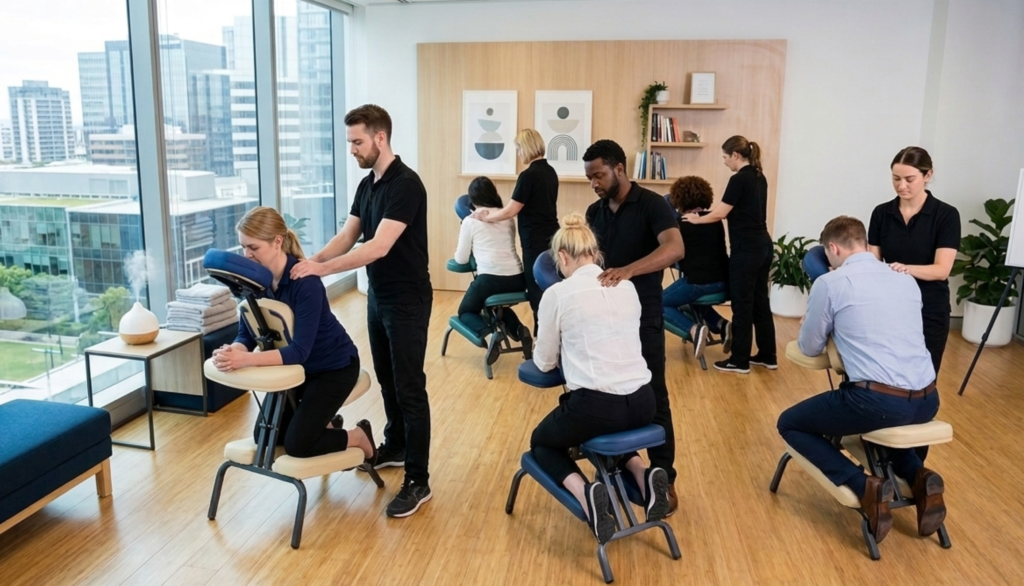
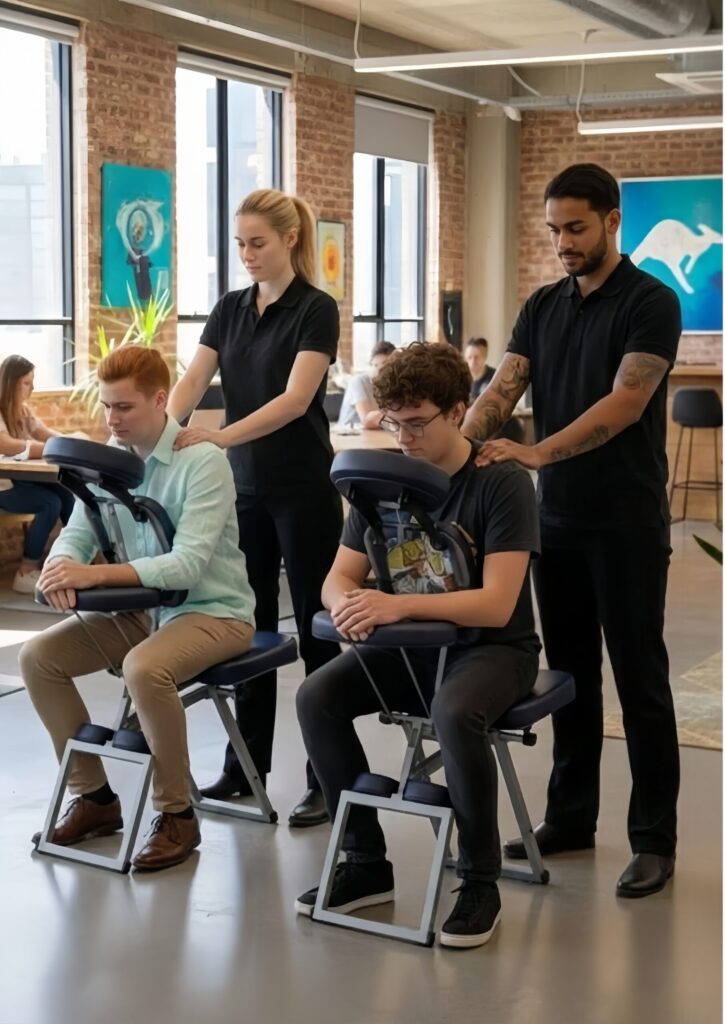
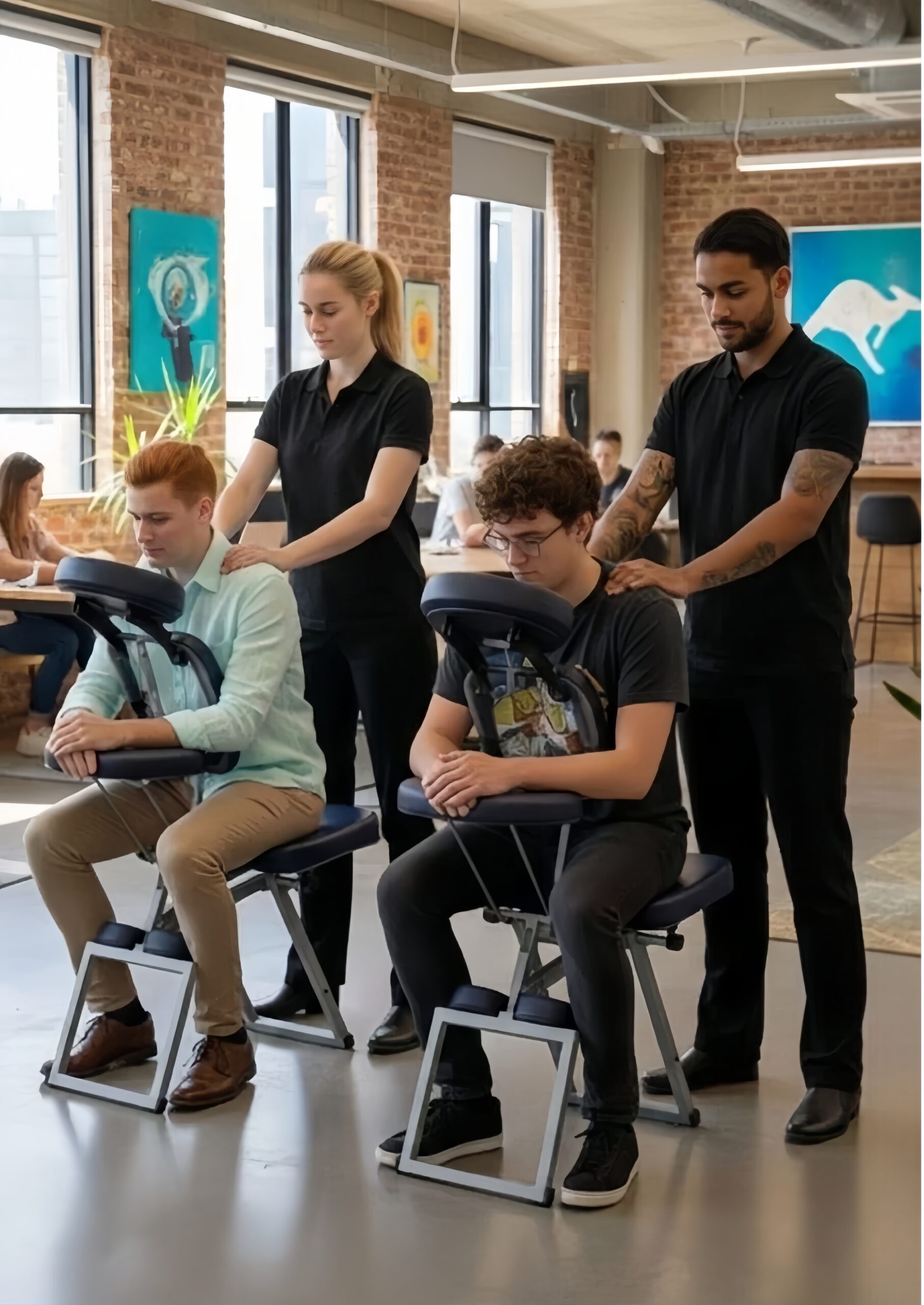
Event massage refers to professional chair massage services delivered at a one-off or special-occasion event, rather than a recurring workplace wellness program. The mechanics are similar — a qualified therapist brings portable equipment, sets up on-site, and delivers short, fully clothed seated massage sessions to attendees — but the context and purpose are different.
Where regular corporate chair massage is typically scheduled on a fortnightly or monthly cycle as part of an ongoing wellness program, event massage is designed to serve a specific occasion:
- End-of-year parties and Christmas functions
- Team appreciation and reward days
- Conference breaks and leadership off-sites
- Product launches and client-facing events
- Wellness days and health fairs
- Fundraising events and charity activations
The key distinction is that event massage is self-contained. Your provider brings everything, sets up, delivers the sessions, and packs down when done. There is no ongoing commitment required, and the experience is complete within the event itself.
Why Event Massage Works So Well at Corporate Functions
The numbers around Australian workplace wellbeing make a compelling case for prioritising wellness at events. According to Compono’s 2026 Australian engagement report, just 21% of Australian employees are actively engaged at work, with 50% reporting significant daily stress. Events are one of the few moments where organisations can change how people feel about their work — and event massage is one of the most tangible, memorable ways to do that.
Unlike a free drink or a gift bag, a massage is a physical experience. It requires no assembly, doesn’t go stale, and produces an immediate, felt result. Employees walk out of a 15-minute session measurably different to how they walked in — calmer, more relaxed, and aware that the company invested in something real for them.
Research cited by Workhuman’s 2026 recognition report found that when an employer recognises work milestones or shows genuine care, employees are 3x as likely to strongly agree their organisation cares about their wellbeing. Event massage is precisely that kind of visible, felt gesture — and it works at scale.
From a practical event standpoint, chair massage also creates a natural focal point. It gives people a reason to move through the space, creates positive queues (the good kind), and generates conversation. Attendees who receive a massage tend to mention it afterwards — and that word-of-mouth is valuable for future engagement initiatives.
The Logistics: Less Complicated Than You Think
Here is where most people expect the catch. In practice, adding event massage to a corporate function involves four straightforward decisions.
1. Headcount and session length
The first thing to establish is how many people you want to reach and how long each session should run.
For corporate events, 10–15 minutes per person is the standard session length. It’s enough time for a therapist to meaningfully address the neck, shoulders, upper back, arms, and hands — the areas that carry the most tension in desk-based workers — without pulling anyone away from the event for too long.
A general guide for therapist numbers:
| Event size | Session length | Therapists needed |
| Up to 30 people | 10 minutes | 1 therapist |
| 30–80 people | 10–15 minutes | 2 therapists |
| 80–150 people | 10–15 minutes | 3–4 therapists |
| 150+ people | 10–15 minutes | Discuss with provider |
These figures assume not every attendee will participate, which is typical. In practice, uptake at well-run events tends to be higher than organisers expect once the first few people have gone through.
2. Space
Chair massage has a small footprint. Each therapist setup — portable massage chair, small bag of equipment, and a clear zone for movement — requires roughly 2 to 3 square metres of floor space. No power, no plumbing, no special requirements.
The space can be:
- A quiet corner of the main event room
- A dedicated breakout room or adjacent meeting space
- A corridor or atrium with sufficient foot traffic
- An outdoor area under shelter
The only real consideration is minimising distractions and background noise, which makes the experience better for both the recipient and the therapist. A busy, noisy production floor is less ideal than a calm breakout space — but it’s not a dealbreaker. Experienced therapists adapt.
3. Scheduling: sign-up sheet or walk-up?
There are two ways to manage participant flow at an event, and both work well depending on your event format.
Walk-up queue: Attendees join a visible queue at the massage station and wait their turn. Works well at events with a defined break period (a 30-minute drinks reception, a lunch break) where people have unstructured time and can self-manage their spot.
Pre-event sign-up sheet: Slots are allocated in advance, either via a printed sheet at the event or a shared form sent beforehand. This works well at structured events where you want to ensure specific people receive a session — senior team members, award recipients, or a full team rotation.
Most corporate events use a combination: a sign-up sheet for the first hour, then walk-ups for remaining slots. Your provider can advise on what works best based on your specific event format.
4. Lead time
Event massage at Corporate Care Therapies can be confirmed with as little as a few days’ notice, depending on availability and the number of therapists required. For larger events or specific dates (end-of-year Fridays are predictably busy), booking two to four weeks in advance is recommended to guarantee therapist availability and smooth logistics.
If you’re planning a recurring calendar of events, locking in dates early gives the best access to preferred therapists and time slots across Melbourne, Sydney, Brisbane, Perth, Adelaide, and Canberra.
What Your Provider Handles — and What You Don’t Have to
One of the most common sources of hesitation is the assumption that you’ll need to manage something on the day. Here is what a professional event massage provider brings and manages entirely:
- Portable, ergonomic massage chairs (no chairs borrowed from the venue)
- All equipment including face cradle covers, clean linens, and setup materials
- Qualified, accredited therapists who understand corporate environments
- Setup and pack-down (typically 15–20 minutes each way)
- Scheduling management and flow of attendees on the day
What the client is responsible for:
- Communicating the space available and event format at time of booking
- Letting attendees know the massage service will be there (a single internal message is sufficient)
- Ensuring the space is accessible to the therapist on arrival
That’s the full scope. There is no equipment hire, no venue negotiation, no day-of coordination beyond letting attendees know where to go.
Types of Corporate Events That Work Well With Event Massage
Event massage is versatile enough to fit almost any corporate occasion. The most common contexts Corporate Care Therapies serves include:
End-of-year celebrations and Christmas parties. One of the most popular occasions for event massage in Australia. Adding a massage station alongside food and drinks creates a wellness counterbalance to the social occasion — and gives people something to queue for that isn’t the bar.
Conference and leadership off-sites. Day-long conferences involve hours of sitting in chairs, absorbing presentations. A 15-minute chair massage during a coffee break or lunch is both a recovery tool and a reward. It’s also a talking point between sessions.
Product launches and client events. For external-facing events, event massage creates a premium, memorable experience that reflects well on the brand hosting it. A client who receives a massage at your launch is far more likely to remember the event positively.
Employee appreciation and recognition days. Days specifically designed to reward staff performance benefit enormously from the physicality of massage. Saying “thank you” with something people can feel, rather than just hear, lands differently.
Fundraising and charity events. Corporate Care Therapies has a strong track record in supporting fundraising events — providing massage services that create a positive experience for donors and attendees while contributing to the event’s purpose.
Frequently Asked Questions From Event Planners
Do therapists bring their own chairs?
Yes. Your provider supplies all equipment. No venue chairs are repurposed, and no furniture needs to be moved.
Do recipients need to undress?
No. All sessions are conducted fully clothed. There are no oils, no need for a private changing area, and no disruption to formalwear or business attire.
What if some employees don’t want a massage?
Participation is always voluntary. Therapists are experienced in welcoming people without pressure. It’s common for hesitant attendees to become willing participants once they see colleagues go through and come back smiling.
Does location matter? We’re outside the CBD.
Corporate Care Therapies operates across Australia — including regional locations — so city-centre proximity is not a requirement. At time of booking, confirm your venue address and your provider will advise on travel arrangements.
A Note on Why This Works Better Than Most Other Event Add-Ons
There is a long list of things you can add to a corporate function: photo booths, cocktail masterclasses, team trivia, caricature artists. Many of these are enjoyable. Few of them leave people feeling physically and mentally better than when they arrived.
Event massage does. Research on on-site massage consistently shows that even short sessions produce measurable reductions in cortisol and self-reported stress — and that the positive association extends to the organisation that provided it. An employee who feels genuinely cared for at a company event carries that experience back into their day-to-day work in ways that a photo strip does not replicate.
For HR managers and event planners trying to demonstrate that a budget line produced something real, the feedback loop from event massage is fast and direct: people come back from their session and say so.
Book Event Massage for Your Next Corporate Function
Corporate Care Therapies provides professional event massage across Australia — from intimate team appreciation days to large-scale conferences and client events. Sessions are fully clothed, equipment is supplied, and the booking process is designed to be simple.
Get in touch to book your event massage or call 0406 760 305 to discuss your event date, headcount, and location. Most enquiries are confirmed within 24 hours.
Your next corporate function doesn’t need more complexity. It needs one addition that people will actually remember.