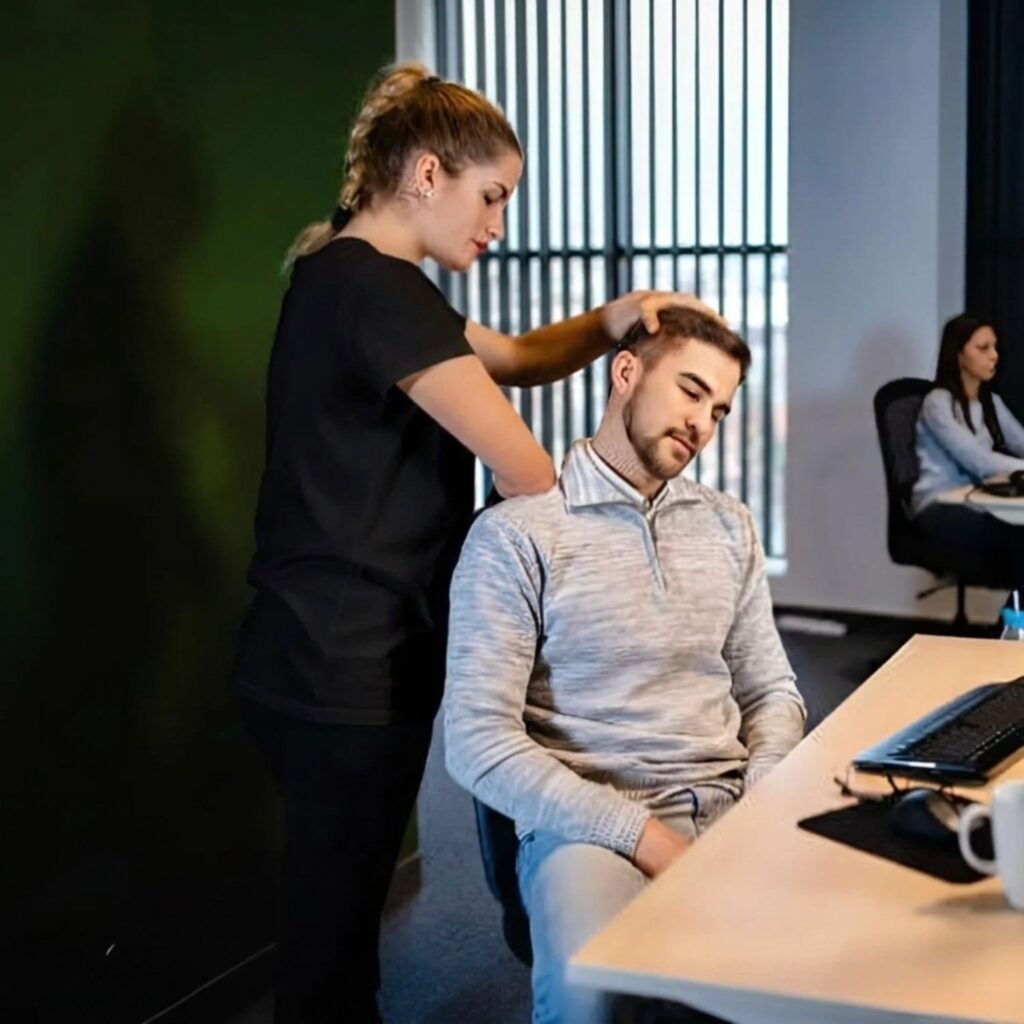

Regular stretching and a massage at work program solve two different halves of the same problem, and understanding that distinction is the key to why one without the other never quite works as well as expected. Stretching prevents the tension of a static workday from building up in the first place. Massage clears out the tension that builds up anyway, despite stretching, over weeks and months. Neither one covers the whole cycle on its own — which is exactly why they need to be done together, not as alternatives to each other, and not as a choice between the two.
This article answers both halves of that question directly: why regular stretching is necessary at all when a massage program is already in place, and exactly how the two work together to produce a result that neither delivers alone.
Why regular stretching at work is necessary in the first place
A desk-based workday keeps the same small group of muscles in the same static position for hours at a time — shoulders rounded forward, neck tilted toward a screen, wrists held at an awkward angle for typing. Muscles held in one position for long, uninterrupted stretches gradually tighten and lose blood flow, which is what produces the familiar stiffness and dull ache by the end of the day.
This isn’t the same mechanism as a single traumatic injury like a fall or a strain from lifting something heavy. It’s a slow, cumulative process — a little more tightness added each day, largely unnoticed until it’s built up enough to become genuinely uncomfortable or to start restricting movement. That gradual nature is exactly why it responds so well to a preventative habit rather than an occasional fix.
What happens in the body during a long static workday
This pattern of injury has a name and a well-documented scale. Occupational health data consistently shows that body stressing — the category covering exactly this kind of gradual muscular strain from repetitive movement and sustained postures — is the single largest mechanism behind serious workplace injury claims in Australia, ahead of falls, being hit by objects, or any other cause. It isn’t a dramatic, single-incident injury; it’s the slow accumulation of exactly the kind of tension a static desk job produces every day.
For a desk-based role specifically, the areas most affected are predictable: the neck and shoulders from screen posture, the lower back from prolonged sitting, and the wrists and forearms from constant keyboard and mouse use. These aren’t random complaints — they’re a direct, expected consequence of the exact posture most office work requires for most of the day.
What the research shows about regular movement breaks
This is precisely the gap that regular stretching is designed to close. A systematic review of active microbreaks found that short bursts of light activity — as little as two to three minutes every half hour of sedentary work — can meaningfully reduce musculoskeletal discomfort and help offset the effects of prolonged sitting. A separate eight-week controlled study published in Sport Sciences for Health in 2025 found that office workers doing regular short active breaks — including stretching and mobility work delivered twice weekly — reported significantly less discomfort in the neck, lower back and overall body score by the end of the program, along with lower perceived stress.
Both studies point to the same underlying answer: regular stretching works because it interrupts the build-up of tension while it’s still small and manageable, rather than letting it accumulate for weeks.
Why massage at work alone doesn’t cover the other half
A massage at work session works from the opposite direction, and does something stretching genuinely can’t. A therapist can work directly into a knot that’s been sitting between someone’s shoulder blades for a month — the kind of deep, longer-standing tension that a quick stretch can ease slightly but rarely resolves. That’s the part of the problem regular stretching alone doesn’t reach.
But that relief has a shelf life. Returning straight back to eight hours of static screen work, with no movement in between, means the exact same postural strain starts rebuilding almost as soon as the session ends. A massage clears what’s already there; it does very little to stop the next few weeks of desk work from creating more of the same tension.
How regular stretching and massage at work complement each other
Put the two side by side and the complementary relationship becomes straightforward. Regular stretching keeps the daily build-up of tension low and manageable, so it never has the chance to become the kind of deep, stubborn knot that’s hard to shift. A recurring massage at work session then clears out whatever does accumulate despite that — the residual tension that even consistent stretching can’t fully prevent, especially around the neck, shoulders and lower back.
Used together, each one is doing the job it’s actually good at, rather than being asked to cover for the other. Stretching alone leaves the deeper knots unresolved. Massage alone leaves the daily build-up unaddressed. Combined, the two cover the entire cycle of desk-related tension, from the moment it starts to the point it would otherwise become a real problem.
In practice, this might look like a two-week gap between massage sessions where a handful of short stretch breaks each day keep the shoulders and neck from tightening back up to where they were before the last session. By the time the next massage session comes around, there’s meaningfully less accumulated tension for the therapist to work through — and the whole cycle stays easier to manage than if stretching wasn’t happening in between at all.
What a regular stretching habit at work actually looks like
A regular stretching habit doesn’t need to be complicated to be effective. A few short movements, done consistently, cover most of the areas that tighten up fastest at a desk: neck and shoulder rolls, a chest-opening stretch to counter forward-hunched posture, and a wrist stretch to offset repetitive typing and mouse use. None of this requires special equipment or a break away from the desk longer than a couple of minutes.
A more complete routine, with suggested timing across a full workday, is available in Corporate Care Therapies’ office stretches guide, which can be shared with a team as a simple, no-cost reference alongside a booked massage program.
How often to stretch, and how often to book a massage
| Activity | Suggested frequency | What it addresses |
| Regular stretching | 2 to 3 minutes every 30 to 60 minutes | Prevents daily tension from building up |
| Massage at work sessions | Fortnightly or monthly | Clears deeper tension stretching alone can’t reach |
| Routine check-in | Quarterly | Confirms the combined routine still fits the team |
Neither cadence needs to be exact. What matters is consistency on both sides: stretching that happens occasionally, or a massage booked once and never repeated, will do far less than either one built into a regular, predictable rhythm.
Building both into a workplace wellness program
For a whole team, the simplest way to run both elements is to treat them as two parts of the same offering rather than separate initiatives. A recurring desk massage or seated chair massage booking gives staff the periodic reset, while the shared stretching guide gives them something to use every day in between — together forming a more complete corporate wellness program than either element delivers alone.
How Corporate Care Therapies supports both sides of this routine
Corporate Care Therapies has delivered massage at work programs to Australian businesses for over 20 years, offering desk massage and seated chair massage sessions that fit around a team’s existing schedule. Alongside a booked program, businesses can share the office stretches guide with staff as a simple way to keep tension from rebuilding between visits.
Summary
Regular stretching and massage at work are not competing options — they solve two different halves of the same problem. Stretching keeps the daily build-up of tension low, preventing it from turning into the kind of deep, stubborn knot that’s hard to shift. Massage clears out whatever tension accumulates despite that, reaching the deeper strain a stretch alone can’t resolve. Doing only one leaves the other half of the problem unaddressed. Done together — a few minutes of stretching every hour and a properly scheduled massage every few weeks — the two cover the entire cycle of desk-related tension, which is exactly why they work best as a pair rather than a choice between them.
For anyone weighing up whether stretching is really necessary alongside an existing massage program, this is the direct answer: yes, because the two aren’t solving the same problem in the first place. Skipping one simply leaves that half of the cycle unmanaged, regardless of how good the other half is on its own.
Ready to pair regular stretching with a massage at work program your team will actually use? Contact Corporate Care Therapies to set up a program built around both, tailored to your team’s schedule and current routine.