Childcare centres run on the emotional state of the adults in the room. A stretched, exhausted educator doesn’t just feel worse — the children notice, and they respond to it. Workplace massage services are one of the more direct, practical ways centre directors can support the people holding that emotional load every day, without adding another thing to an already full roster.
This article looks at why staff stress in early learning settings ripples out to the children in care, what a workplace massage program actually looks like around ratios and shift patterns, and why it’s increasingly treated as a retention tool rather than a nice-to-have — particularly at a time when centres are already struggling to keep experienced staff in the room.
The childcare workforce is stretched thin
The pressure on Australian early learning staff is well documented. A national workforce survey covered by SBS reported that 91 percent of surveyed childcare centres had current staff vacancies, with almost half of those centres carrying three or more open positions, and 95 percent had seen staff leave in the previous 12 months. Two-thirds of respondents felt the staffing shortage had already affected children’s wellbeing, and close to a quarter felt children’s safety was now genuinely at risk.
Behind those numbers is a workforce doing physically and emotionally demanding work — lifting, bending, and managing groups of young children — on long, continuous shifts with little built-in recovery time. When the people doing that work are running on empty, it doesn’t stay contained to the staff room.
Why a calm educator changes the whole room
This isn’t just intuition. Peer-reviewed research published in Early Childhood Research Quarterly found that when lead and assistant teachers reported higher personal and job-related stress, they also reported more anger, aggression and withdrawal in the children in their care, along with lower social competence. The effect held for both lead and assistant educators, and it lines up with a broader body of research showing that a stressed, dysregulated adult finds it harder to model calm behavior, which children pick up on quickly.
In practice, this means an educator’s stress level isn’t a private, personal issue that stays with them after their shift ends — it’s part of the classroom environment itself, in the same way lighting or noise levels are. A centre that supports staff regulation is, indirectly, supporting the children’s regulation too.
What a session actually feels like for staff
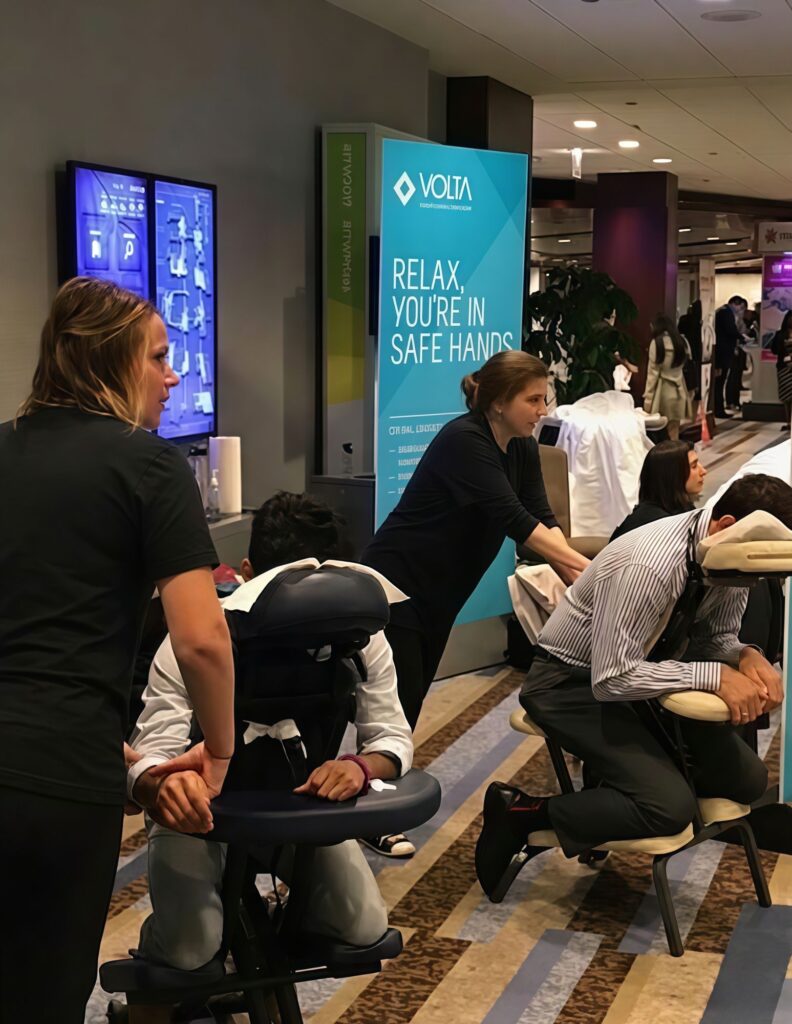
- A short, guided settling-in period, usually seated fully clothed in an ergonomic chair
- Focused work on the neck, shoulders and upper back, where lifting and constant movement tend to concentrate tension
- A noticeable drop in shoulder tightness by the end of a 10 to 15 minute session
- A calmer return to the floor, rather than a groggy or disoriented one
For educators who spend most of the day standing, bending, or crouched down at a child’s height, the difference a focused session makes to the neck and shoulders is usually immediate and easy to notice, even for staff who are initially sceptical about trying it.
What workplace massage services actually look like in a childcare setting
The idea of fitting a wellness program into a childcare centre can sound impractical at first, given ratios, nap times and the constant movement of the day. In reality, the format is designed around exactly those constraints rather than against them.
Fitting sessions around ratios and shift patterns
Sessions are typically scheduled in short blocks during rostered breaks or quieter parts of the day — often rotating staff through in 10 to 15 minute slots so ratios are never compromised. Because bookings can be arranged around each centre’s specific routine rather than a fixed external schedule, directors can slot sessions into whatever window actually exists in a real day, rather than an idealized one.
This matters more in a childcare setting than almost any other workplace, since educator-to-child ratios are non-negotiable for compliance and safety. A wellness program that ignores that reality simply won’t get used, no matter how good the idea is on paper — which is why session length and rotation are built around the roster from the outset, rather than treated as an afterthought.
Formats that work best for centre environments
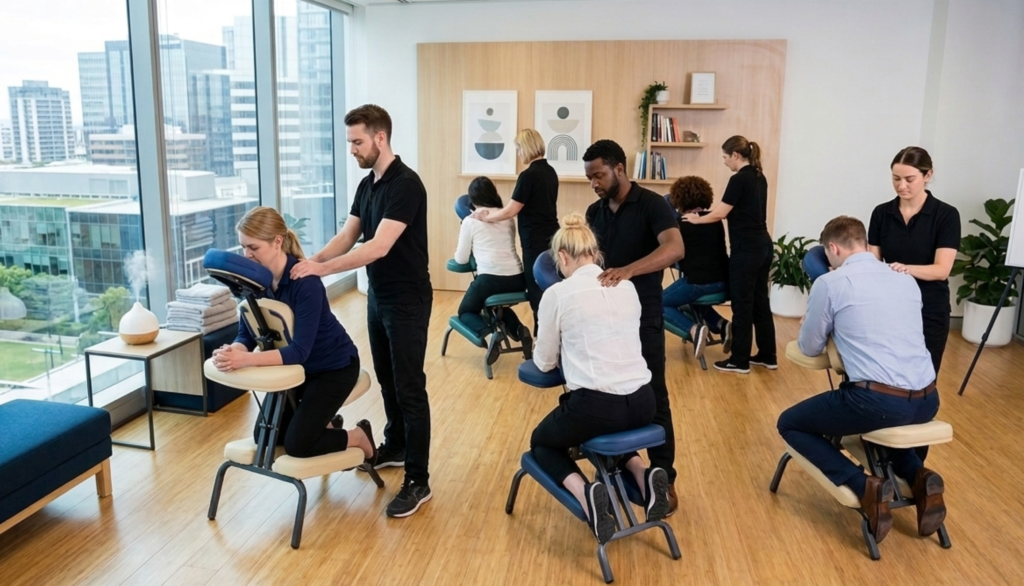
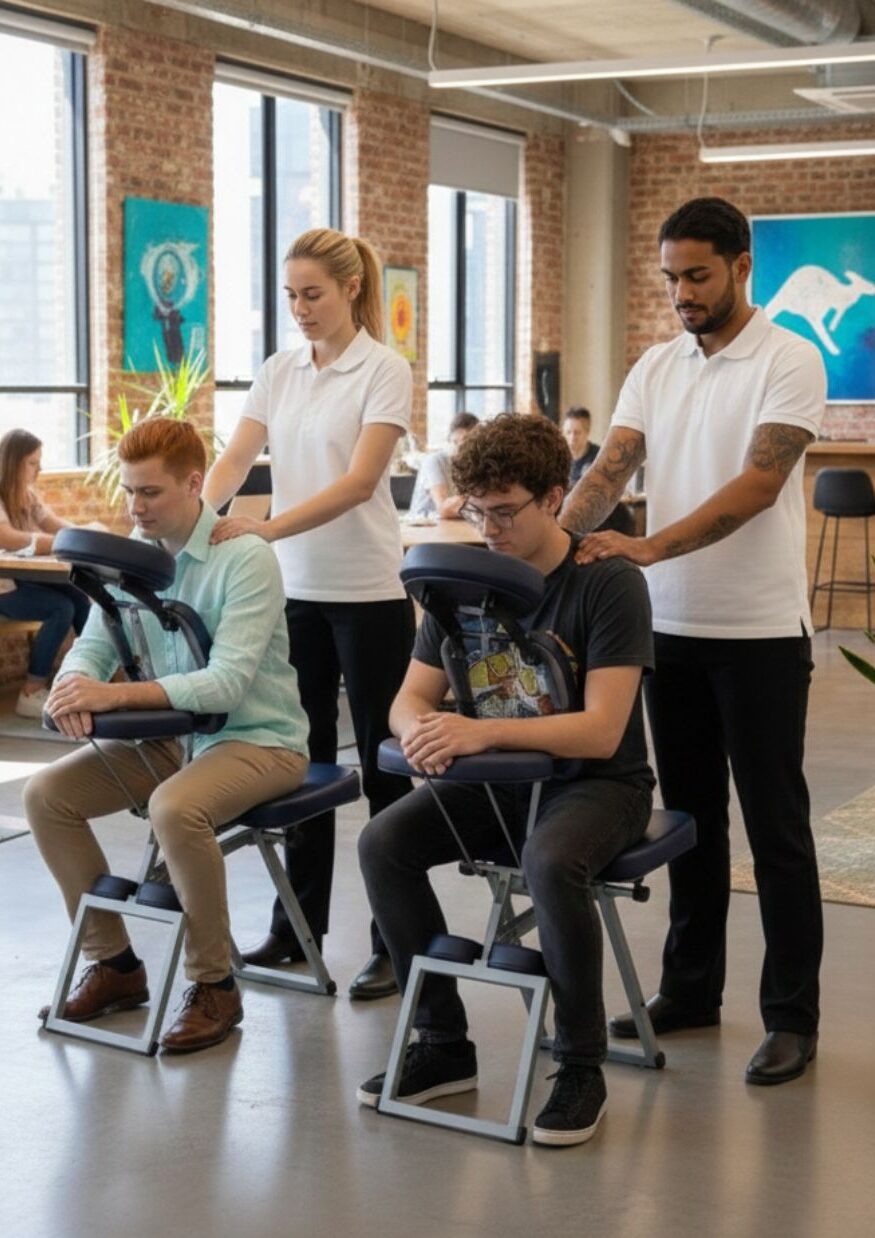
Seated chair massage is the most practical format for most centres — no need to change clothes, no lying down, and a session that can start and stop cleanly within a rostered break. It’s delivered fully clothed in a specially designed ergonomic chair, which suits a staff room far better than equipment requiring a private treatment space.
The ripple effect: from staff room to the classroom floor
The mechanism here is straightforward. An educator who leaves a short massage session with looser shoulders and a calmer nervous system returns to the group more able to respond patiently to a toddler’s meltdown, rather than reacting from an already-depleted state. Multiply that across a whole team, several times a week, and the shift in overall centre tone becomes noticeable — not because massage replaces good training or support, but because it addresses the physical and nervous-system side of stress that training alone doesn’t touch.
It’s worth being clear about what this can and can’t do. A single session won’t undo a genuinely under-resourced roster or resolve a difficult day with a challenging group of children. What it does offer is one more layer of support alongside good supervision, manageable ratios and adequate breaks — the kind of small, consistent buffer that makes the difference between an educator who’s simply coping and one who has enough left in reserve to stay patient through a hard afternoon.
Retention: the business case centre directors can’t ignore
Given how tight the staffing market already is, every retention lever matters. A visible, recurring wellness benefit signals to a stretched team that their physical and emotional load is recognized, rather than simply expected. It won’t fix underlying workforce pressures like pay and staffing ratios on its own, but as part of a broader retention strategy, a workplace massage program is one of the more tangible, immediate signals a centre can offer — and one that doesn’t require a policy change or a budget cycle to implement.
It also costs less to trial than most retention initiatives. Recruitment, onboarding and the disruption of losing an experienced educator all carry a real cost to a centre, well beyond the advertised salary of the role being filled. A modest, recurring wellness booking is a small, comparatively low-risk investment set against that backdrop, and one that staff notice immediately rather than months later.
Getting started without disrupting ratios or routines
Introducing a wellness program doesn’t need to mean reorganizing the whole week. Most centres find it easiest to trial the idea in a single room or shift first, then expand once the timing and format have been tested against a real day.
- Start with a single session during a quiet afternoon to see how it fits your specific roster
- Rotate staff through in short blocks rather than trying to cover the whole team in one visit
- Choose a fortnightly or monthly cadence to begin with, and adjust based on staff feedback
- Review after a term to see whether the timing still suits the centre’s routine
Because bookings can be arranged as once-off, fortnightly or monthly visits, a centre can trial the idea at a small scale before deciding whether to make it a permanent part of the staff wellbeing offering.
How Corporate Care Therapies supports childcare teams
Corporate Care Therapies has delivered workplace massage services to Australian workplaces for over 20 years, including early learning and childcare settings, using seated chair massage sessions that fit around rostered breaks rather than disrupting them. Programs can be booked once-off or folded into a recurring corporate wellness program, with further context on how Australian workplaces are approaching staff wellbeing available in Massage at Work: why Australian businesses are prioritising workplace wellness in 2026.
Summary
Childcare centres operate on the emotional state of the adults running them, and the research is clear that a stressed, depleted educator affects the children in the room, not just their own wellbeing. Workplace massage services offer a practical, low-disruption way to support staff through short, rostered sessions that fit around ratios and shift patterns rather than working against them. For centre directors facing a genuinely difficult staffing market, it’s a visible, immediate way to show a stretched team that their wellbeing is taken seriously — with a flow-on effect that reaches every child in the centre.
None of this replaces the deeper, systemic work of fixing pay, ratios and resourcing across the sector — but while that work continues at a policy level, centre directors still need practical ways to support the team in front of them today. A short, well-timed massage session is one of the more immediate options available, and one that most teams notice the value of from the very first visit.
Want to see how workplace massage services could fit your centre’s roster?
Contact Corporate Care Therapies to discuss a program built around your team’s actual shift patterns.