A call centre role concentrates almost every known driver of neck and shoulder tension into a single job: a headset worn for hours, a screen fixed directly in front, a phone call arriving the moment the last one ends, and very little natural reason to get up and move. It’s a specific, predictable pattern of physical strain — and corporate chair massage is one of the few interventions built to target exactly that pattern, rather than a generic version of desk discomfort that could apply to any office role.
This article looks at why call centre roles produce this tension pattern so consistently, why general advice about posture and stretching often isn’t enough on its own in this environment, and how a corporate chair massage program fits around call volume and rostering rather than competing with it — written for call centre and contact centre managers weighing up practical options for reducing this kind of strain across a floor.
Why call centre roles create a distinct tension pattern
The combination of a fixed screen, a headset, and near-constant seated work is a well-documented driver of a specific postural pattern. A narrative review on upper crossed syndrome — forward head posture, rounded shoulders, and reduced shoulder blade mobility — found the condition is particularly common among office workers who spend long periods on computers, with neck pain affecting roughly 2,450 people per 100,000 and shoulder pain incidence running at close to 38 per 1,000 people annually. Left unaddressed, the review notes it can progress toward more persistent issues such as tension headaches and reduced shoulder mobility over time.
This sits within a broader pattern already well established in Australian workplace data. Safe Work Australia’s work health and safety statistics consistently show body stressing — gradual muscular strain from repetitive movement and sustained posture — as the single largest mechanism behind serious workplace injury claims nationally. A call centre role, with its fixed posture and repetitive headset and keyboard use, sits squarely inside that category.
What this tension pattern actually looks like day to day
For call centre agents specifically, the pattern tends to show up as tightness across the top of the shoulders, a stiff or aching neck by the afternoon, and a gradual rounding forward of the shoulders that becomes more pronounced the longer someone has been in the role. Headaches originating at the base of the skull are common, since sustained forward head posture places ongoing load on the same small group of neck muscles for an entire shift.
None of this happens because of one bad day. It builds gradually, call after call, shift after shift — which is exactly why a single ergonomic fix rarely resolves it on its own. By the time an agent mentions ongoing neck or shoulder discomfort, the pattern has usually been building for weeks or months, not days, which is part of why quick fixes tend to offer only temporary relief.
Why stretching and ergonomics alone often aren’t enough here
Standard advice for desk-related tension — adjust the monitor, take a stretch break every 30 minutes, check your posture — assumes a level of control over your own schedule that a call centre floor doesn’t always allow. Break timing is frequently dictated by call volume and rostering rather than personal choice, and stepping away mid-call simply isn’t an option. Ergonomic adjustments help, but they can’t fully offset a job structure built around near-continuous seated, headset-based work.
This isn’t a criticism of ergonomic advice — a properly adjusted chair and monitor genuinely reduce strain, and they’re worth getting right regardless. The issue is one of scale: good ergonomics slows how quickly tension builds, but it doesn’t reduce the total hours spent in a fixed, headset-bound posture, which is the underlying driver of the pattern in the first place.
This is the gap a hands-on approach fills. Where a stretch or a posture reminder helps prevent tension from building as quickly, it doesn’t clear tension that’s already accumulated over weeks of shift work — which is where corporate chair massage does something stretching and ergonomics alone can’t.
How corporate chair massage directly addresses this tension pattern
Targeted work on the exact muscles affected
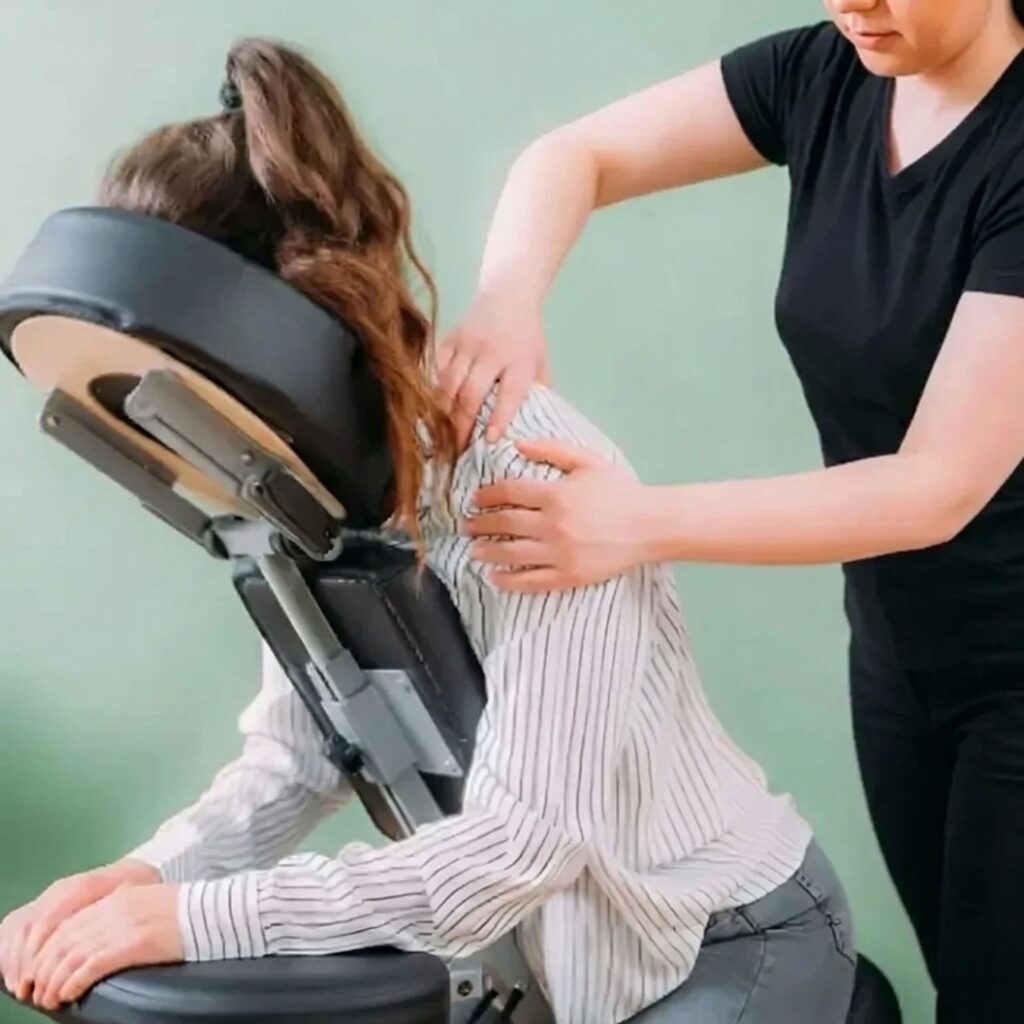
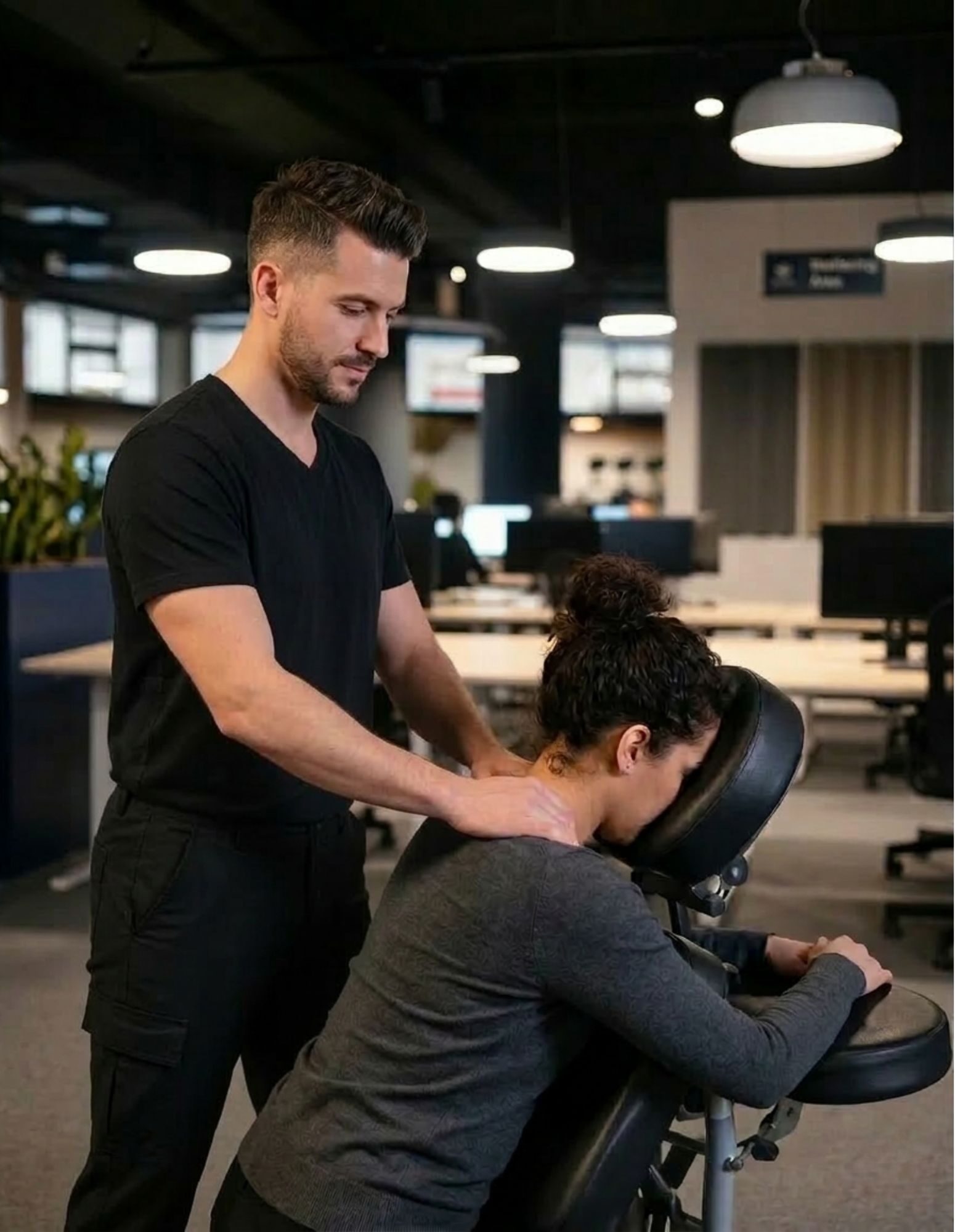
A therapist can work directly into the upper trapezius, levator scapulae and base-of-skull area — the specific muscle group most heavily loaded by forward head posture and headset use — rather than offering the generalized relief of a stretch. For a tension pattern this specific, targeted, hands-on work reaches areas that self-directed movement alone struggles to fully release.
This matters because the same few muscles are doing almost all of the work across an entire shift, call after call, with very little variation. A generalized wellness activity that treats the whole body evenly misses the fact that a call centre role concentrates strain into a narrow band of muscles rather than spreading it out — which is exactly why targeted, localized work tends to outperform broader interventions for this particular role.
Fits around call volume and rostering
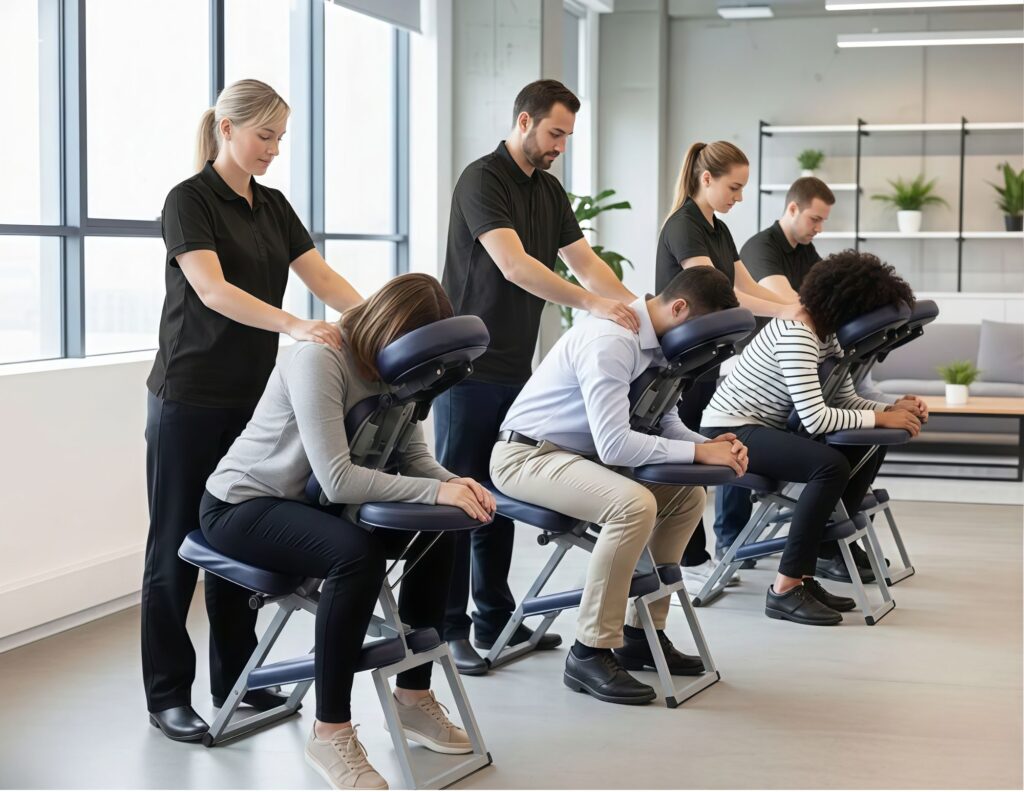
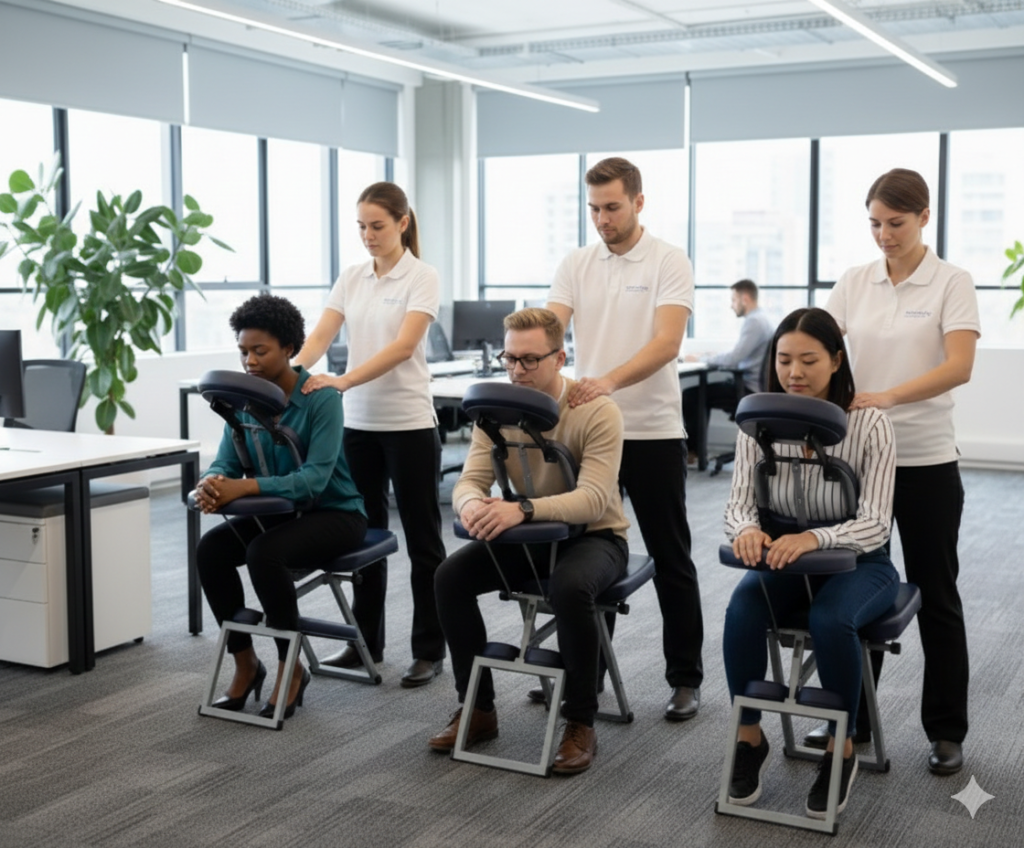
Sessions are typically delivered in short rotations of 10 to 15 minutes, scheduled around rostered breaks or quieter call periods, so a full floor can be seen across a single booking without disrupting coverage. Because the format doesn’t require anyone to leave the building or change clothes, it works within the same shift constraints that make longer breaks impractical in a call centre setting.
This is one of the main reasons the format suits contact centres better than off-site wellness options. A gym session or a spa Book now requires someone to leave the building entirely, which simply isn’t realistic mid-shift on a rostered floor. A session delivered at or near the workstation removes that barrier completely, which is often the deciding factor for floors that have tried other wellness formats without much success.
What a session looks like in a call centre setting
Most call centres run this using a seated chair massage or desk massage format, delivered fully clothed at or near the workstation, with a therapist rotating through agents during a scheduled window that fits around shift patterns and rostered breaks. No special room or setup is required beyond a corner of the floor with enough space for the chair, which makes it straightforward to run even on a busy, fully staffed floor.
Building this into a regular program for call centre teams
A single session eases the tension that’s already built up, but a call centre role keeps generating the same strain shift after shift — so the benefit fades unless the program repeats. Pairing a recurring corporate wellness program with a simple movement routine between sessions, such as the one outlined in Corporate Care Therapies’ office stretches guide, helps keep tension lower between visits, so each session has less accumulated strain to work through.
Fortnightly or monthly bookings tend to suit high-volume floors best, since the tension pattern rebuilds continuously rather than after a single bad week. A one-off session provides welcome relief, but it’s the repeated, predictable rhythm that keeps pace with a role that never really stops generating the same strain.
For larger contact centres running multiple shifts, staggering sessions across different shift blocks — rather than trying to cover the whole floor in a single window — tends to work better than a single large event, since it avoids pulling too many agents off the phones at the same time and lets the program run without disrupting service levels.
How Corporate Care Therapies supports call centre teams
Corporate Care Therapies has delivered corporate chair massage to Australian call centres and contact centre floors for over 20 years, with accredited therapists experienced in working around rostered breaks and high call volumes. Sessions can be booked once-off to trial the format, or set up as a recurring program scaled to the size of the floor and the shift patterns already in place, including multi-shift and multi-site arrangements for larger contact centre operations.
Summary
Call centre roles concentrate the exact conditions that drive neck and shoulder tension — fixed screen posture, constant headset use, and very little natural movement — into a single job, which is why the resulting strain is so consistent and predictable across the industry. Standard advice about stretching and posture helps slow the build-up, but it rarely has the reach to clear tension that’s already accumulated across weeks of shift work. Corporate chair massage, delivered in short rotations that fit around call volume and rostering, targets exactly the muscle group this role strains most, and repeated on a regular schedule, it keeps pace with a role that generates the same tension shift after shift.
For a floor already managing tight rostering and service-level targets, the appeal is largely practical: a format that delivers targeted relief without requiring anyone to step away from the building or disrupt coverage.
Want to reduce neck and shoulder tension across your call centre floor? Contact Corporate Care Therapies to set up a corporate chair massage program that fits your shift patterns, call volume and floor size.