Corporate massage has gone from a niche perk to a mainstream business strategy — and the data behind it is hard to ignore.
When people think of Google, they think of search algorithms and artificial intelligence. But for decades, one of the lesser-known pillars of Google’s workplace culture has been corporate massage – on-site massage rooms, licensed therapists, and massage chairs available to employees across its global campuses.
This wasn’t a quirky Silicon Valley experiment. It was a deliberate investment in productivity, and the science behind it backs up the logic.
This article breaks down why companies like Google, Apple and Boeing have built formal massage programs into their employee benefits, what the research actually says about massage and output, and what Australian businesses – of any size – can take from that playbook.
What Google actually built — and why it matters
The Googleplex — Google’s headquarters in Mountain View, California — is famous for its campus-style perks: free meals, gyms, and community bikes. Less publicised but equally deliberate are the dedicated massage rooms with professional massage therapists, plus electronic massage chairs placed in common areas throughout the building.
Former CEO Eric Schmidt captured the philosophy directly: “The goal is to strip away everything that gets in our employees’ way.” That framing is important. Corporate massage at Google was not positioned as a luxury — it was positioned as a removal of friction, a way to keep high-output people performing at their best.
For employees spending long hours in front of screens doing cognitively demanding work, on-site massage addressed two real problems: accumulated physical tension from sedentary work, and accumulated stress from a high-pressure environment. Both are documented drains on productivity.
Google is not alone. Apple operates an on-site wellness centre (AC Wellness) at its campuses, which includes massage therapists alongside nurse practitioners, nutritionists and exercise specialists. Boeing has long maintained a formal corporate massage program for its workforce. Meta (Facebook) has historically offered on-site massage rooms in every office building through a scheduled-therapist model.
The pattern across these organisations is consistent: massage is integrated into the physical workplace, not offered as an external reimbursement benefit. It is designed to be used during the workday, not after hours — because the productivity benefit is immediate.
What the research says about corporate massage and productivity
The most frequently cited research in this area comes from the Touch Research Institute (TRI) at the University of Miami School of Medicine, which has conducted over 100 studies on the effects of massage therapy across different populations and conditions.
In a landmark workplace study, adults received a 15-minute chair massage twice a week for five weeks. The control group rested in a chair for the same duration. The results were clear: participants in the massage group showed decreased stress indicators in brain-wave patterns, increased alertness, and improved speed and accuracy on math computations — completed in less time with fewer errors. No equivalent effect was observed in the rest-only group.
A separate study published in the Journal of Alternative and Complementary Medicine found that employees who received regular massage maintained their job satisfaction over the study period, while those who did not receive massage showed a measurable decline. That distinction matters: retention and engagement are among the most significant — and least visible — drivers of organisational productivity.
On the physical side, the American Massage Therapy Association reports that recipients of on-site chair massage show significant reductions in blood pressure, anxiety and tension levels, as well as reduced pain intensity. For office-based teams carrying musculoskeletal load from prolonged sitting and screen use, these are not minor effects — they translate directly to comfort, concentration and output.
Corporate wellness research also points to downstream cost savings. Studies indicate that on-site massage programs can reduce workers’ compensation claims by over 40% and sick leave by up to 25%, directly affecting attendance and operational continuity. These are significant figures, and they are consistent with the broader evidence base on the ROI of preventive employee health investment.
Note: specific figures on compensation and sick-leave reduction should be verified with a qualified occupational health advisor for your industry context, as results vary by workforce type and program frequency.
Why high-performing teams burn out faster — and what corporate massage addresses
The logic behind Google’s investment in corporate massage becomes clearer when you consider the specific demands of knowledge-work environments. High-output teams face a compound problem: cognitive load accumulates, postural load accumulates, and stress hormones — particularly cortisol — accumulate in parallel.
None of these are addressed by a standard break. Coffee, a walk, or five minutes away from a screen help modestly. Massage addresses all three directly.
The TRI research confirmed that 15 minutes of chair massage was more effective than 15 minutes of rest in reducing anxiety and improving subsequent task performance. This is a meaningful distinction for organisations that operate in high-pressure environments where the quality of thinking — not just the volume of hours — determines output.
In Australia, the scale of the problem is well-documented. The SafeWork NSW Psychological Health and Safety Strategy 2024–2026 estimates that workplace mental ill-health costs Australian businesses up to $39 billion per year through lost participation and productivity. Safe Work Australia research separately found that untreated psychological health problems cost Australian organisations approximately $10.9 billion annually through absenteeism, presenteeism and workers’ compensation.
A 2025 survey by people2people Recruitment found that 40% of Australian employees were already experiencing burnout, with two in five expecting stress to be harder to manage during the year. Burnout at that scale has a direct and measurable effect on output, and it does not resolve without active intervention.
Corporate massage is one of the few wellness interventions that addresses the physical and psychological dimensions of burnout simultaneously, in-session, with an immediate physiological effect that the research consistently supports.
The corporate wellness market in 2025–2026: why investment is accelerating
The commercial scale of corporate wellness investment reflects the shift from welfare gesture to business strategy.
According to Fortune Business Insights, the global corporate wellness market was valued at approximately USD 68.4 billion in 2025 and is projected to reach USD 118.2 billion by 2034, growing at a compound annual rate of 6.41%. The on-site delivery model — which includes corporate massage — holds the largest market share in 2025.
A separate report from Market Research Future puts the 2025 market size at USD 97.1 billion, growing at a CAGR of 9.32% through 2035. While the exact figures differ between research houses, the direction is consistent: large-scale, accelerating investment.
Wellhub’s Corporate Wellness Report 2025 found that 73% of wellness operators reported increased profitability, while 89% experienced higher member retention through corporate wellness partnerships — signals that the ROI case for structured wellness programs, including massage, is becoming easier to make inside organisations.
For context Johnson & Johnson’s employee wellness program — which spans nutrition, weight management, stress management and fitness — cumulatively saved the company USD 250 million on healthcare costs over a decade. According to a study cited in Harvard Business Review, the return between 2002 and 2008 was $2.71 for every dollar spent. Massage and physical recovery services formed part of that broader investment in workforce health.
How corporate massage actually works in an office setting
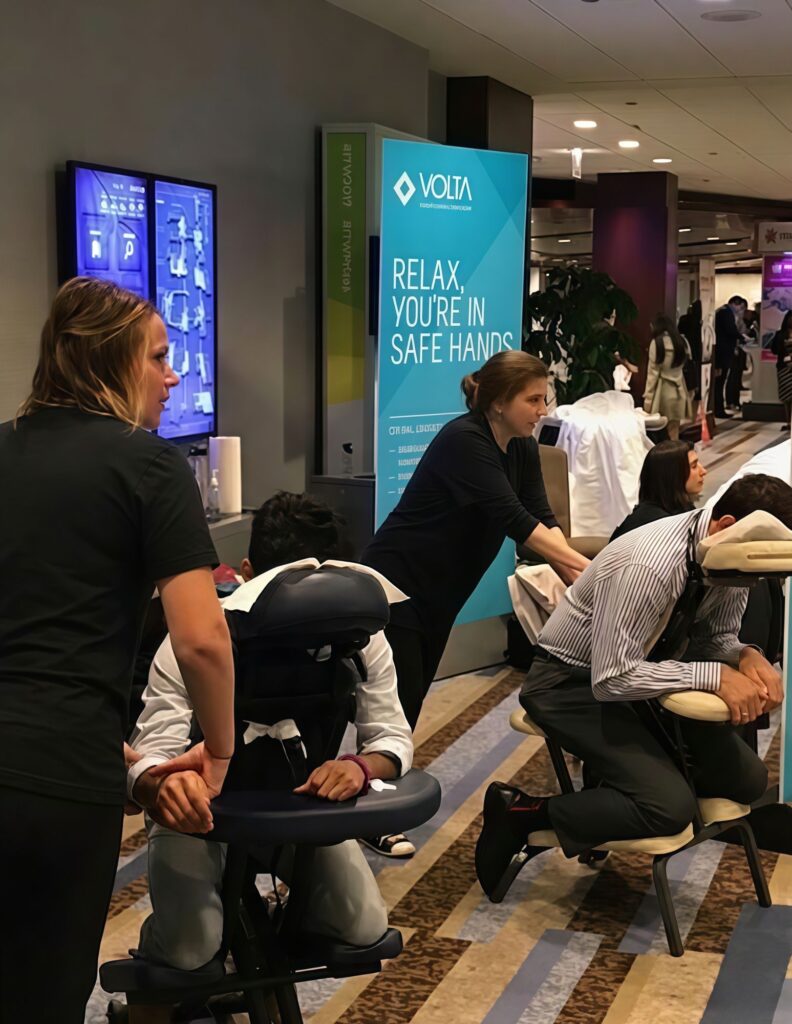
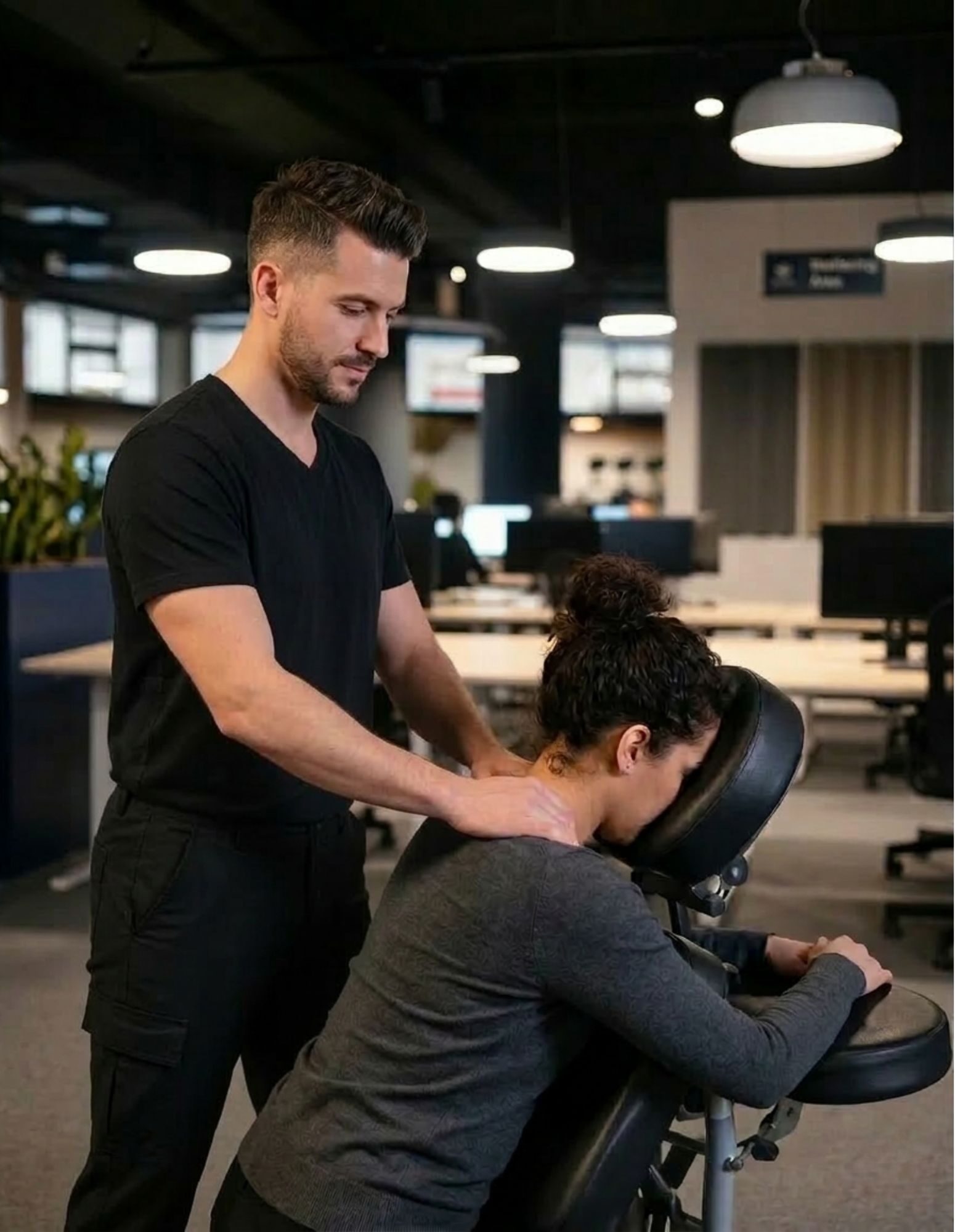
One of the practical reasons tech companies adopted corporate massage early is how easy it is to implement. No special infrastructure is required. A massage therapist brings a portable chair, sets up in a breakout room, meeting room or common area, and works with employees fully clothed — no oils, no change of clothes, no disruption to the working day.
Sessions typically run between 15 and 30 minutes. For a team of 10 to 20 people, a half-day visit covers everyone. For larger teams, a full-day booking or a fortnightly rotation is the standard model.
The chair massage technique focuses on the neck, shoulders, upper back and arms — exactly the muscle groups that accumulate tension from keyboard and screen work. The effect is immediate: reduced tension, improved circulation and a measurable shift in alertness that the TRI research documented through EEG brain-wave analysis.
From an organisational standpoint, the administrative overhead is minimal. A pre-arranged booking with a corporate massage provider means the therapist arrives, the session runs, and the only thing required internally is a space and a schedule. Most programs are confirmed within 24 hours of initial contact.
What Australian businesses can take from the Google model
Google built its massage program at scale because it had the infrastructure to do so. Most Australian businesses don’t need to — and they can achieve comparable outcomes through a straightforward on-site booking model.
The core principles translate directly:
1. Make it part of the workday, not an after-hours perk. Google’s massage rooms were available during work hours. The productivity benefit is immediate and in-session — it only works if employees use it while they are at work.
2. Make it regular, not occasional. The TRI research showed cumulative benefit from repeated sessions. A one-off event produces short-term goodwill. A fortnightly or monthly program produces a sustained shift in baseline stress levels and team climate.
3. Frame it as a performance investment, not a reward. Schmidt’s “strip away everything in the way” framing is instructive. Corporate massage works when it is positioned as a tool for output, not a treat for good behaviour. The employee response is different, and so is the internal justification.
4. Pair it with communication. A single internal message announcing the schedule, followed by a reminder the day before, is typically enough to achieve full participation. The cultural signal — that the organisation invests in its people — amplifies the direct physical benefit.
Corporate massage vs other wellness initiatives: a quick comparison
| Initiative | Setup required | In-session effect | Best for |
| Corporate massage | Minimal — booking only | Physical + psychological, immediate | On-site teams, high-load environments |
| EAP / counselling | Provider contract | Psychological, delayed | Crisis support, acute stress |
| Gym/fitness subsidy | Moderate — enrolment | Physical, cumulative | Individual take-up, long-term health |
| Wellness app | Licensing only | Psychological, variable | Remote and distributed teams |
| Flexible work | Policy change | Structural, broad | Retention, work-life balance |
How often should you book — and what can you realistically expect?
Frequency determines outcomes. A one-off session is a morale gesture — meaningful but not transformative. A structured program is a wellness intervention with measurable effects on team climate and individual output.
Weekly corporate massage
Weekly sessions produce the strongest cumulative effect on stress hormones and overall alertness. Benefits from one session carry over into the next, building a lower physiological baseline rather than resetting each time. Best for high-volume, high-pressure environments — call centres, development teams under deadline, open-plan offices with significant keyboard and screen load.
Fortnightly corporate massage
Fortnightly is the most commonly recommended starting point. At two sessions per month, the benefit window of each visit overlaps meaningfully with the next. Over two to three months, this typically produces a visible shift in reported stress, physical complaints and the sense that the organisation invests in its people. This is the cadence Corporate Care Therapies finds works for the broadest range of team types and sizes.
Monthly corporate massage
Monthly is the accessible entry point. The direct therapeutic carryover is more limited, but the cultural signal is real and consistent. A team that knows a therapist arrives every four weeks experiences something the TRI research does not capture in cortisol measurements: they feel seen and prioritised. For organisations pairing massage with other wellness initiatives, monthly sessions are a natural complement.
Getting started with corporate massage in Australia
You don’t need a Googleplex to run a corporate massage program. You need a qualified therapist, a room, a schedule and a booking. The mechanics are straightforward; the outcomes are documented.
Corporate Care Therapies provides professional corporate massage services across Australia — Melbourne, Sydney, Brisbane, Perth, Adelaide and Canberra — with qualified therapists and a booking process designed to be simple for whoever manages it. Sessions are delivered on-site, fully clothed, with no equipment the team needs to supply.
Whether you are starting with a monthly program to test the response, or moving straight to fortnightly sessions for a team under sustained pressure, the conversation starts with your team size and preferred date. Most bookings are confirmed within 24 hours.
Google made the investment decades ago. The research has kept building since. If you’re ready to bring corporate massage into your workplace, get in touch with Corporate Care Therapies — or explore the full range of on-site wellness services for office teams at Corporate Massage Melbourne, Brisbane, Sydney & Perth | Corporate Care Therapies.