One objection comes up more than any other when compact offices consider adding on-site massage to their wellness offering: we don’t have the space. It is an understandable concern for teams working in dense open-plan environments, hot-desk layouts, or serviced offices where every square metre is accounted for.
It is also, in almost every case, incorrect. A desk massage session requires a footprint roughly equivalent to two office chairs placed side by side. The portable massage chair sets up in three to five minutes, requires no electricity or water, and packs down to a bag that fits in a car boot or a corner cupboard. When the session is over, the space returns to exactly what it was before.
This article walks through what the setup actually requires, which workspace configurations work, and why the offices with the least space often have the strongest case for bringing desk massage in.
Australian offices are getting smaller per person, and that changes the wellness equation
The trend toward denser office environments in Australia is well documented. According to CBRE’s Australian Office Tenant Trends report (September 2024), the typical floor space ratio for a private sector tenant fell from approximately 12 square metres per employee in 2014 to approximately 9 square metres per employee in 2024. Over the same period, white-collar employment grew by 28%, while occupied office stock grew by only 3.8%.
More people, less space per person. That compression has been driven partly by hybrid working – fewer employees in the office on any given day means tenants can accommodate larger headcounts in smaller footprints, and partly by the widespread adoption of activity-based working and hot-desk models. Employees no longer have assigned desks. Shared spaces, collaboration zones, and rotating workstations have replaced the fixed-seat office.
For wellness programs, this creates a real problem. The traditional model – a dedicated wellness room, a fixed massage table, a permanent booking in a spare meeting room – simply does not fit a 9 sqm-per-person office. But the assumption that on-site massage requires that kind of dedicated space is itself outdated. Chair massage was designed specifically for environments where space is the constraint.
The actual physical footprint of a desk massage setup
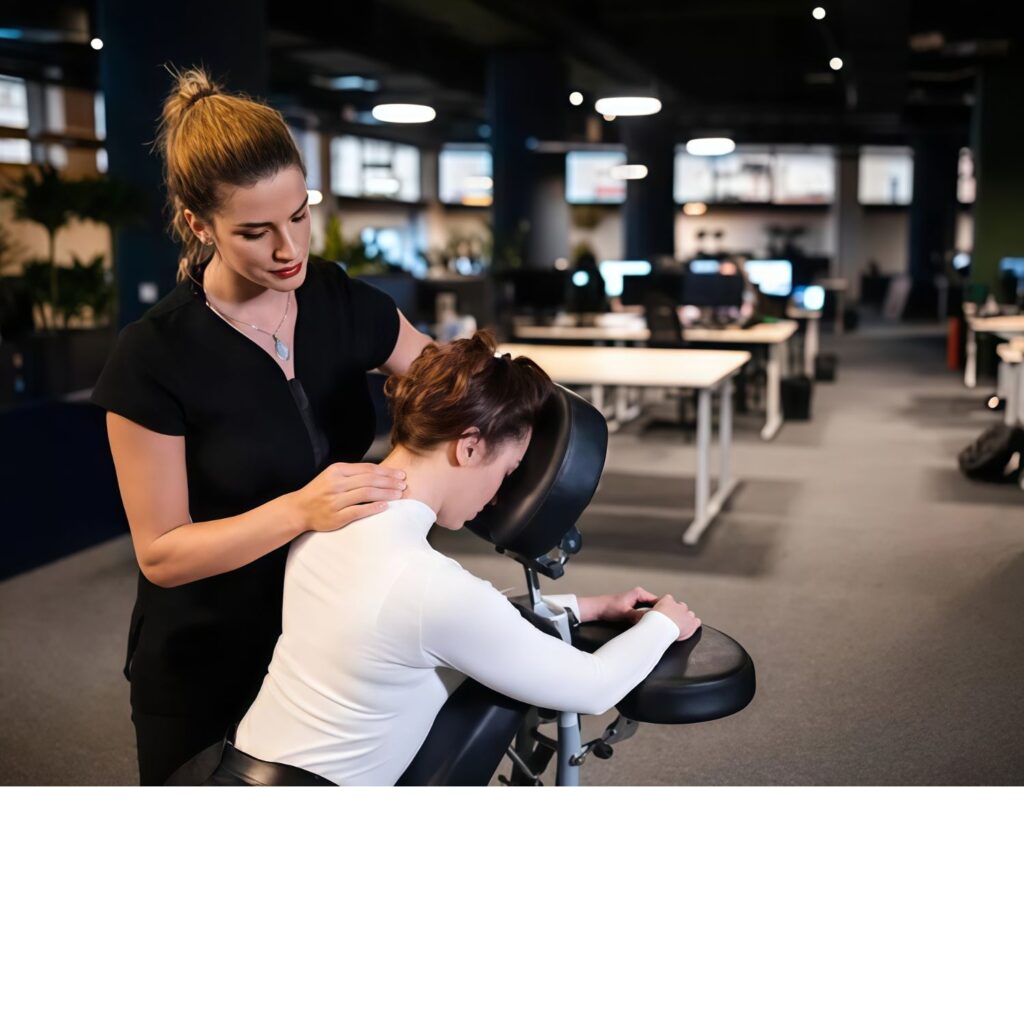
The portable massage chair used for corporate on-site sessions is not the reclining electric chair that fills a corner of a shopping centre. It is a lightweight frame – typically around 8 kilograms – that folds flat and carries in a bag. When unfolded and in use, the chair and the working space around it occupy approximately 2 to 2.5 square metres.
To put that in context: a standard office desk occupies roughly 1.5 square metres of floor space. A single car parking bay occupies approximately 12 square metres. The working footprint of a desk massage setup is smaller than two desks placed end to end, and significantly smaller than the meeting room most offices already use for video calls.
The breakdown of that space is straightforward. The chair itself sits within an area of approximately 60 to 70 centimetres wide by 120 centimetres long. The therapist works primarily from behind the chair and needs roughly 50 to 60 centimetres of clear space to move. That’s the total. No table, no bench, no screen, no power point.
When the session ends, the chair folds down to 95 centimetres by 50 centimetres by 23 centimetres – about the size of a large piece of luggage – and can be stored in a cupboard, under a desk, or in a storage room until the next visit. The space it occupied returns to normal use immediately.
Five workspace configurations that work for on-site chair massage
The practical question is not whether your office can accommodate a desk massage setup – most can – but which part of your office works best. Here are five configurations that come up regularly, and how each one handles the logistics.
1. Open-plan floor (ABW or hot-desk environment)
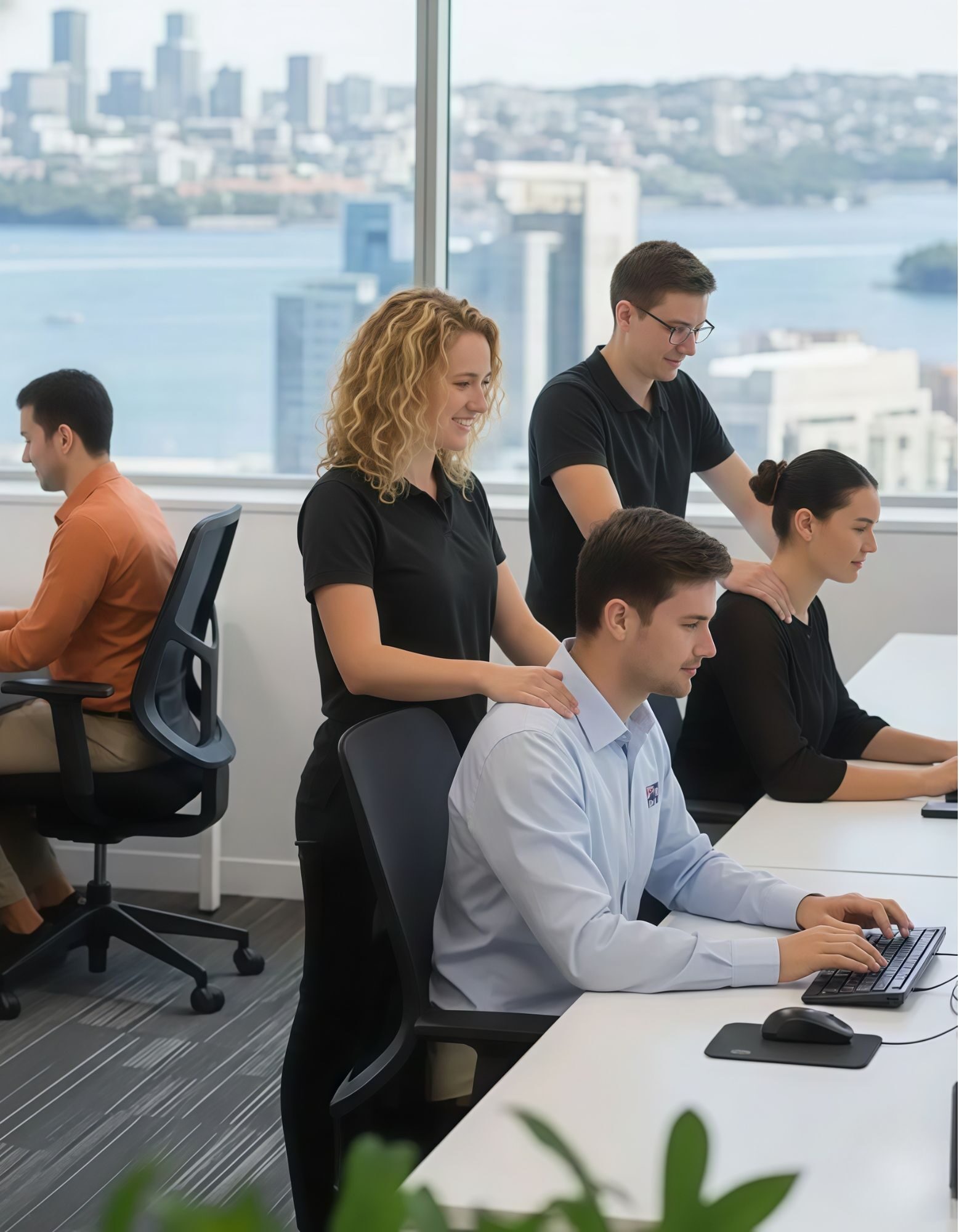
In an activity-based working layout, the floor plan already includes informal zones – collaboration areas, quiet corners, bench seating along windows. Any of these areas can accommodate a massage chair setup for the duration of a booking. The therapist works through a sign-up list, employees come to the chair rather than the chair coming to them, and the flow is managed like any other shared resource on the floor.
Privacy in an open plan is a legitimate consideration but not a barrier. Chair massage is delivered with the employee fully clothed, seated facing forward, which is no more exposed than sitting at a desk. Most employees adjust quickly once they see a colleague go first.
2. Shared meeting room
A standard four-person meeting room booked for a half-day can comfortably accommodate a massage chair and a full session schedule. At 15 minutes per employee, a three-hour booking covers 12 people. The room’s existing walls provide the privacy that some employees prefer, and the setup and pack-down happen entirely within the room without disrupting the rest of the floor.
This is the most common configuration for first-time bookings. It is familiar, contained, and easy to communicate to the team: “Massage is in Meeting Room 2 from 10am to 1pm – sign up for a slot.”
3. Breakout area or kitchen zone
Breakout areas and kitchen zones are typically used in concentrated bursts – around meal times and coffee breaks, and sit empty for most of the working day. Scheduling a massage session during quieter periods (a mid-morning or mid-afternoon block, for example) allows the space to serve a wellness function without conflicting with its primary use.
The key check is clearance: the breakout area needs approximately 2.5 square metres of usable floor space after accounting for existing furniture. In most medium-sized offices, this is easily achievable by temporarily moving a single chair or stool.
4. Corridor alcove or landing space
Many commercial office buildings include landing areas between lift lobbies and office entry doors, or alcoves set back from the main corridor. These spaces are often left unfurnished and unused. A portable massage chair fits comfortably in most of these footprints, and the natural separation from the main office floor provides a degree of ambient privacy without requiring a closed room.
This option works particularly well in buildings with multiple tenants, where a landing space may be shared across floors but rarely occupied during business hours.
5. Serviced office or coworking space
Serviced office providers and coworking operators often include wellness rooms, phone booths, or quiet focus pods as part of their offering. These spaces are bookable by members and, while typically designed for individual calls or heads-down work, are well-suited to a massage chair setup. The dimensions of a standard wellness or focus room — usually between 4 and 8 square metres — accommodate a chair setup with room to spare.
For teams in coworking environments, the seated chair massage format is particularly practical: it requires no permanent infrastructure, fits within a bookable shared space, and can be scheduled on anchor office days without any arrangement with building management.
Why compact offices need desk massage more than large ones
There is a counterintuitive argument to be made here. The offices most likely to say they “don’t have the space” for desk massage are often the offices where the need for it is highest.
Dense work environments – high headcounts relative to floor area, shared desks, limited private space – produce specific physical and psychological stressors. Employees in hot-desk environments often work from whatever chair and desk they find available, without the ergonomic adjustments that reduce postural load over a long day. The result is a higher baseline of accumulated muscle tension by end of day, and less individual control over the ergonomic conditions that contribute to it.
The data on desk workers and musculoskeletal health is significant. According to the Australian Chiropractors Association WorkSpace Week 2025 media release, a 2023 study found that 89% of desk workers had suffered a work-related musculoskeletal disorder (WMSD), with female desk workers reporting the highest rate at 91%. Musculoskeletal disorders account for 57% of serious workers’ compensation claims in Australia, and desk and computer users represent 10% of those serious claims.
The broader picture is similarly stark: approximately 7.3 million Australians – 29% of the population – were estimated to live with chronic musculoskeletal conditions as of the Australian Institute of Health and Welfare’s June 2024 report. These conditions do not develop overnight. They accumulate from sustained postural load over years of desk-based work.
Beyond the physical, the 2025 Pureprofile survey cited by the ACA found that tech neck – the neck and shoulder tension pattern associated with prolonged screen use – produced higher irritability in 24% of sufferers, poorer concentration in 20%, and sleep disruption in 23%. These effects compound in dense environments where employees have fewer opportunities to move, decompress, or adjust their physical situation.
A 15-minute desk massage session does not solve a structural ergonomics problem. But it does interrupt the accumulation cycle, reduce the immediate load on the trapezius and suboccipital muscles, and produce the cortisol reduction and parasympathetic shift that carries over into the afternoon’s work. For employees who cannot adjust their desk, cannot guarantee a good ergonomic setup, and spend the day in a shared environment with limited personal space – the session is more valuable, not less.
What the session flow looks like in a tight space
For HR managers and office managers organising a session for the first time, understanding the logistics from arrival to departure helps clarify how little disruption is actually involved.
The therapist arrives with the massage chair in a carry bag – light enough to carry in one hand and compact enough to bring up in a standard office lift without issue. Setup takes three to five minutes: the chair unfolds, the face cradle and chest pad are adjusted to height, and the therapist is ready. No installation, no tools, no assistance from office staff required.
Employees arrive for their pre-booked slots. The session runs for 15 minutes. Between employees, the therapist cleans the face cradle cover (disposable or fabric, changed each session) in under a minute. The sequence continues until the booking is complete.
When the last session ends, the chair packs down in three to five minutes. The therapist collects their bag and leaves. The space that was used – a corner of the breakout room, the meeting room that has been booked back for the afternoon, the alcove beside the lift – returns to exactly its prior state.
The total footprint on the office is a few hours of one quiet corner being occupied. The logistical ask from the team is booking a slot. Everything else is handled by the therapist.
Practical checklist: is your office ready for desk massage?
Most offices are. The following five questions identify whether yours is:
✓ Is there 2 to 2.5 square metres of clear floor space available anywhere in the office – including a space that can be created temporarily by moving a single item of furniture?
✓ Is the ceiling height at least 2 metres (standard in virtually all commercial buildings)?
✓ Is there no need for access to power? (Chair massage requires no electricity.)
✓ Is there no requirement for a sink or running water nearby? (Not needed.)
✓ Is the team comfortable with a shared-space setup, or is there a bookable room available for the session?
If the answer to the first question is yes – even temporarily – your office can run a desk massage program. The remaining questions narrow down the best format, not whether it is possible.
For teams running corporate wellness programs across multiple sites, including compact satellite offices or coworking locations, the same checklist applies at each location. The therapist travels to each site with the same setup, and the program scales without any permanent infrastructure commitment.
For larger team events, team days, or all-hands sessions where a higher volume of employees need to be served across a shorter window, the event massage format can bring multiple therapists to one location, running parallel chair setups in adjacent spaces.
Book a desk massage session for your team – whatever your office looks like
Corporate Care Therapies delivers desk massage services to offices of all sizes across Melbourne. Therapists bring everything needed for the session and handle all setup and pack-down independently. There is no minimum office size, no dedicated room requirement, and no lock-in contract.
If you are unsure whether your specific workspace configuration will work, the easiest answer is a single trial session. The logistics become clear quickly, and most teams find that the space concern that held them back was smaller than the benefit they were missing out on.
Visit our desk massage page for full service details, or get in touch to discuss scheduling a session around your team’s next office day.