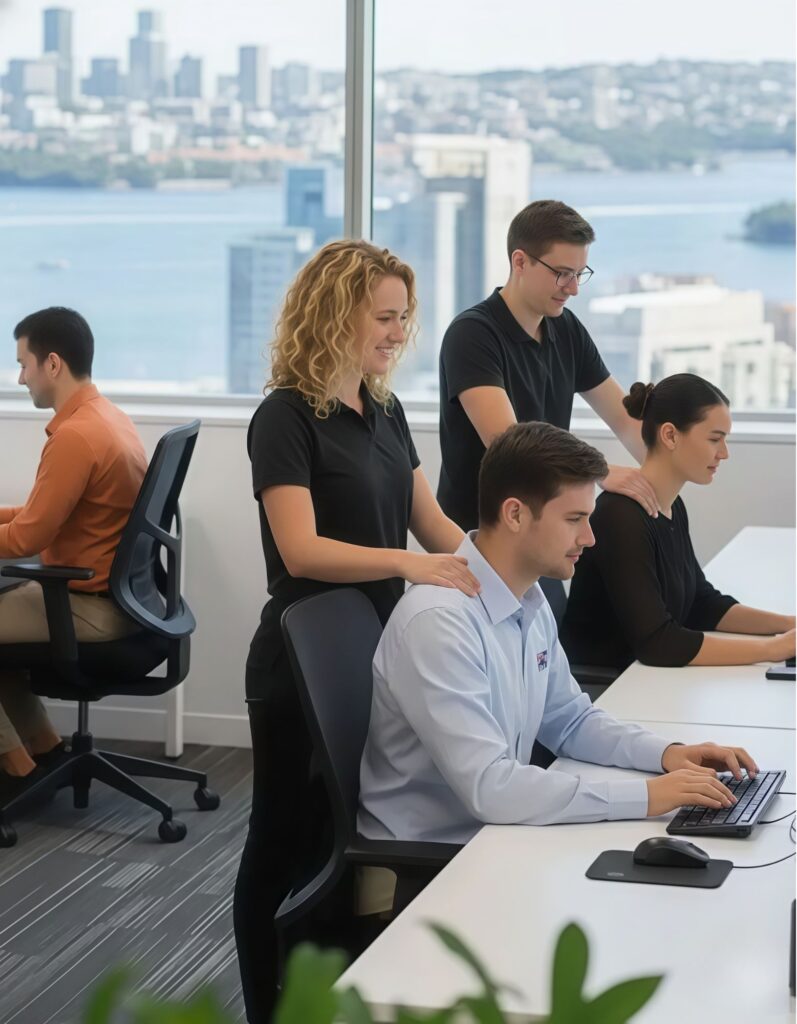
A quarter of an hour. No oils, no change of clothes, no time off the clock. Here is what a desk massage session actually involves — and why it keeps getting booked again.
Desk massage is one of those workplace benefits that sounds simple until you try to explain it to someone who has never had one. The format is unfamiliar – you sit facing forward in a purpose-built chair, fully clothed, while a therapist works across the muscles your workday spends eight hours loading up. The whole thing takes fifteen minutes. And yet the anecdotal feedback from employees who have experienced it is remarkably consistent: it works, and they want it again.
This article walks through exactly what happens during a desk massage session – what the therapist does, which muscle groups they target, what the physiological effect is, and why the request-rate for repeat bookings tends to surprise even the managers who arranged the first one.
If you are an HR manager, office manager or team leader weighing up whether to bring a corporate massage program into your workplace, understanding the mechanics of a session is the most useful place to start.
What a desk massage session actually looks like
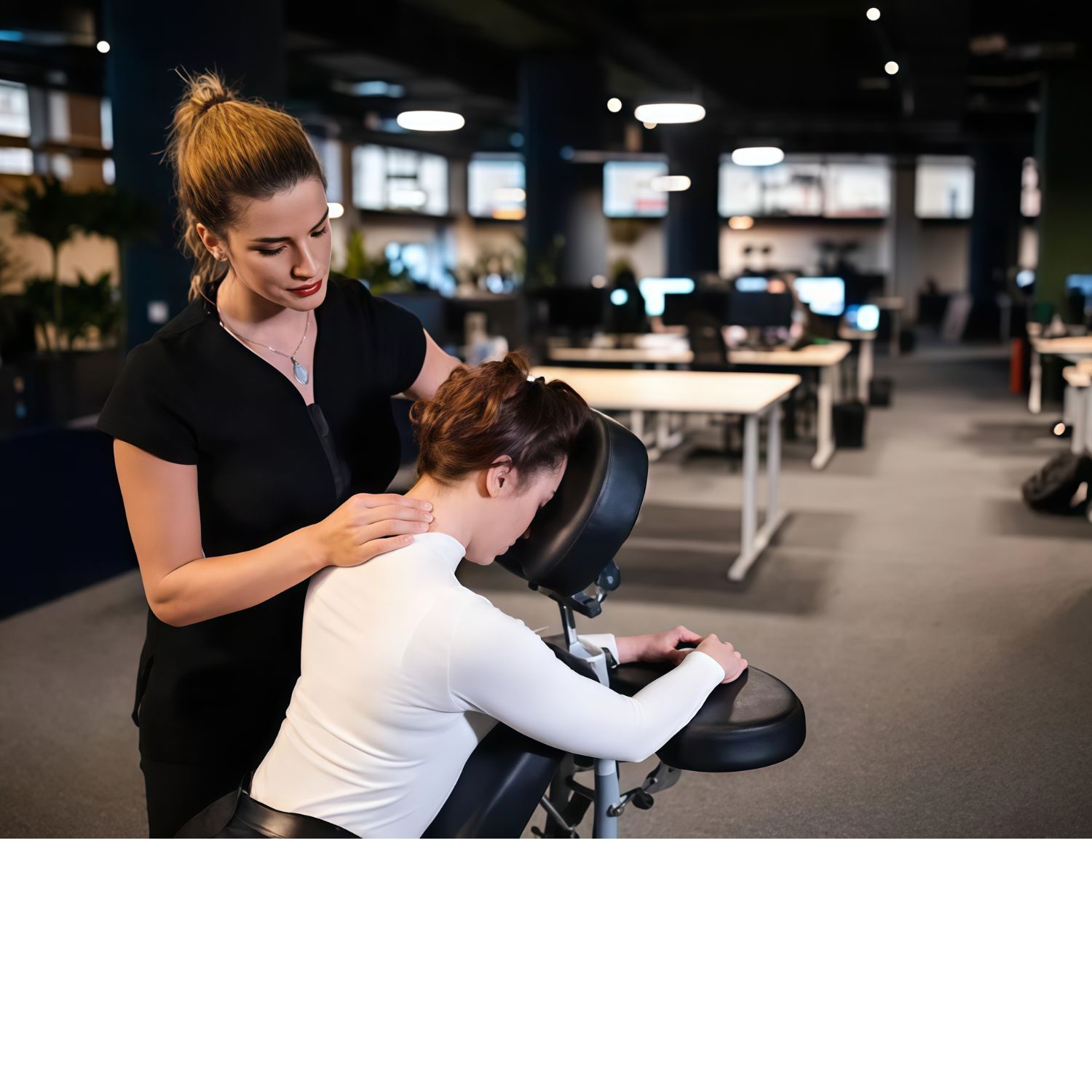
The term “desk massage” is shorthand for on-site chair massage – a session delivered in a specially designed massage chair that a therapist brings to your workplace. The chair is portable, ergonomically engineered, and takes about two minutes to set up in any clear space: a breakout room, a meeting room, a quiet corner of the office floor.
The employee sits facing forward with their chest resting against the chair’s front pad and their face cradled at the head support. The position is often described as resembling a forward lean – not particularly glamorous, but designed to open up access to the full length of the back, shoulders and neck without requiring the employee to remove any clothing.
No oils are used. No undressing is required. The session begins and ends with the employee fully clothed, and they return to their desk afterwards without needing to do anything – no washing up, no reapplying anything. For an office context, that absence of friction matters more than it might seem.
The first two minutes: setup and communication
Before the massage begins, a qualified therapist will ask a few brief questions. These are not a formality. They are how the therapist identifies any areas to focus on or avoid – a shoulder that has been aggravated recently, a lower back that has been flaring up, a preference for lighter or deeper pressure.
This intake process typically takes under two minutes. It is worth it: a desk massage session is short, and precision matters more than in a longer table session. The therapist is mapping the available time to the employee’s most pressing areas of load before they begin.
It also establishes communication as normal. Employees who have not had a chair massage before sometimes assume they should stay silent throughout. The opposite is true – checking in on pressure, flagging an uncomfortable spot, or asking the therapist to spend more time on the upper traps are all things a therapist expects and wants to hear.
Minutes two to twelve: what the therapist actually does
The core of a fifteen-minute desk massage session follows a structured sequence. Experienced therapists vary their approach based on the individual, but the broad anatomy targeted is consistent.
Upper back and trapezius muscles
The trapezius – the large muscle that runs from the base of the skull across the top of the shoulders and down the mid-back – is the primary accumulator of postural tension in office workers. It bears the weight of the head’s forward position during screen work, and it tightens progressively over the course of a day, a week, and a career spent at a desk.
The therapist uses a combination of compression, kneading and sustained pressure to release the trapezius. Most employees report that this is where they feel the greatest immediate change. A tight upper trap can refer pain into the neck, head and upper arms — which is why neck pain, headaches and shoulder stiffness in office workers are so often related to the same underlying muscle group.
Neck and suboccipital muscles
The suboccipitals are a group of small muscles at the base of the skull that most people do not know they have until a therapist finds them. They are responsible for fine head movements and bear continuous load during screen-based work. Restriction here is one of the more common contributors to tension headaches in office workers.
Therapist technique in this area is typically slow and precise – sustained compression rather than kneading, working with the natural release of the muscle rather than against it. The effect is often described by recipients as a release of pressure behind the eyes and across the crown of the head.
Mid-back and rhomboids
The rhomboids sit between the shoulder blades and are responsible for retracting the scapulae. In workers who spend long periods at keyboards, the rhomboids are typically in a chronically lengthened and weakened position – held stretched rather than contracted, which paradoxically produces the sensation of tightness and aching between the shoulder blades.
Massage in this region addresses that sensation directly and can contribute to a short-term improvement in posture as the surrounding musculature rebalances.
Arms and forearms — if time permits
In sessions of twenty minutes or longer, or when the employee specifically requests it, a therapist will often move to the forearms and hands. The extensor and flexor muscles of the forearm are heavily loaded in keyboard and mouse work, and are frequently sore or tight in ways employees have habituated to noticing. Release here can produce a disproportionately strong sense of overall relief.
The last two minutes: the close and the carry-over effect
A well-structured chair massage session does not simply stop. The final minutes typically involve a transition from deeper work to lighter effleurage — long, gliding strokes — that settle the nervous system and signal the close of the session. Some therapists use percussion techniques across the upper back at this point, which also serves as a physiological signal that the deep work has finished.
The carry-over effect — the period during which the employee continues to feel the benefit after they return to their desk — is well documented. Research from the Touch Research Institute at the University of Miami found that a fifteen-minute chair massage produced measurable improvements in alertness and task accuracy that persisted after the session ended. It was not simply that employees felt more relaxed during the massage – the effect carried into their subsequent work.
This is what separates a desk massage from a standard break. A coffee or a walk helps, but the recovery is passive. A chair massage actively interrupts the physiological stress cycle – lowering cortisol, reducing muscle tension and shifting the autonomic nervous system toward a parasympathetic state – in a way that persists after the session ends.
What the physiology actually explains
The reason desk massage keeps getting requested is not sentiment. It is the predictability of the physical response.
Cortisol is the primary stress hormone and a reliable marker of physiological load. Multiple studies have shown that even short massage sessions produce meaningful reductions in cortisol. A randomised controlled pilot study published in Frontiers in Public Health found measurable cortisol reductions in employees who received regular workplace massage. Blood pressure and heart rate also dropped – markers that are physiologically significant independent of how the employee subjectively describes feeling.
A comprehensive scoping review of 18 studies found that chair massage in office environments delivered measurable benefits across cognitive function, mental fatigue, muscle stiffness and pain relief. Over 52% of desk-based workers experience neck and shoulder pain – the exact anatomical territory a desk massage session directly addresses.
The result is a benefit that employees can feel immediately and that persists in ways they notice at their desk. That combination – immediate, felt, and verifiable – is exactly why re-booking rates for desk massage programs tend to be high. The experience is not abstract.
Why employees keep requesting it: what the pattern tells you
When a desk massage program runs for the first time in an office, the first session typically generates curiosity. Some employees book out of interest. Some join because a colleague mentioned it. A few book reluctantly, unsure what to expect from something that sounds slightly unfamiliar.
The second booking cycle is different. The employees who had a session come back. In some workplaces, the waitlist for the second visit is longer than the first.
There are a few things driving this pattern:
The result is immediate and unambiguous. Unlike many wellness initiatives – fitness subsidies, meditation apps, ergonomic assessments – a desk massage produces a result the employee can feel before they stand up from the chair. There is no learning curve, no sustained commitment required. The effect is obvious and immediate, which makes re-booking easy to justify.
It addresses the specific load of their work. Desk-based employees carry tension in exactly the areas a chair massage targets. The relief is not generic – it is precisely placed at the sites of accumulation. Employees recognise this specificity as different from what a gym session, a walk, or a stretch at their desk produces.
It fits in the workday without disruption. Fifteen minutes, no preparation, fully clothed, back at the desk immediately. The format removes every practical barrier. There is nothing to organise, nothing to clean up, and no period of feeling too relaxed to work. The carry-over effect is alertness, not drowsiness.
It signals that the organisation sees them. Research from Victoria University on workplace massage programs in Australian settings found that employees consistently cited the cultural signal – that their employer had arranged the program – as a distinct component of the benefit. The physical relief mattered. But so did the fact that it had been provided.
Desk massage vs other short workplace wellness breaks: a practical comparison
| Break type | Time required | Physiological effect | Carry-over into work |
| Desk massage (chair massage) | 15–20 minutes | Cortisol reduction, muscle release, blood pressure drop | Alertness, reduced pain, improved focus – confirmed post-session |
| Coffee break | 5–15 minutes | Caffeine stimulation | Variable; diminishing returns across the day |
| Walk/fresh air | 10–20 minutes | Mild stress relief, circulation | General lift; does not address muscle-specific load |
| Stretching at desk | 5 minutes | Mild muscle release | Useful; limited depth compared to therapeutic technique |
| Rest (eyes closed) | 10–15 minutes | Cognitive rest | TRI research: less effective than massage of equal duration |
How often should your team be getting desk massage?
The research on cumulative benefit points to regularity as the key variable. A single session addresses immediate load. A fortnightly or monthly program builds on each visit, producing a lower baseline of accumulated tension across the team over time.
The practical starting point for most organisations is monthly — one visit per month, with a therapist spending a half-day in the office covering each team member in rotation. This is enough to establish the pattern, get genuine employee feedback, and assess whether the program warrants a higher frequency.
For teams carrying heavier load — open-plan environments with sustained screen time, customer-facing roles, development teams under deadline — fortnightly desk massage is typically where the benefit becomes most visible to management. Attendance, reported energy levels and the informal mood of the team are all places where the effect shows up.
The logistics are minimal. A therapist arrives with their own chair. A room or a clear space is enough. Most desk massage programs can be confirmed within 24 hours of initial contact with a provider.
Bring desk massage to your workplace
Corporate Care Therapies provides professional desk massage and corporate massage services across Australia — Melbourne, Sydney, Brisbane, Perth, Adelaide and Canberra. Sessions are delivered on-site, fully clothed, with no setup required from your team.
If you are considering a program for the first time or looking to increase frequency for an existing one, the conversation starts with your team size and a preferred date. Explore the full range of workplace wellness services at Corporate Massage Melbourne, Brisbane, Sydney & Perth | Corporate Care Therapies, or get in touch to arrange a booking.