Most workplace benefits are things employees know exist rather than things they actually feel day to day. Workplace massage is different. It’s one of the few benefits an employee experiences directly, in the moment, with an outcome they notice immediately — and that direct, felt experience is exactly why it tends to show up so clearly in how staff describe their satisfaction with the job.
This article looks at why that direct connection exists, what it means for the satisfaction scores businesses already track, and how a recurring program can be built into a broader loyalty strategy — one that shapes how staff talk about their employer over months and years, not just how they feel on the afternoon of a session. It’s written with HR and office managers in mind, since they’re usually the ones weighing whether a program like this earns its place in the wellbeing budget.
Why employee satisfaction scores matter for retention
The connection between benefits and satisfaction is well established, and it’s worth setting out clearly before looking at massage specifically. Research from the Employee Benefit Research Institute found that 85 percent of organizations report their benefit programs have a positive impact on employee satisfaction, and nearly three-quarters see a measurable effect on recruiting and retention as well. Improving morale was the most commonly cited reason organizations invest in benefits in the first place.
That research covers benefits broadly, not workplace massage specifically — there isn’t a dedicated study isolating massage as a single variable against satisfaction scores. What it does establish clearly is the underlying mechanism: benefits that employees genuinely value translate into measurably higher satisfaction, and higher satisfaction is one of the strongest predictors of whether someone stays.
Satisfaction and loyalty aren’t quite the same thing, but they’re closely linked in practice. A satisfied employee is more likely to stay through a difficult stretch, more likely to speak positively about the business to people outside it, and less likely to actively browse job listings out of frustration. None of that shows up as a single dramatic event — it shows up gradually, in retention numbers and in the tone of exit interviews for the people who do eventually leave for other reasons. Businesses tracking satisfaction scores over multiple quarters are, in effect, watching an early indicator of loyalty long before it would otherwise show up in turnover figures.
Why workplace massage translates into satisfaction so directly
Workplace massage sits in an unusual position among employee benefits, because the value isn’t something staff have to imagine or plan to use eventually — it’s delivered, felt, and complete within a single session.
Employees feel it immediately
A session produces a physical, noticeable change within minutes: looser shoulders, a calmer state, visibly less tension. That immediacy matters for how a benefit gets remembered. A perk that produces an instant, tangible result tends to register far more strongly in someone’s day-to-day impression of their employer than one whose value is abstract or deferred.
This matters for satisfaction surveys specifically, because those surveys ask people to reflect on how they feel about their job in the recent past. A benefit with a strong, recent, physically felt moment attached to it is simply easier to recall and credit than one that exists quietly in the background of a benefits document.
It’s a visible, recurring signal of care
A recurring program means the benefit shows up again and again, rather than being a single memory from an induction pack. Each session is a fresh, visible reminder that the business is actively investing in staff wellbeing — not a line item mentioned once and then forgotten. Over a year, an employee who has experienced a dozen sessions has a dozen separate, positive data points attached to their employer, compared with a benefit they simply know exists on paper.
Everyone can take part, regardless of role or seniority
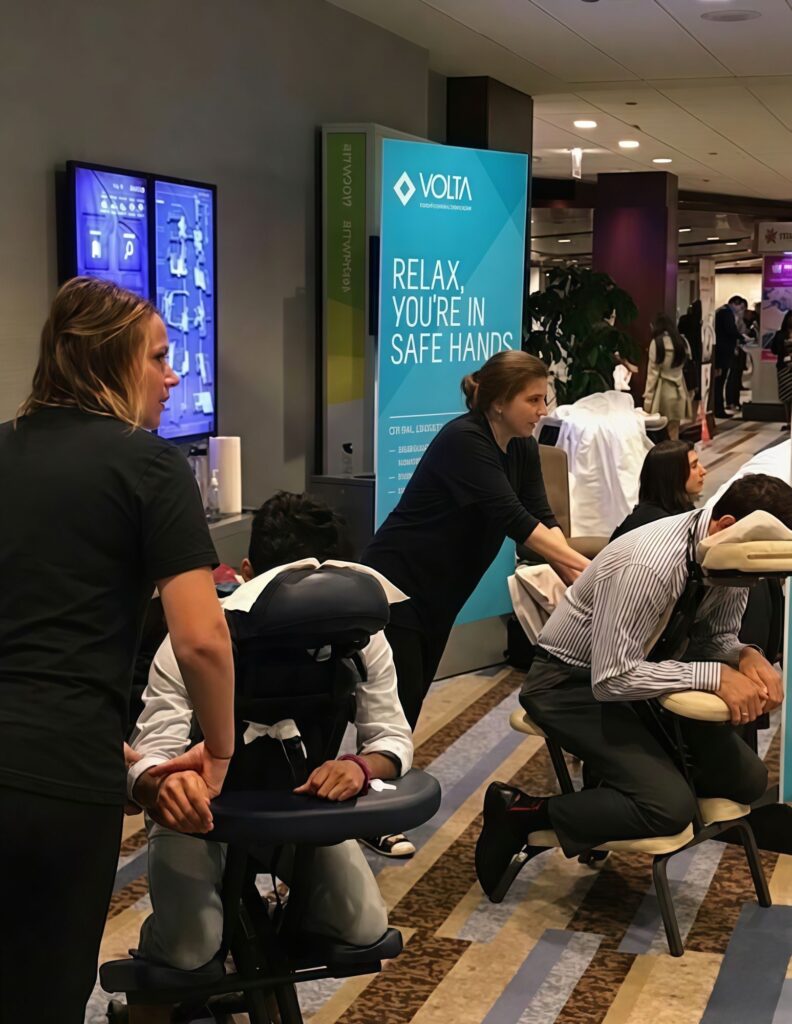
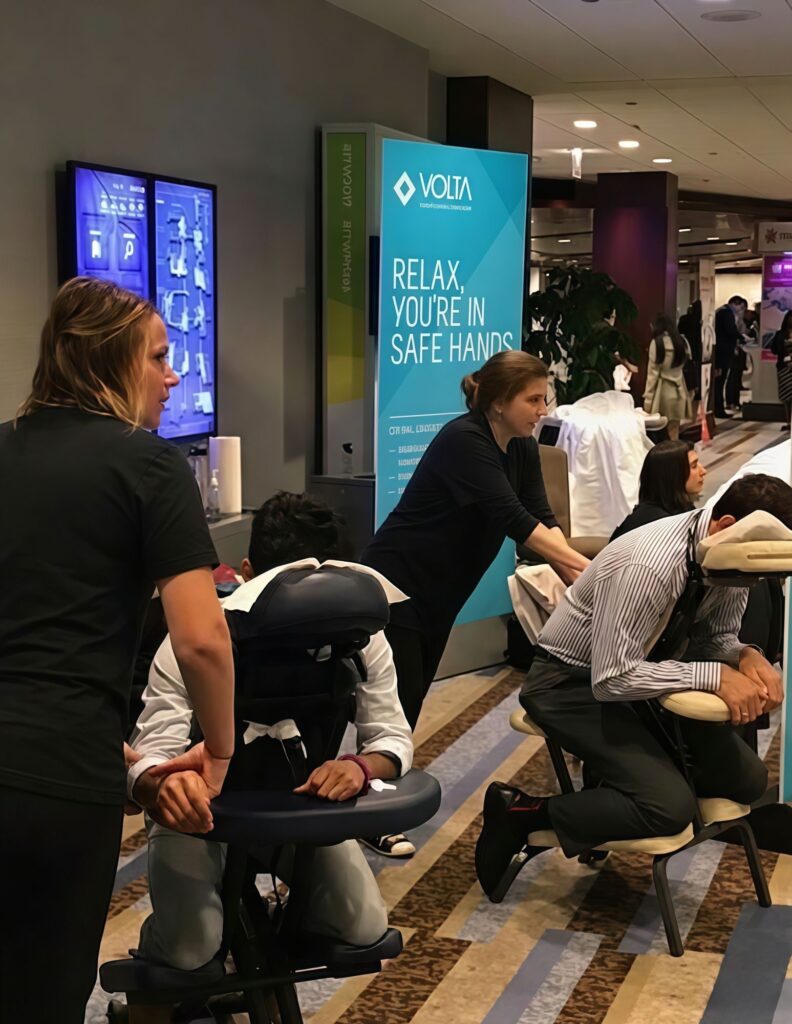
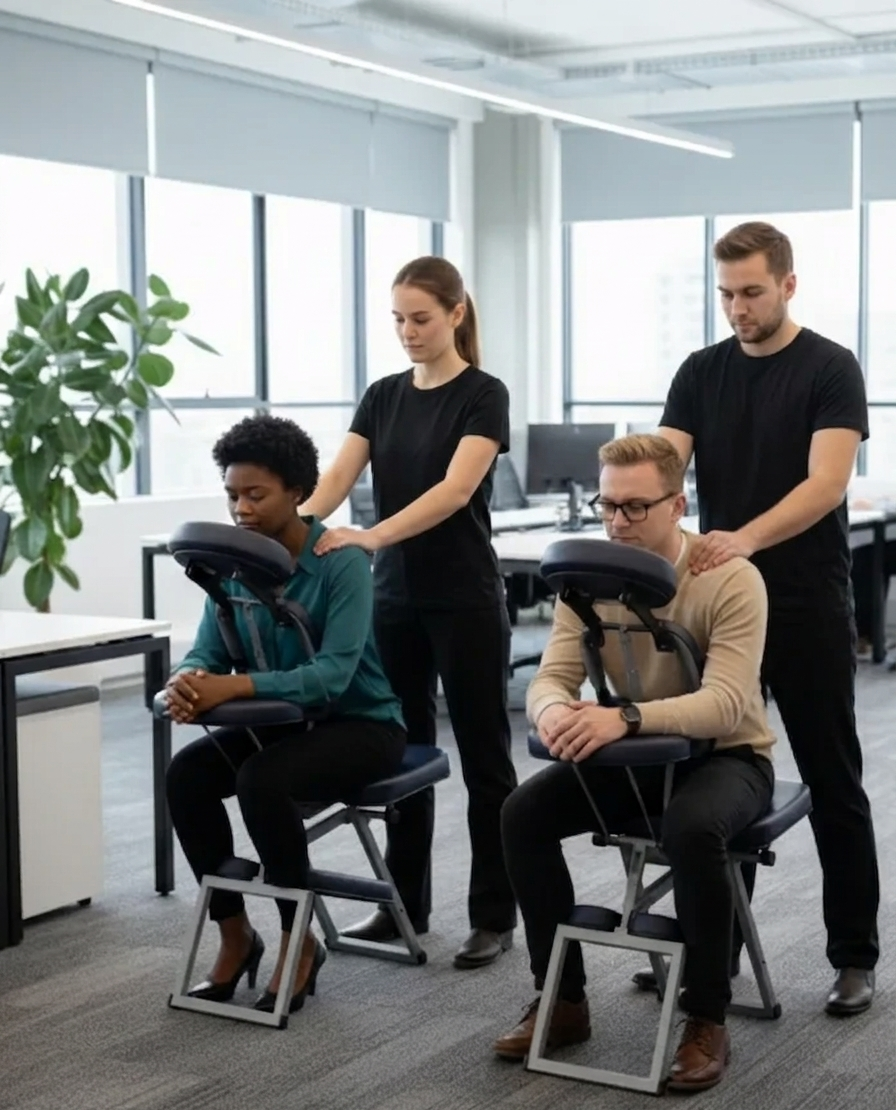
Because sessions are delivered at the desk or in a shared space during work hours, participation doesn’t depend on rank, tenure, or department. Every member of a team experiences the same benefit in the same way, which tends to make it register as a genuinely shared gesture rather than something reserved for a particular group.
This matters more than it might first appear. Benefits that are technically available to everyone but practically used by a narrow slice of staff — because of cost, location, or eligibility rules — rarely shift how the wider team feels about the organization as a whole. A benefit with genuinely universal, low-friction access is more likely to influence satisfaction broadly across a team rather than just among the small group who happen to make use of it.
How this shows up in employee satisfaction scores
It’s worth being precise here rather than overstating the case. There’s no published study that isolates workplace massage as the sole driver of a satisfaction score movement, and any business claiming a guaranteed percentage lift from a program alone should be treated with scepticism. What can be measured, reliably and specifically, is how a program is landing with your own team — which is ultimately more useful than a generic industry figure anyway, since it reflects your workforce rather than an average drawn from unrelated organizations.
A short pulse survey run after each session — a handful of consistent questions on perceived stress relief and satisfaction — builds a trend line over several months. Reviewing that trend line alongside your existing quarterly or annual satisfaction survey shows whether the two move together for your particular workforce, rather than relying on a generic industry claim that may not reflect your team at all.
This kind of tracking also has a secondary benefit: it gives HR a concrete, team-specific data point to bring to a budget conversation, rather than relying on general sentiment or anecdotal comments about how well-received a session was.
- Track a short pulse-survey score after each massage session, using the same few questions every time
- Review that trend quarterly alongside your existing employee satisfaction survey
- Look for movement in the specific questions most likely to be influenced — perceived support, day-to-day comfort, and overall morale
- Treat the comparison as directional evidence for your own team, not a universal guarantee
Building this into a broader loyalty strategy
A single session delivers a moment of relief. A properly scheduled program delivers a recurring signal that compounds over time. Businesses looking to build this into a loyalty strategy typically start with a desk massage or seated chair massage booking on a fortnightly or monthly cadence, then fold it into a broader corporate wellness program alongside other initiatives already in place, so the benefit is reinforced rather than sitting as a standalone event.
Consistency matters more here than scale. A modest, reliable program that runs every few weeks tends to build a stronger, more lasting impression than an occasional, larger event that staff can’t predict or rely on. Over time, that predictability is what shifts a benefit from being a pleasant surprise into being part of how staff describe working there.
How Corporate Care Therapies supports this
Corporate Care Therapies has delivered workplace massage to Australian businesses for over 20 years, offering desk massage and seated chair massage sessions that fit around a team’s existing schedule. Programs can be booked once-off or as a recurring fortnightly or monthly arrangement, giving HR teams the flexibility to start small and scale up once the cadence has proven itself with staff. Further context on how Australian workplaces are approaching staff wellbeing is available in Massage at Work: why Australian businesses are prioritising workplace wellness in 2026.
Summary
Workplace massage occupies a distinct position among employee benefits because its value is felt directly and immediately, delivered on a recurring basis, and open to everyone in the same way, regardless of role or seniority. That direct experience is what makes it register so clearly in how staff describe their day-to-day satisfaction — even though no single study proves a fixed causal link between sessions and satisfaction scores. What businesses can do reliably is track the connection for their own team: a short pulse survey after each session, reviewed against the broader satisfaction survey each quarter, shows exactly how the two are moving together in practice.
For a program to genuinely support loyalty rather than function as a one-off gesture, consistency is the deciding factor. A recurring, dependable schedule builds a stronger impression over time than a single high-profile event ever could, and it’s that steady, repeated signal — not any one session on its own — that tends to shape how staff talk about their employer months and years down the track. Starting small and reviewing the trend over a couple of quarters is usually enough to know whether the program is worth expanding.
Want to see how a workplace massage program could support satisfaction and loyalty on your team?Contact Corporate Care Therapies to set up a program built around your team’s schedule and existing wellbeing initiatives.