Every resignation costs more than the obvious expense of advertising and interviewing for a replacement. Between recruitment, onboarding, lost productivity and the ramp-up time before a new hire reaches full output, the real cost of a single departure typically runs into tens of thousands of dollars. A regular workplace massage program is a modest, comparatively low-cost addition to a retention strategy — and the math behind why it’s worth considering starts with just how expensive turnover actually is, once someone takes the time to add it all up properly.
This article breaks down what staff turnover really costs a business, why wellbeing support has become one of the most commonly used retention levers among Australian employers, and where a workplace massage program fits into that picture financially — written for anyone weighing up a wellbeing budget against the alternative cost of doing nothing.
What staff turnover actually costs a business
One clear Australian benchmark comes from the Northern Territory Government’s own cost of turnover calculator, which estimates the cost of replacing an employee at around 1.5 times their annual salary, once recruitment, onboarding and lost productivity during the transition are factored in. It’s one of the few government-published figures available in Australia for this specific calculation, and while other tools — such as Business Victoria’s staff turnover calculator — arrive at a lower estimate depending on the assumptions used, the Northern Territory figure offers a straightforward, conservative starting point for a business trying to estimate what turnover is actually costing it.
Applied to a modest average salary of $70,000, that works out to roughly $105,000 per departure — for a single role. A business losing several people a year at that rate is looking at a genuinely significant, recurring cost, well before factoring in the less tangible impact on the team left behind to cover the gap.
Why wellbeing support is already a top retention lever in Australia
This isn’t a theoretical connection, and it’s worth taking seriously as more than an assumption. The Australian HR Institute’s Quarterly Australian Work Outlook found that improved support for employee wellbeing is now one of the three most frequently used retention measures among Australian employers, used by 36 percent of organizations — level with increased learning and development opportunities and enhanced flexible working arrangements, and ahead of most other retention levers employers have available.
In other words, Australian HR teams are already treating wellbeing support as a serious retention tool, not a soft add-on. A workplace massage program sits squarely inside that category — a visible, recurring form of wellbeing investment rather than a one-off gesture.
It’s worth noting what “wellbeing support” covers in that AHRI data — it’s a broad category that can include anything from mental health resources to flexible leave policies. A workplace massage program is one specific, tangible way to deliver on that broader commitment, rather than the only way. Its advantage over some alternatives in the same category is that it’s visible and experienced directly, rather than existing as a policy document staff may never actually engage with or even know exists.
Where workplace massage fits into the cost equation
It’s worth being precise about what these figures do and don’t show. No credible source claims a wellness perk single-handedly prevents resignations — turnover has many drivers, including pay, workload and career progression, and a massage program won’t fix a genuinely broken team culture. What it does is add a low-cost, visible signal to the retention mix, at a price point that’s easy to weigh directly against the cost of even a single departure.
A recurring fortnightly or monthly program for a mid-sized team typically costs a small fraction of the replacement cost of one employee on the Northern Territory Government benchmark above. Framed that way, the relevant question for a budget conversation isn’t whether a wellbeing program guarantees zero turnover — it’s how many departures the program would need to help prevent, even indirectly, to justify its cost. For most teams, the answer is very few.
This framing also holds up better under scrutiny than a vaguer claim about “improving culture.” A finance team evaluating a wellbeing spend doesn’t need to be convinced the program is transformative — they need the arithmetic to make sense against a number they already have on hand, which is exactly what the turnover-cost comparison provides, without requiring anyone to take a leap of faith on soft, hard-to-measure benefits.
What this looks like in practice
| Cost item | Approximate scale |
| Replacing one employee on $70,000 | $35,000 to $140,000 |
| Recurring monthly workplace massage program, mid-sized team | A small fraction of a single replacement cost |
| Break-even point | Preventing a very small number of departures a year |
These figures are illustrative rather than a guarantee for any specific business — actual salaries, program costs and turnover drivers vary. The point of laying it out this way isn’t to promise a fixed return, but to show how modest the investment looks next to the cost it’s positioned against.
Businesses that track this properly tend to review the comparison annually rather than assuming it holds indefinitely — salaries change, program costs shift with team size, and turnover rates move with the broader labor market. A once-off calculation is a useful starting point for a budget conversation, not a figure to set and forget without revisiting it as circumstances change.
How to trial this without a large upfront commitment
- Start with a single once-off or monthly session to gauge staff response before scaling up
- Calculate the annual cost of a recurring program at your team’s size and compare it directly against your own average replacement cost
- Review participation and informal feedback after the first quarter before committing to a longer-term arrangement
- Fold the program into existing wellbeing reporting so its cost sits alongside other retention measures, not as an isolated line item
None of this requires a large upfront commitment or a lengthy approval process. Because the format scales up or down easily, a business can test the idea at a modest size, see how staff respond, and expand from there once the numbers make sense for that specific team, rather than committing to a full-scale program before knowing whether it fits the culture.
Building this into a broader retention strategy
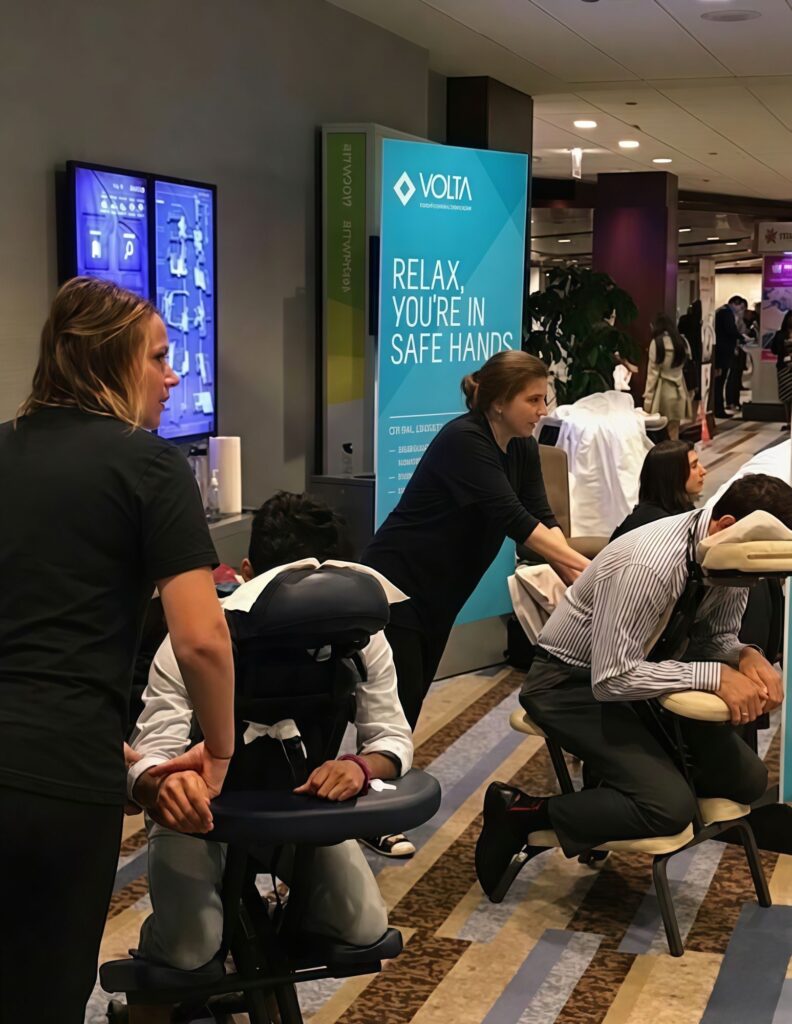
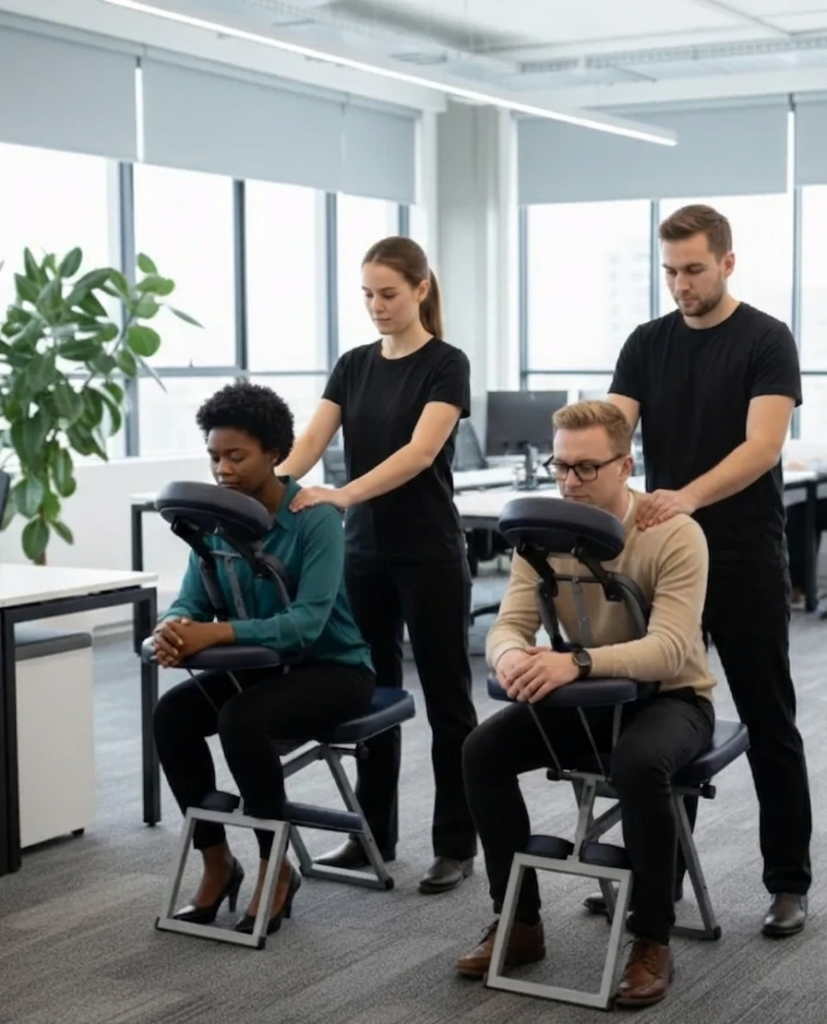
A workplace massage program works best as one part of a wellbeing offering rather than a standalone fix. Most businesses start with a recurring desk massage or seated chair massage booking, then fold it into a broader corporate wellness program alongside flexible work arrangements and development opportunities — the same three levers the AHRI data shows Australian employers already lean on most.
Layering these together tends to matter more than any single measure on its own. A business offering flexible work but nothing visible on the wellbeing side, or vice versa, is covering only part of what the data shows actually keeps people. Combining the three most-used levers gives staff multiple, different reasons to stay, rather than betting everything on one initiative.
How Corporate Care Therapies supports this
Corporate Care Therapies has delivered workplace massage programs to Australian businesses for over 20 years, with flexible booking options that let a team trial a program at modest scale before committing to a larger, ongoing arrangement. Pricing scales with team size and frequency, which makes it straightforward for a business to run the same cost comparison outlined above using its own numbers before committing to anything long-term. Further context on how Australian workplaces are approaching staff wellbeing is available in Massage at Work: why Australian businesses are prioritising workplace wellness in 2026.
Summary
Staff turnover is expensive by any credible benchmark, typically running to half or double an employee’s annual salary once the full cost of replacement is counted. Australian employers already recognize wellbeing support as one of their most-used retention levers, alongside flexible work and development opportunities. A workplace massage program is a visible, comparatively low-cost way to invest in that category — not a guaranteed fix for turnover, but a modest addition that’s easy to justify against the cost of even a single avoidable departure.
For a business weighing up where a limited retention budget goes furthest, the maths is worth doing properly rather than assumed: compare the cost of a recurring program against the replacement cost of the people you’d most want to keep, using your own salary figures rather than the illustrative example above.
Want to see how a workplace massage program fits your retention budget? Contact Corporate Care Therapies to discuss a program scaled to your team and its numbers.