When a manager books chair massage for their team, the goal is usually straightforward: a visible gesture of appreciation, a few people who leave the session feeling better. What most don’t anticipate is that the session is simultaneously restructuring the biochemistry of everyone who sits down.
The physiological effects of chair massage on cortisol and endorphin production are well-documented in peer-reviewed literature. Understanding what is actually happening inside the body during a session doesn’t just make for interesting reading — it is the clearest available explanation for why these programs produce measurable outcomes, and why the benefits extend well past the session itself.
Why cortisol is the metric that matters in workplace wellbeing
Cortisol is the body’s primary stress hormone. When pressure builds — a difficult client, an impossible deadline, a sustained workload with no visible end — the hypothalamic-pituitary-adrenal (HPA) axis activates and cortisol is released into the bloodstream. In the short term, this is useful: it sharpens focus, suppresses non-essential functions, and primes the body for action.
The problem is that most modern workplace stress is not short-term. It is chronic. When cortisol levels remain elevated across weeks and months, the downstream effects are significant: impaired immune function, disrupted sleep, reduced capacity for complex decision-making, heightened inflammation, and higher rates of absenteeism and burnout.
The scale of the problem in Australia is considerable. According to research cited by the Melbourne Business School, burnout-related absenteeism costs the Australian economy an estimated $14 billion annually, and 61% of Australian workers report experiencing burnout — a rate that exceeds the global average of 48%. Prolonged elevated cortisol is a core biological driver of that toll.
Most workplace interventions address the surface symptoms: flexible hours, extra leave days, access to EAPs that, according to Foremind’s 2025 analysis, only 5% of eligible employees actually use. What far fewer programs address is the cortisol response itself — the biochemical state that, left unmanaged, keeps the nervous system locked in fight-or-flight regardless of whatever else is offered.
What chair massage does to cortisol: the research
The foundational study on massage and cortisol remains Field et al. (2005), published in the International Journal of Neuroscience. Reviewing 17 studies conducted at the Touch Research Institute at the University of Miami School of Medicine, the researchers found that massage therapy produced an average cortisol reduction of 31% across a range of conditions, measured in both salivary and urinary samples. The same review found average increases of 28% in serotonin and 31% in dopamine — both neurotransmitters central to mood regulation and motivational function.
It is worth noting that these figures are averages across multiple conditions and populations. More recent and controlled research has produced more nuanced results, and some critics have raised methodological questions about early Touch Research Institute studies. What the broader body of literature does consistently support, however, is that physical touch — specifically the kind of sustained, deliberate pressure applied during a chair massage — activates the parasympathetic nervous system and produces measurable reductions in physiological markers of stress.
A 2024 study published in Comprehensive Psychoneuroendocrinology examined the effects of a 17-minute seated Amma massage on 33 participants, finding significant reductions in perceived anxiety and improvements in self-confidence, accompanied by measurable increases in oxytocin — a neuropeptide associated with social bonding, calm, and trust. Importantly for workplace contexts, the improvements in psychological state were observed in healthy participants under ordinary conditions, not clinical populations under acute distress.
The University of Konstanz found that just 10 minutes of massage is sufficient to activate the body’s parasympathetic response. The University of Miami’s Touch Research Institute found that 15 minutes of chair massage shifted EEG brain activity toward heightened alertness, with participants performing faster and more accurately on mathematical tasks immediately after the session than they did before.
The endorphin mechanism: why sessions feel immediately different
Endorphins are neuropeptides produced primarily in the pituitary gland and hypothalamus. They bind to the same opioid receptors targeted by pain-relief medication, producing analgesia and a sense of wellbeing. Exercise is the most commonly cited trigger, but physical touch — particularly sustained pressure on soft tissue — also stimulates endorphin release through a different and complementary pathway.
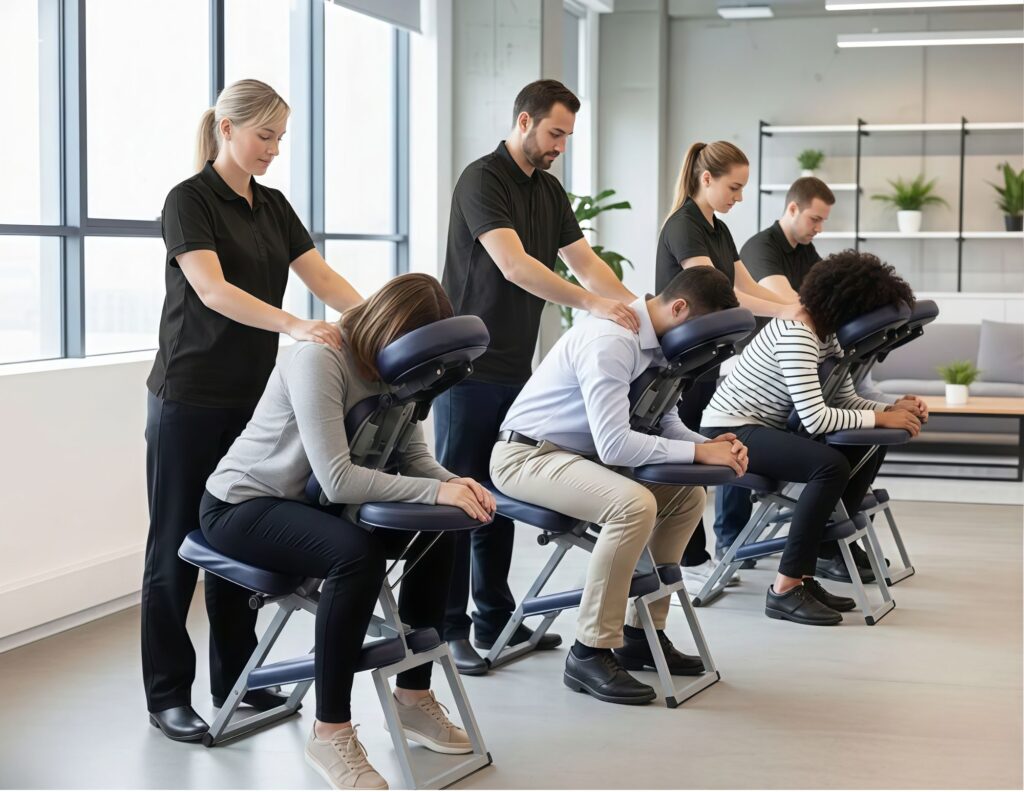
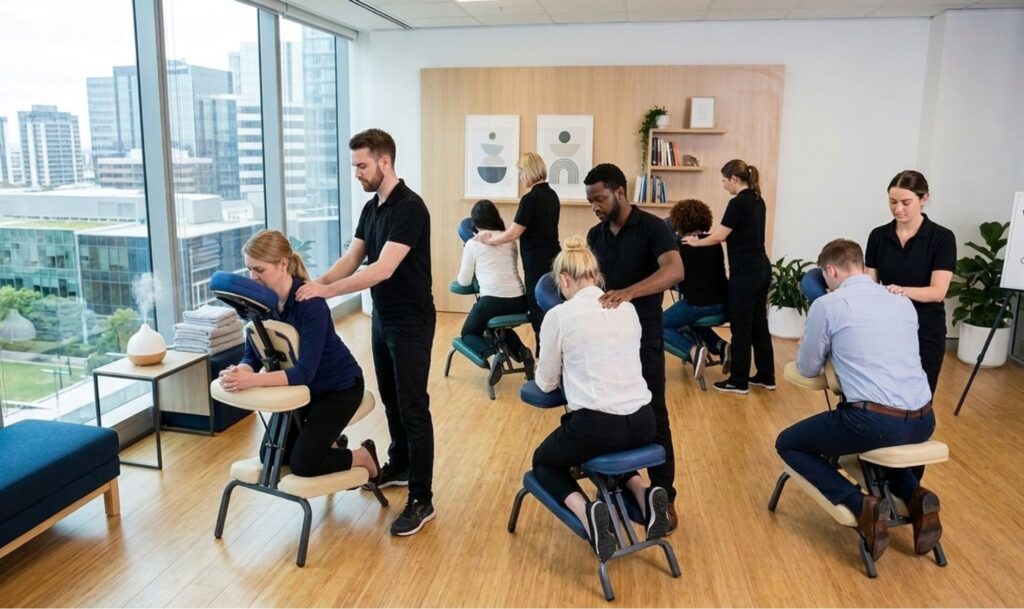
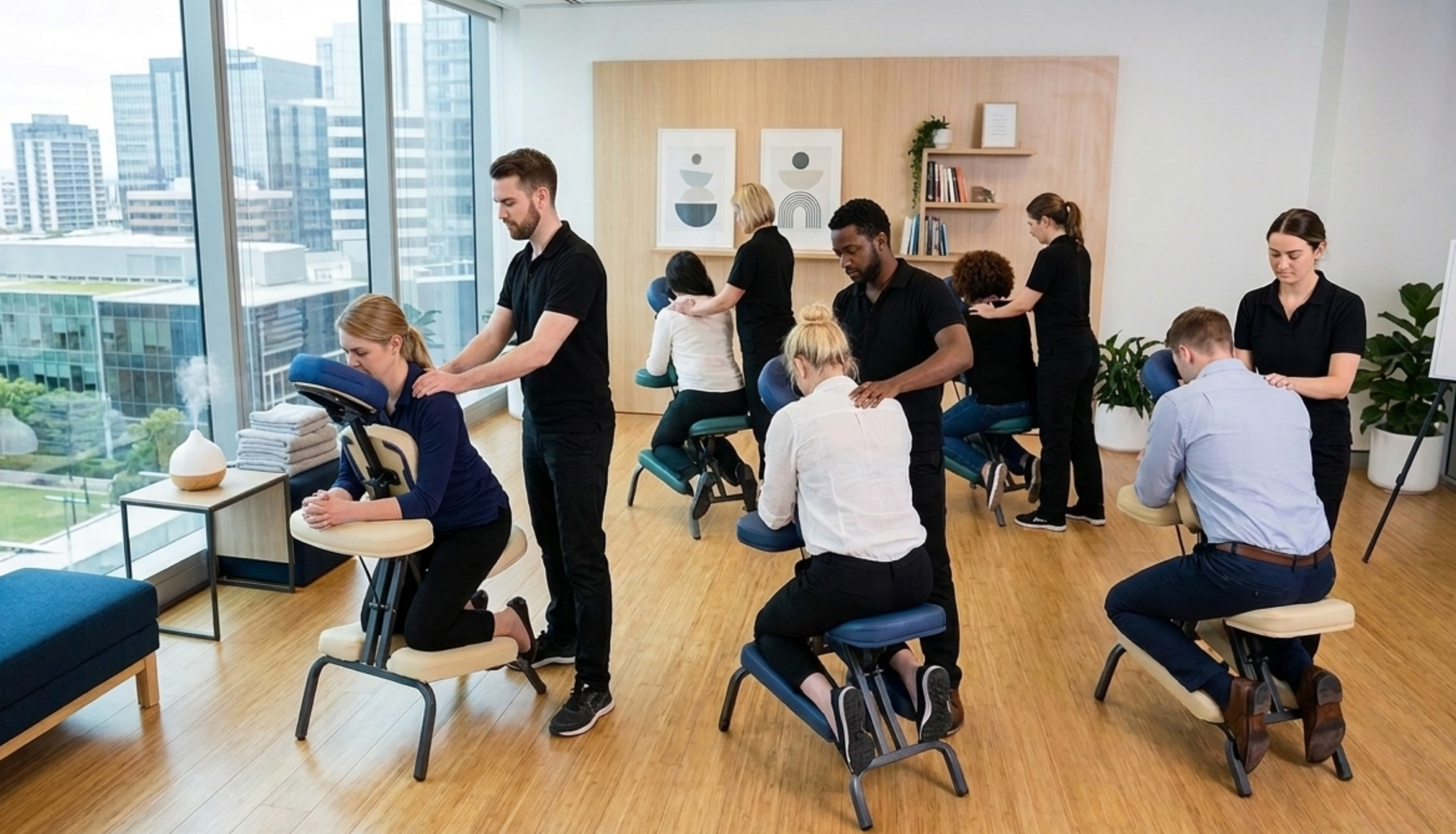
During a chair massage session, the therapist applies consistent pressure across the neck, shoulders and upper back — the areas where most office-based and frontline workers carry the highest density of muscle tension. This pressure stimulates mechanoreceptors in the skin and underlying tissue, which signal the central nervous system through afferent nerve pathways. The brain responds by releasing endorphins, along with serotonin and dopamine, as part of a broader parasympathetic activation.
The subjective experience of this — the noticeable shift in mood that most people report within the first few minutes of a session — is not psychological in origin. It is a direct biochemical response to physical input. The body is not “tricked” into relaxing; it is being given a stimulus that reliably produces a neurochemical outcome.
This matters particularly in high-stress work environments, where the sympathetic nervous system becomes the default state. A team that spends the majority of its working week in a low-grade fight-or-flight posture has elevated cortisol, suppressed endorphin production, and a corresponding reduction in the baseline mood and cognitive capacity that good work requires. A seated chair massage session intervenes directly in that cycle — not through conversation or cognitive reframing, but through the body’s own chemistry.
Why short sessions are physiologically sufficient
One of the more counterintuitive findings in the massage research is how quickly the physiological shift occurs. Most people assume that longer sessions produce proportionally greater benefits. The evidence suggests a different picture.
The EEG study from the University of Miami found measurable cognitive improvements after just 15 minutes. The Konstanz research found parasympathetic activation within 10. The 2024 oxytocin study used a 17-minute session and found significant effects on anxiety and self-confidence.
For employers, this is practically significant. A chair massage program does not require hour-long Book nows, a dedicated wellness suite, or a major disruption to the working day. Sessions of 10 to 20 minutes per person — delivered in rotation across a shift or during a lunch period — are sufficient to produce the neurochemical changes the research identifies. The format that works logistically is also the format that works biologically.
The cumulative effect: why recurring programs outperform one-off events
A single session produces an immediate and measurable shift in cortisol and endorphin levels. But the more significant finding in the research literature is what happens over time with regular sessions.
Field et al.’s review found that the neurochemical effects of massage therapy were observed both immediately following individual sessions and across the course of ongoing treatment periods. In other words, the body’s stress response does not simply reset to baseline between sessions: repeated intervention appears to recalibrate the HPA axis, reducing the frequency and intensity of cortisol spikes in response to ordinary workplace stressors.
For Australian employers navigating a workforce where 41% of workers face constant stress (TELUS Health Mental Health Barometer, 2025) and burnout is linked to 40% of all resignations, the clinical case for a recurring corporate wellness program is the same as for any other intervention with a documented physiological mechanism: consistency produces results that a single exposure cannot.
The logistical format that Corporate Care Therapies uses — recurring programs on a fortnightly or monthly cadence, scaled to the size and roster structure of a given workplace — is designed precisely to deliver this cumulative effect without requiring a sustained time commitment from any individual employee or a fixed dedicated space.
What this means for the wellbeing programs most organizations are already running
Most corporate wellness offerings sit at the cognitive or behavioral layer: mindfulness apps, mental health days, manager training, EAP access. These interventions have genuine value, but they rely on employees choosing to engage, which research consistently shows most people under high stress do not do.
Chair massage works at the physiological layer, beneath the cognitive. It does not require the person to acknowledge that they are stressed, to take initiative, to book an Book now, or to be receptive to a conversation. It requires only that they sit down for 15 minutes.
For HR teams trying to close the gap between a formal wellbeing program and the employees who are not using it — the majority, in most organizations — this is not a minor distinction. Physical intervention that operates independently of voluntary engagement is categorically different from one that depends on it. Further context on how Australian workplaces are approaching this gap is covered in Massage at Work: why Australian businesses are prioritizing workplace wellness in 2026.
How Corporate Care Therapies delivers this in practice
Corporate Care Therapies has been providing accredited chair massage to Australian workplaces for over 20 years. Programs are structured around the roster and operational reality of each workplace — whether that is a corporate office, a warehouse, a hospital ward or a retail floor — with sessions run in short rotations so that coverage is maintained and no team is left short-staffed during a session.
The neurochemical case for chair massage is not a marketing claim. It is a documented biological mechanism, supported by peer-reviewed research across multiple populations and conditions. The case for incorporating it into a structured, recurring workplace program is built on the same evidence.
Ready to put the science to work in your organization? Contact Corporate Care Therapies to discuss a program structured around your team’s size, schedule, and site — and built to deliver the physiological outcomes the research supports.