Most workplace wellness conversations start with the majority. The question is usually: “what does the average employee want?” For corporate wellness programs, the answer tends to land somewhere around a shared space, a short session, and a simple sign-up process. That works for a large proportion of the workforce. But it leaves a meaningful share of employees on the sidelines.
For the first time in history, many Australian businesses now have five generations working alongside each other. At the same time, awareness of neurodiversity in the workplace has grown substantially – research consistently puts the proportion of neurodivergent people in the general population at 15 to 20 per cent globally, and a CYPHER Learning and Censuswide survey covering more than 4,000 workers found that one in five employees identifies as neurodivergent. Among workers aged 16 to 24, that figure rises to 38 per cent.
These are not edge cases. They are a large and growing part of the workforce. A corporate massage program that does not account for sensory sensitivities, different communication preferences, and varying physical needs will consistently underserve a significant portion of the people it is supposed to support.
This article works through what that adaptation looks like in practice: what neurodivergent employees actually need from a massage program, how generational preferences differ, and how a single flexible program, rather than five separate ones – can cover all of it.
Why Australian workforces are more diverse than most wellness programs assume
The phrase “diverse workforce” is used broadly, but the practical reality for HR managers in 2025 is specific. Two dimensions in particular are reshaping how workplace wellness programs need to be designed: neurodiversity and generational spread.
On neurodiversity: global estimates consistently indicate that 15 to 20 per cent of people are neurodivergent — a category that includes autism spectrum disorder, ADHD, dyslexia, dyspraxia, and other cognitive differences. A 2024 Australian Catholic University study published in Employee Relations found that neurodiversity policies and awareness are positively linked to employees’ emotional attachment to their organisation, and that the benefits extend to all staff, not just those who are neurodivergent. The ABS records 94,600 working-age Australians living with autism spectrum disorder alone.
On generational spread: Australian businesses now routinely employ staff spanning Baby Boomers (born 1946–1964), Generation X (born 1965–1980), Millennials (born 1981–1996), and Generation Z (born 1997 onward). Each group brings different expectations around wellness, privacy, communication, and what “support at work” looks like.
The physical stakes are consistent across all groups. Musculoskeletal disorders (MSDs) are the most common workplace injury in Australia, accounting for 57 per cent of serious workers’ compensation claims. Desk and computer workers alone account for 10 per cent of those serious claims. The load is shared across generations and cognitive profiles alike. but the experience of receiving support for it is not.
Why corporate massage is not a one-size-fits-all intervention
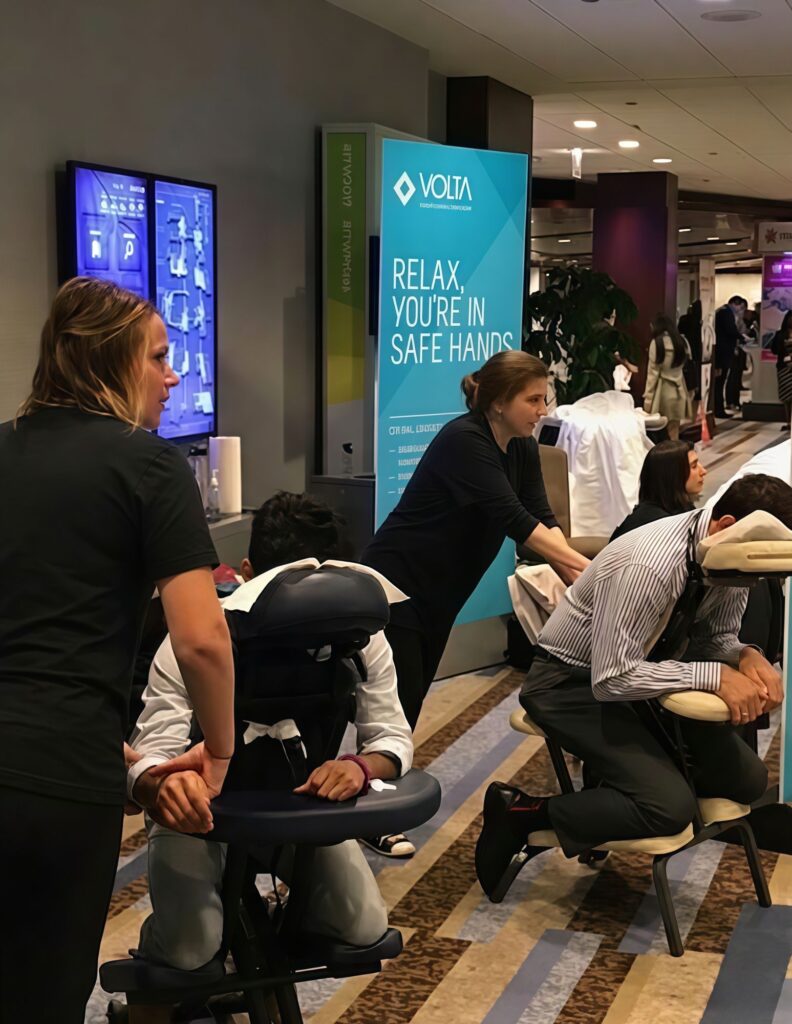
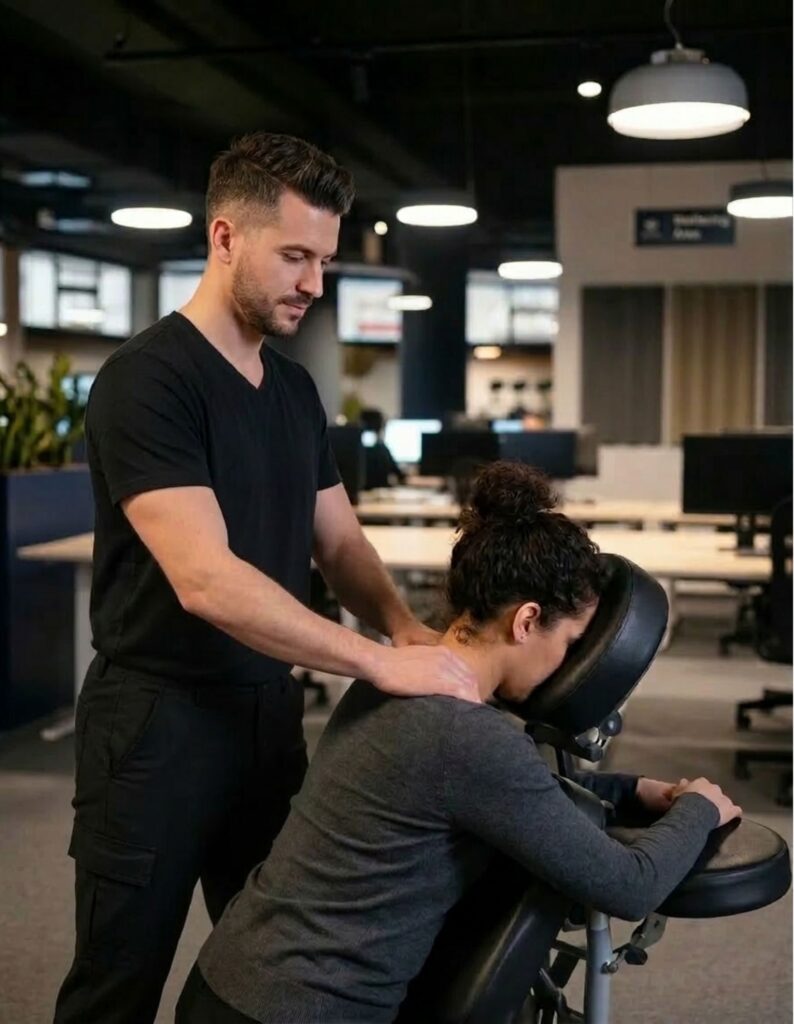
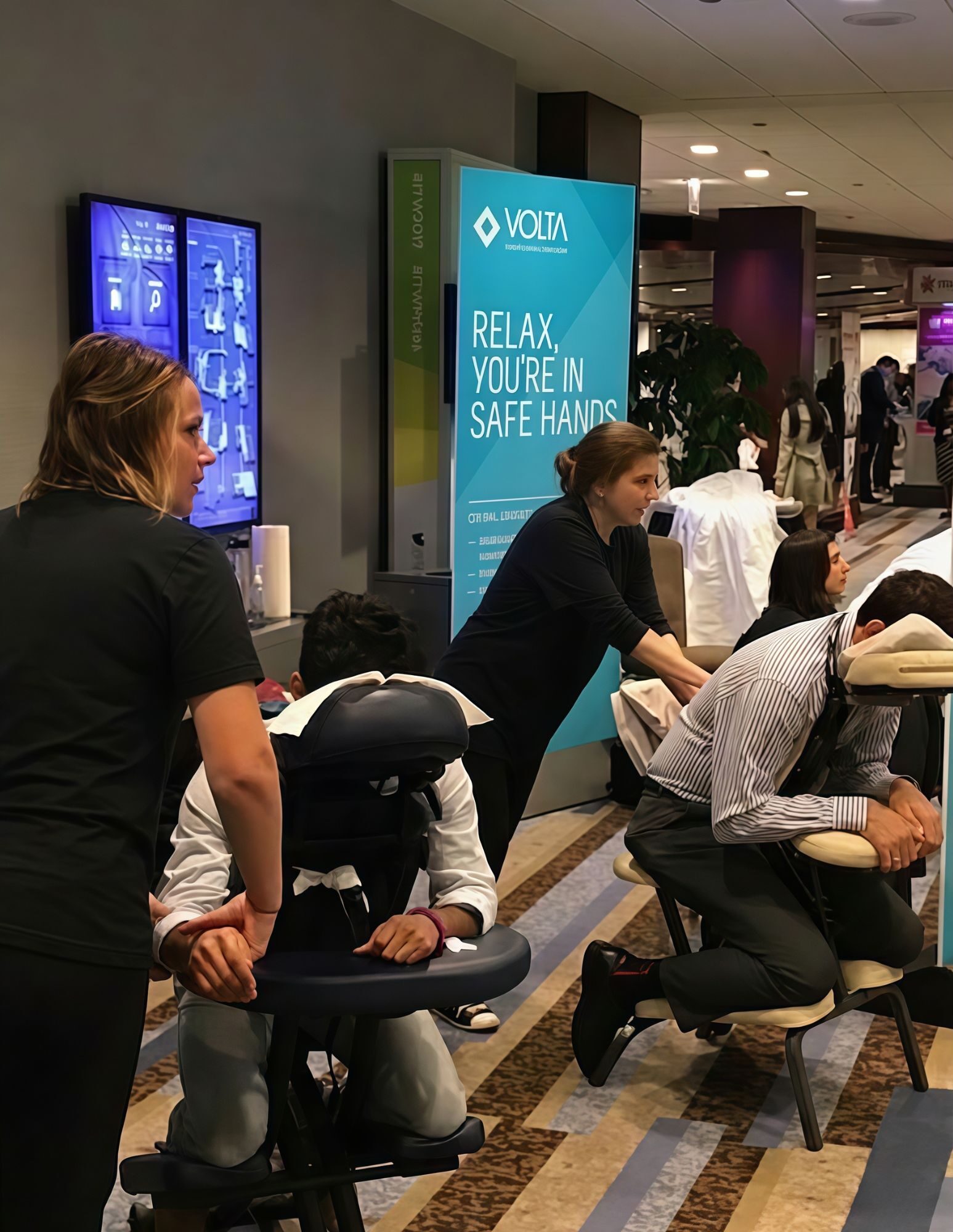
Most corporate massage programs are designed for ease of delivery. The therapist arrives with a portable chair, sets up in an open space or meeting room, staff sign up for 15-minute slots, and the day runs through without much coordination required. For the majority of participants, this is a smooth and welcome experience.
For some employees, however, the default setup creates friction that is significant enough to prevent participation entirely. Employees with sensory sensitivities may find the open environment, unexpected physical contact, or lack of clear procedural information enough to opt out — not because they do not want the benefit, but because the format does not accommodate how they process the world.
Similarly, different generations bring different comfort levels and expectations. An older employee with a chronic condition needs different pressure and communication than a 24-year-old joining a team wellness activity for the first time. A Gen X worker managing caregiver stress wants a consistent, contained experience. A Gen Z employee might not care at all about privacy but will disengage from a program that feels generic or imposed.
The gap between a program that is “available” and one that is genuinely accessible is usually not about resources. It is about how the program is structured and communicated before the therapist even arrives.
Adapting corporate massage for neurodivergent employees
Sensory considerations
The most common barrier for neurodivergent employees, particularly those on the autism spectrum or with sensory processing differences, is uncertainty about what the physical experience will involve. Chair massage, by its nature, involves direct physical contact, proximity, and a sequence of techniques that vary in pressure and location.
Three adjustments address the majority of sensory concerns without requiring any special equipment or significant operational change:
Offer explicit pressure options. Rather than asking “what pressure do you prefer?” at the start of the session, list the options clearly in the booking process: light, medium, or firm. This allows the employee to make their choice in advance, without having to negotiate in the moment.
Describe the sequence before starting. A brief verbal or written walkthrough of the session structure – “I will start at your shoulders, move to your upper back, and finish at your neck and scalp unless you prefer to skip that” – removes uncertainty for employees who find unexpected transitions difficult. This takes under 30 seconds and benefits all participants.
Offer a private or lower-stimulus setup option. Not every employee needs this, but for those who do, access to a quieter space or a corner screened from foot traffic makes the difference between participating and not. In most offices, this is already available in the form of a small meeting room or a phone booth.
Communication and consent
A pre-session preference form is the single most effective tool for making a corporate massage program inclusive of neurodivergent staff. It does not need to be long. Three to four questions — preferred pressure level, any areas to avoid, whether the employee prefers silence or light conversation during the session, and whether there are any sensory sensitivities the therapist should know about – give the therapist everything needed to adapt without requiring the employee to advocate for themselves in real time.
Opt-in design is equally important. For employees who find it difficult to say no in social or professional contexts, an opt-out model, where participation is assumed unless the employee declines, creates pressure rather than opportunity. An explicit opt-in means the employee’s presence reflects genuine choice.
The Australian Disability Network’s guidance on sensory sensitivity and the working environment provides a useful framework for understanding the range of sensory differences employees may experience and the low-cost environmental adjustments that support them.
Adapting for a multi-generational workforce
Generation Z and Millennials (born 1981–2012)
According to 2025 data compiled by VantageFit, approximately 83 per cent of Gen Z employees report that burnout affects them at work, and 42 per cent report a mental health diagnosis before their mid-20s. For Millennials, nearly one third are affected by behavioural health conditions. Both groups consistently prioritise mental health support, stress relief, and holistic wellbeing as workplace benefits.
For these employees, desk massage and chair massage land well as immediate, tangible stress relief, particularly when framed as a team wellness activity rather than a medical or remedial intervention. Shorter 10 to 15 minute sessions with a clear, low-friction sign-up process tend to see the highest participation from this group.
These generations are generally comfortable with open-plan setups and are less likely to require private spaces. They respond better to programs with digital booking, short lead times, and minimal administrative friction. They are also the group most likely to share feedback on the program through team channels, so a poor experience will circulate quickly.
Generation X (born 1965–1980)
Generation X sits in a particularly high-stress position in most workplaces. More than 30 per cent of Gen X workers are simultaneously managing caregiving responsibilities for aging parents while raising children of their own. They tend to carry higher accumulated musculoskeletal load from years of desk work, and they are often in management roles that add cognitive and emotional pressure on top of physical stress.
For this group, the most effective design approach is consistency and clarity. Gen X workers respond well to a reliable schedule – a regular visit on the same day each month, with pre-bookable slots, and to a clear explanation of what the session will involve. The 1-on-1 format of seated chair massage suits Gen X well: it provides the individual attention and predictability they value, without the group dynamics of a class-based wellness activity.
Baby Boomers (born 1946–1964)
Employees in this age group bring decades of accumulated physical load to the workplace. Around 93 per cent of adults aged 65 and over live with at least one chronic condition, and workers over 55 are projected to make up roughly 25 per cent of the workforce in high-income countries by 2030, according to Bain & Company.
For Baby Boomers, the priority is physical care delivered with genuine expertise and clear communication. Light to medium pressure is often more appropriate than the deeper techniques some younger employees prefer. A brief verbal check-in at the start of the session, asking about any areas of concern or recent injuries, signals that the therapist is working attentively rather than running through a routine.
This group also tends to appreciate face-to-face information about the program. An email sign-up link may see lower uptake than a direct invitation from a manager or colleague. Once they have experienced a session, repeat participation is typically high.
Designing a flexible program: what this looks like in practice
Adapting a corporate massage program for a neurodiverse and multi-generational workforce does not require running five separate programs. It requires building one program with enough flexibility to serve a wide range of participants well.
Three structural elements cover most of the adaptation needed:
A short pre-session preference form. Sent with the booking confirmation, this takes under two minutes to complete and gives the therapist the information needed to personalise each session. Pressure preference, areas to avoid, and communication style are the three most important fields. This single change has the largest impact on neurodivergent participation.
A choice of setup environments. Offering both an open-plan setup and a private room option, even if only one of each is available, allows employees to self-select the environment that suits them. Most employees will choose the open setup. The private option exists for those who need it, without drawing attention to the distinction.
Therapists briefed on diversity and sensory considerations. The adjustment that most affects quality of experience is the therapist’s awareness going in. A therapist who has been briefed on the range of participants — including potential sensory sensitivities, preferences for silence, and varying physical needs — will handle session-to-session variation more smoothly and consistently.
For organisations running workplace massage across multiple sites, including satellite offices, coworking locations, or hybrid team setups, the same flexible structure applies at each location. For larger events or team days requiring higher throughput, the event massage format can bring multiple therapists to one location, running parallel setups adapted for the same range of participant needs.
Why inclusive design produces better outcomes for everyone
There is a practical case for designing a corporate massage program with diversity in mind that goes beyond inclusion for its own sake.
Participation rates are the clearest indicator. A program that a significant portion of the workforce cannot comfortably access will see lower sign-up rates, more no-shows, and less consistent engagement. Those outcomes reduce the program’s visibility to management and its perceived value as a benefit. A program that employees of different generations and cognitive profiles can each access on their own terms will see consistently higher uptake.
The ACU research published in Employee Relations in 2024 found that neurodiversity-aware policies are positively associated with employee retention and emotional commitment to the organization, and that the positive effects extend across all staff, not just those who are neurodivergent. Designing inclusively lifts the program for the whole team.
For older workers specifically, the stakes are significant. With workers aged 55 and over projected to represent around a quarter of the workforce in high-income countries by 2030, a corporate wellness program that does not account for the physical and communication needs of older employees is already behind.
The most effective corporate massage programs are not the most elaborate ones. They are the ones with the highest actual participation, delivered consistently, by therapists who understand the range of people they are working with.
Book a corporate massage program built around your team
Corporate Care Therapies delivers corporate massage programs nationwide, including Melbourne, Sydney, Brisbane, Perth, Adelaide, Gold Coast, and regional areas across Australia, with therapists briefed on diversity, sensory considerations, and generational preferences. Whether your team is 10 people or 500, across one site or several, the program is designed around your workforce, not the other way around.
Visit our corporate programs page for full service details, or get in touch to discuss how to structure a session for your specific team.