Hybrid working has become the stable new normal for Melbourne offices. According to research from the University of Sydney’s Institute of Transport and Logistics Studies (October 2024), hybrid workers now make up approximately 42% of the Australian workforce – up from 37% just six months earlier. The most common arrangement, reported by 32% of Australian employers in AHRI’s 2025 research, is three office days per week.
For HR managers and team leaders in Melbourne, this shift creates a specific and underappreciated challenge: most workplace wellbeing programs were designed for a five-day-a-week office world. A fixed Wednesday massage booking makes sense when the whole team is always in. It makes much less sense when half your people are working from home that day.
Flexible corporate wellness programs have adapted to meet this reality. Workplace massage Melbourne services can now be scheduled around your team’s actual anchor days – the specific days each week when most of your people are on site – so the benefit lands where your team actually is.
The hybrid shift has changed what “office days” mean in Melbourne
Melbourne’s CBD office market tells the story clearly. JLL research from the fourth quarter of 2024 found that approximately 40% of the city’s top 100 office occupiers have policies that fall short of 2.5 office days per week, and only 3% publicly expect full-time attendance. CBD vacancy is approaching 20% – not because companies are leaving, but because the same organisations now need less floor space for fewer people on any given day.
This is not a transitional moment. Hybrid work patterns in Australia have, in AHRI’s own words, “remained steady since 2023.” Tuesday, Wednesday and Thursday have emerged as the dominant in-office days for most knowledge workers, with Monday and Friday becoming largely work-from-home by default.
The practical consequence for workplace wellness: a benefit that runs on a fixed weekly schedule will miss a significant proportion of your team every time it runs. A workplace massage Melbourne program that is built around your actual attendance pattern – your anchor days – doesn’t have that problem.
Why hybrid workers in Melbourne carry more physical tension, not less
There is a common assumption that working from home is physically easier than commuting to an office. For many employees, the opposite is true.
Home workstations frequently lack the ergonomic design found in properly fitted corporate offices. Improvised seating, laptop-only setups without external monitors, and dining tables used as desks all create postural loads that accumulate over time. According to Safe Work Australia, body stressing – which includes the musculoskeletal strain that comes from sustained poor posture – is the leading mechanism behind serious workers’ compensation claims, accounting for 32.7% of all serious claims in 2022-23.
Beyond the physical, the psychological load on hybrid workers is significant. Allianz Australia’s 2026 research – based on a YouGov survey of over 1,500 employees and managers – found that psychological workers’ compensation claims increased by a relative 17.3% between 2024 and 2025, with 42.3% of those claims caused by mental stress and work pressure. Meanwhile, 74% of workers said their organisation lacked a clear strategy to reduce burnout.
PwC research cited in the hybrid WHS literature found that 42% of hybrid workers report regular loneliness and isolation, and 31% report heightened stress or burnout. These are not abstract concerns: they translate directly into the musculoskeletal and psychological tension that a workplace massage program is specifically designed to address.
When employees come into the office on anchor days, they often arrive carrying several days of accumulated home-desk tension. That context makes the office day – and the wellness intervention offered on it – more important, not less.
What a flexible workplace massage Melbourne program actually looks like
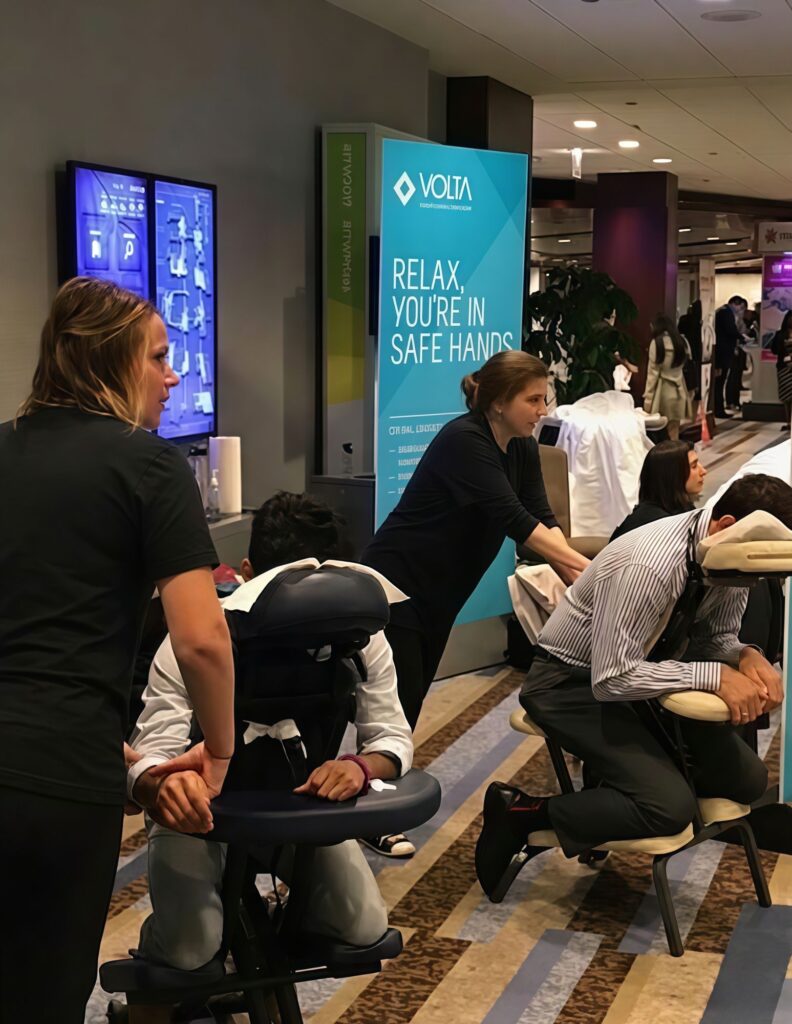
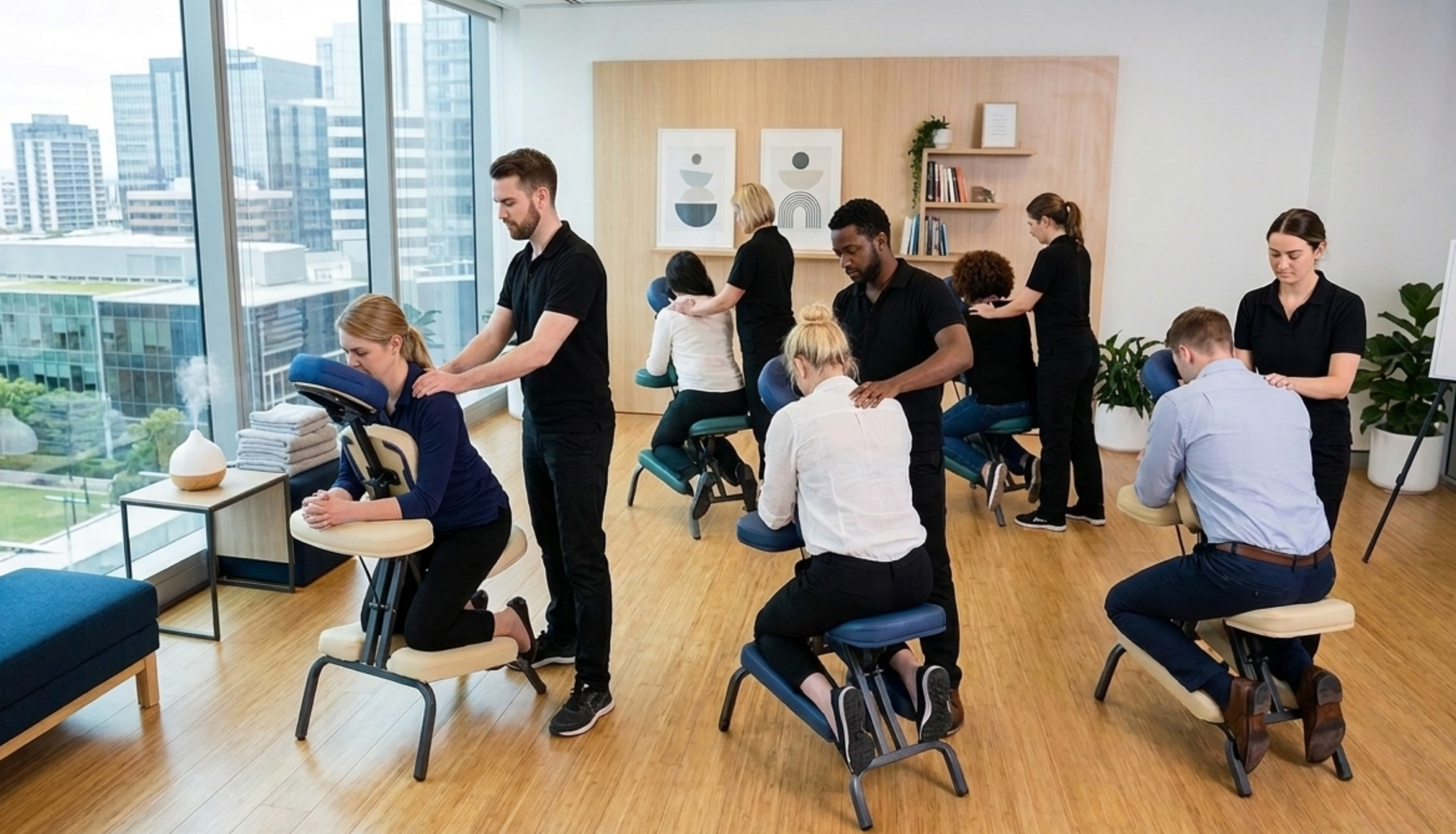
The format itself is straightforward. A qualified therapist arrives at your Melbourne workplace on a pre-agreed schedule, sets up a portable massage chair in a clear space – a breakout room, a meeting room, a quiet corner of the floor – and delivers back-to-back 15-minute sessions throughout the day.
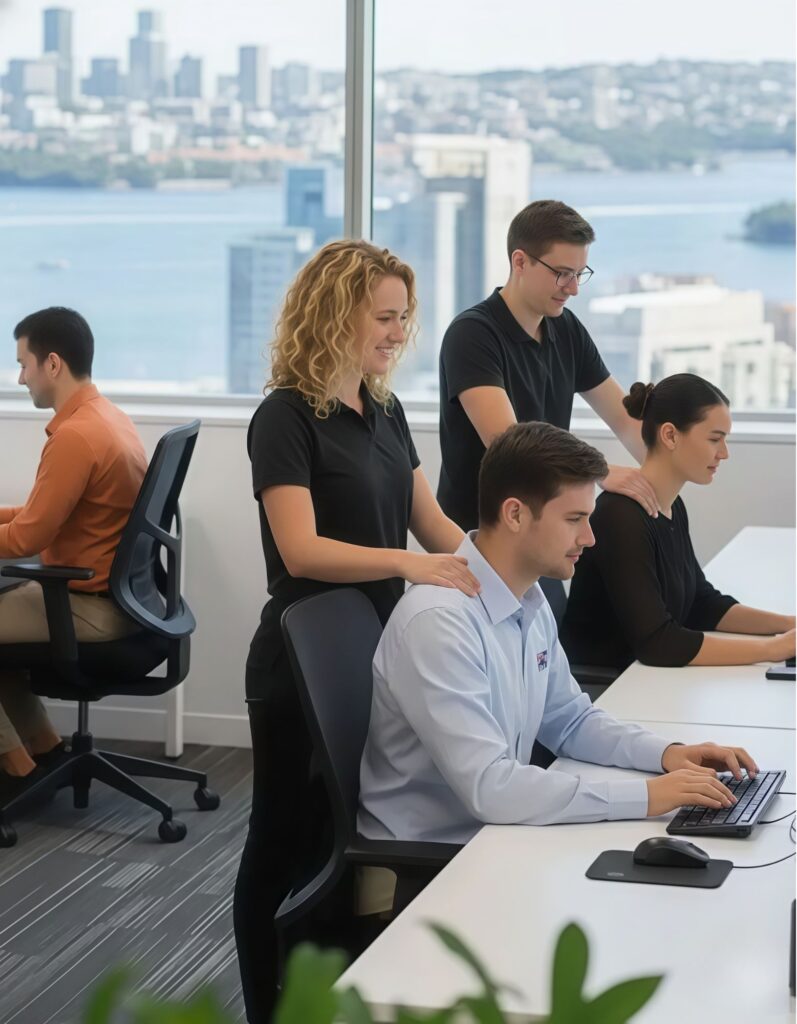
Employees book a slot via a simple sign-up sheet or digital booking link. They sit fully clothed in the chair, the therapist works across the upper back, neck, shoulders and forearms, and the employee returns to their desk without needing to change or clean up. The entire interaction, including setup and handover between employees, takes no more than 20 minutes per person. For a team of 12, that’s a half-day booking that covers everyone.
The key difference in a hybrid-designed program is scheduling flexibility. Rather than committing to a fixed recurring day that may or may not align with your team’s changing roster, Corporate Care Therapies builds the schedule around when your people are actually in. If your anchor days shift – a project crunch pulls everyone in on a Monday, or school holidays thin out your Thursday team – the booking adjusts.
Session format options
The standard format is desk massage – a 15-minute seated chair massage per employee, delivered at a workstation or in a designated quiet space. For larger teams or wellness events, sessions can extend to 20 or 30 minutes. A seated chair massage setup requires no specialist room: a standard meeting room or any clear floor space is sufficient.
Booking around anchor days
Gallup research consistently shows Tuesday, Wednesday and Thursday as the most common in-office days for hybrid knowledge workers. If your Melbourne team follows this pattern, a Wednesday booking reliably catches the highest proportion of your people. But if your team’s anchor days are different – or rotate by fortnight – the booking can move with them. The program fits around your calendar, not the other way around.
Frequency options for hybrid teams
Monthly visits are the most common starting point for hybrid teams. Fortnightly works well for larger organisations or high-stress periods such as end of quarter or launch weeks. Quarterly bookings suit smaller teams or those using massage as part of a broader event massage package tied to team days or all-hands meetings. None of these require a lock-in contract: most Melbourne teams start with a single session, assess the response, and build from there.
The business case: why Melbourne HR teams are adding massage to hybrid benefit packages
Australian organisations are projected to invest AUD $36.2 billion in wellbeing and culture initiatives in 2026, according to Allianz’s research. That scale of investment reflects a clear recognition: employee wellbeing is no longer a discretionary benefit, it is a retention and productivity input.
For HR teams managing hybrid rosters, workplace massage offers a specific advantage that most digital wellness tools do not: it is tangible and visible. Employees experience it directly, feel the result immediately, and remember that the organisation provided it. That visceral quality matters in a hybrid context where employees may only be in the office two or three days a week and the cultural touchpoints that build belonging are fewer.
AHRI’s 2025 research found that 57% of Australian employers identified “disconnection between colleagues” as the primary disadvantage of hybrid working. An in-office wellness day – where employees book adjacent time slots, wait together and debrief informally afterward – creates exactly the kind of low-stakes social interaction that builds connection without requiring a structured team-building exercise.
The retention data is also relevant. Stanford University’s Trip.com study of 1,612 employees found that hybrid working reduced employee turnover by 33% compared to full-time in-office arrangements. A visible, well-regarded benefit like workplace massage signals to employees that the organisation is investing in their experience on the days they come in – reinforcing the value of those days rather than making them feel obligatory.
For context: 41% of Australian employers in the AHRI 2025 report said hybrid working had enhanced employee health and wellbeing. The qualifier is important – that outcome was associated with hybrid arrangements that came with adequate support. Workplace massage is one component of that support framework.
How to structure a workplace massage Melbourne program for a hybrid roster
Setting up a flexible massage program for a hybrid team does not require a long lead time or a large budget. The following four-step approach covers most Melbourne team configurations.
Step 1: map your team’s anchor days
Before booking anything, confirm which days see the highest in-office attendance for your team. For most Melbourne hybrid offices, this is Tuesday through Thursday. If your team has a specific cadence – full team in on the first and third Wednesday of the month, for example – note that pattern. The goal is to align the massage booking with the day that will reach the most people without requiring anyone to come in specially for it.
Step 2: decide on session frequency
Monthly is the most practical starting point: frequent enough to build a habit and generate genuine anticipation, infrequent enough to fit comfortably into most workplace budgets. Fortnightly works well for teams under sustained pressure. Quarterly bookings can be anchored to existing company events: end-of-quarter reviews, all-hands days, or team planning sessions – using the massage as a draw that encourages attendance on days that might otherwise see low turnout.
Step 3: choose your on-site setup
Two formats work in most Melbourne offices. The first is a roaming setup: the therapist moves between desks or a designated area of the open-plan floor, working through a sign-up list. This suits smaller teams and open-plan environments. The second is a designated wellness room: a booked meeting room where employees come to the therapist rather than the therapist coming to them. This is quieter, more private, and preferred in environments where employees are sensitive to receiving treatment in a shared space.
Step 4: use the wellness day as an attendance incentive
This is the strategic move most HR teams underuse. Announcing the massage day one week in advance – via a team Slack channel or calendar invite – reliably increases office attendance on that day. Employees who were planning to work from home will often come in for a confirmed wellness booking. This is a softer and more effective approach to encouraging in-office presence than attendance mandates, which Gallup’s 2026 SAGE analysis found generate resentment without proportional collaboration benefit.
What makes Corporate Care Therapies the right fit for Melbourne hybrid teams
Corporate Care Therapies delivers workplace massage Melbourne services across the CBD and inner suburbs, with a scheduling model built specifically for teams that do not follow a fixed five-day-a-week office pattern.
Bookings are not fixed to a standing weekly slot. If your team’s anchor days shift between quarters, the schedule shifts with them. If you need a single session for a team day rather than a recurring program, that is available too. Therapists are qualified and experienced in corporate on-site delivery, which means the logistics of working in a live office environment – discretion, timing, minimal disruption to the rest of the floor – are handled without needing to be managed by your team.
For Melbourne organisations navigating the practical realities of hybrid work – variable attendance, distributed wellness needs, budget scrutiny on every benefit line – a flexible on-site massage program is one of the more defensible investments on the wellbeing budget. The cost per employee per session is low, the response rate is high, and the benefit is felt immediately on the day it is delivered.
Book a workplace massage Melbourne session for your hybrid team
If you are managing a hybrid team in Melbourne and looking for a wellness benefit that works around your actual roster rather than against it, Corporate Care Therapies can arrange a session on your next anchor day.
Visit our services page to see full service options, or contact us directly to discuss a schedule that fits your team’s hybrid calendar. There is no lock-in contract required, and the first session is a straightforward way to see how your team responds.