Frontline roles rarely involve sitting still. Retail floors, hospital wards, warehouses and emergency response all demand hours of standing, moving and reacting to whatever comes next, often with the public watching and very little downtime built into the shift. Chair massage is one of the few restorative options that actually fits that reality — a genuine seated pause, not another activity layered on top of an already physically demanding day of constant motion.
This article looks at the dual physical and psychological toll frontline work carries, why the usual advice for desk-based teams doesn’t translate well here, and how a restorative session is built around shift patterns rather than competing with them — written for anyone managing a team that’s on its feet, under pressure, or both for most of the working day.
The dual toll of frontline work: physical and psychological
The physical demands most frontline roles share
Standing for long, largely uninterrupted periods is one of the most consistent physical demands across frontline sectors. A Safe Work Australia guidance on prolonged standing found that retail associates, healthcare staff and workers across similar roles who stand for extended periods without the ability to sit face an elevated risk of musculoskeletal pain, along with circulatory strain from the sustained load on the legs and lower back. Unlike a desk-based role, the fix here isn’t more movement — most frontline workers are already moving constantly. The gap is genuine rest.
This distinction matters more than it might first seem. A desk worker’s tension builds from staying still too long; a frontline worker’s tension builds from never stopping. Advice designed for one group rarely transfers cleanly to the other, which is part of why generic workplace wellness programs often land poorly with retail, healthcare and warehouse teams — the underlying problem simply isn’t the same one.
The psychological intensity of public-facing, high-pressure roles
The mental load is just as real. A study of Australian police officers published in the Journal of Police and Criminal Psychology found that, regardless of shift pattern, a majority of officers reported stress (70 percent) and burnout (60 percent) ranging from moderate to extremely high. Policing carries its own specific pressures, but the underlying pattern — sustained public-facing intensity with limited recovery time — echoes across many frontline sectors, from healthcare to emergency response to high-volume retail and hospitality.
None of this is to suggest every frontline role carries an identical burden — a retail shift and an emergency response shift are not the same job. What they tend to share is the absence of a genuine pause: constant visibility to the public or to patients, decisions made on the spot, and very little built-in time to simply stop and recover before the next demand arrives.
Why frontline roles need a different kind of restorative break
Most workplace wellness advice is written with desk-based roles in mind — take a stretch break, get up and move every 30 minutes. That guidance simply doesn’t apply to someone who’s been standing and moving for their entire shift already. What a frontline worker is missing isn’t activity; it’s the chance to sit down, stop moving, and let their nervous system settle for a few minutes without needing to watch a floor, a ward or a queue at the same time.
This is why so many standard wellness initiatives — step challenges, group fitness sessions, standing desks — land oddly with frontline teams. They’re solving for the wrong problem entirely. A retail associate on their feet for an eight-hour shift doesn’t need encouragement to move more; they need a legitimate reason and a legitimate space to stop, even briefly.
Chair massage offers exactly that — genuine stillness, not a different kind of activity. For a role built around near-constant motion and vigilance, a short seated session is a meaningfully different kind of break to a coffee run or a walk outside, both of which still involve being upright, alert and often still watching the clock.
What makes chair massage particularly suited to frontline teams
A genuine seated rest, not just a different activity
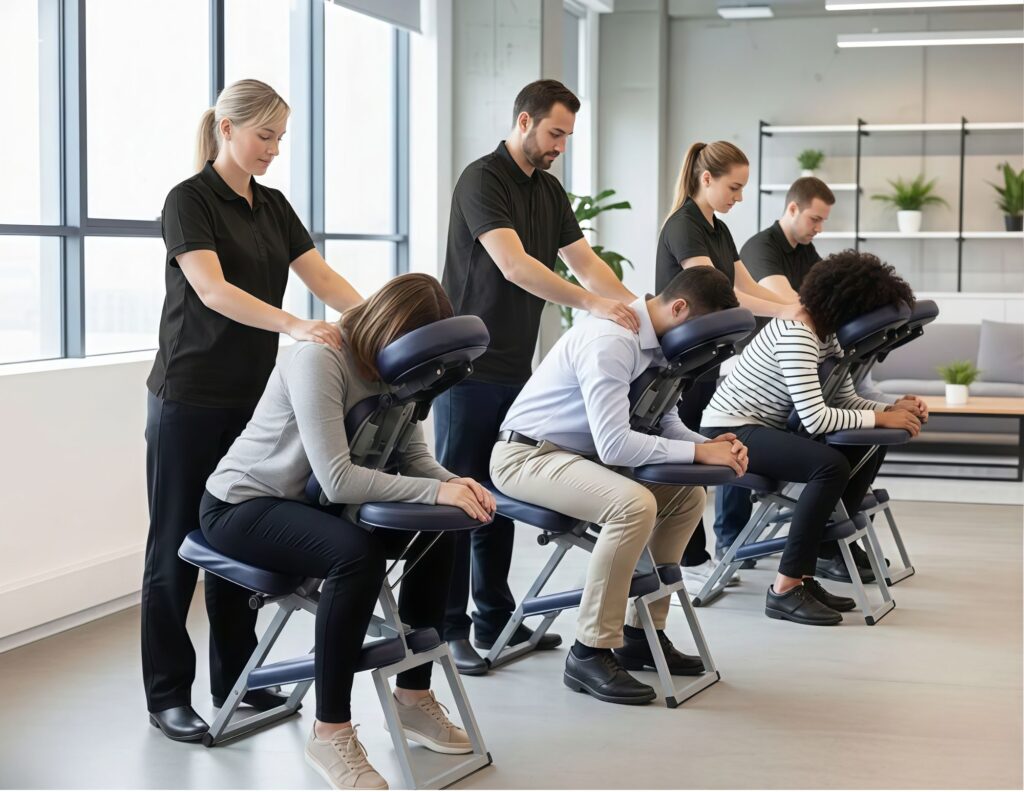
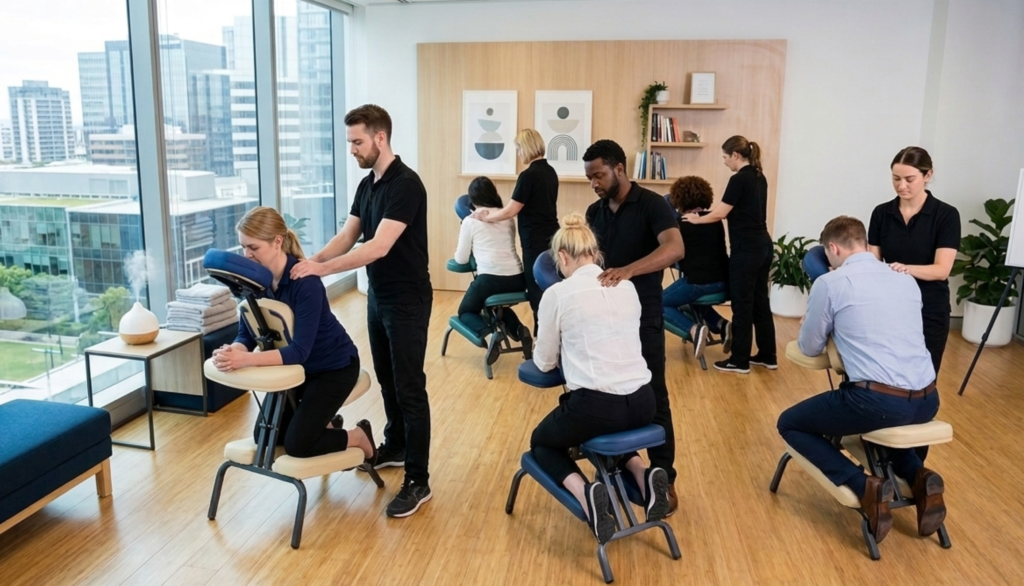
Because the session itself requires sitting still, fully clothed, in a specially designed ergonomic chair, it forces a complete pause that’s otherwise hard to build into a frontline shift. Ten minutes off your feet, with focused physical relief on top, does more for recovery than the same ten minutes spent standing in a break room.
Fits around shift-based rostering, not fixed desk schedules
Frontline teams rarely share a single lunch hour the way an office does — shifts overlap, rosters rotate, and coverage requirements don’t pause for a scheduled break. Sessions can be run in short rotations across a shift change or a quieter period, so each person gets a turn without the floor, ward or counter ever being left short-staffed.
This flexibility is often the deciding factor for whether a wellness initiative actually gets used on a frontline team. A program that assumes everyone is free at the same time simply doesn’t work for rotating rosters, split shifts and 24-hour coverage — which is exactly the gap a mobile, rotation-based format is designed to close, without needing a single person to leave their post unattended.
No equipment or special space required
A corner of a staff room, a quiet spot behind a retail floor, or a break area near a ward is enough — no changing rooms, no oils, and no disruption to the physical layout of a workplace that’s often already tightly used. This matters more for frontline environments than office settings, where space is frequently at a premium and every square metre is already accounted for.
It also means a program can be trialled quickly and easily, without a facilities review or a capital purchase. A single chair and a therapist is the entire footprint required, which lowers the barrier to getting a first session booked considerably compared with wellness initiatives that need a dedicated room or ongoing equipment.
What a restorative chair massage session looks like for frontline teams
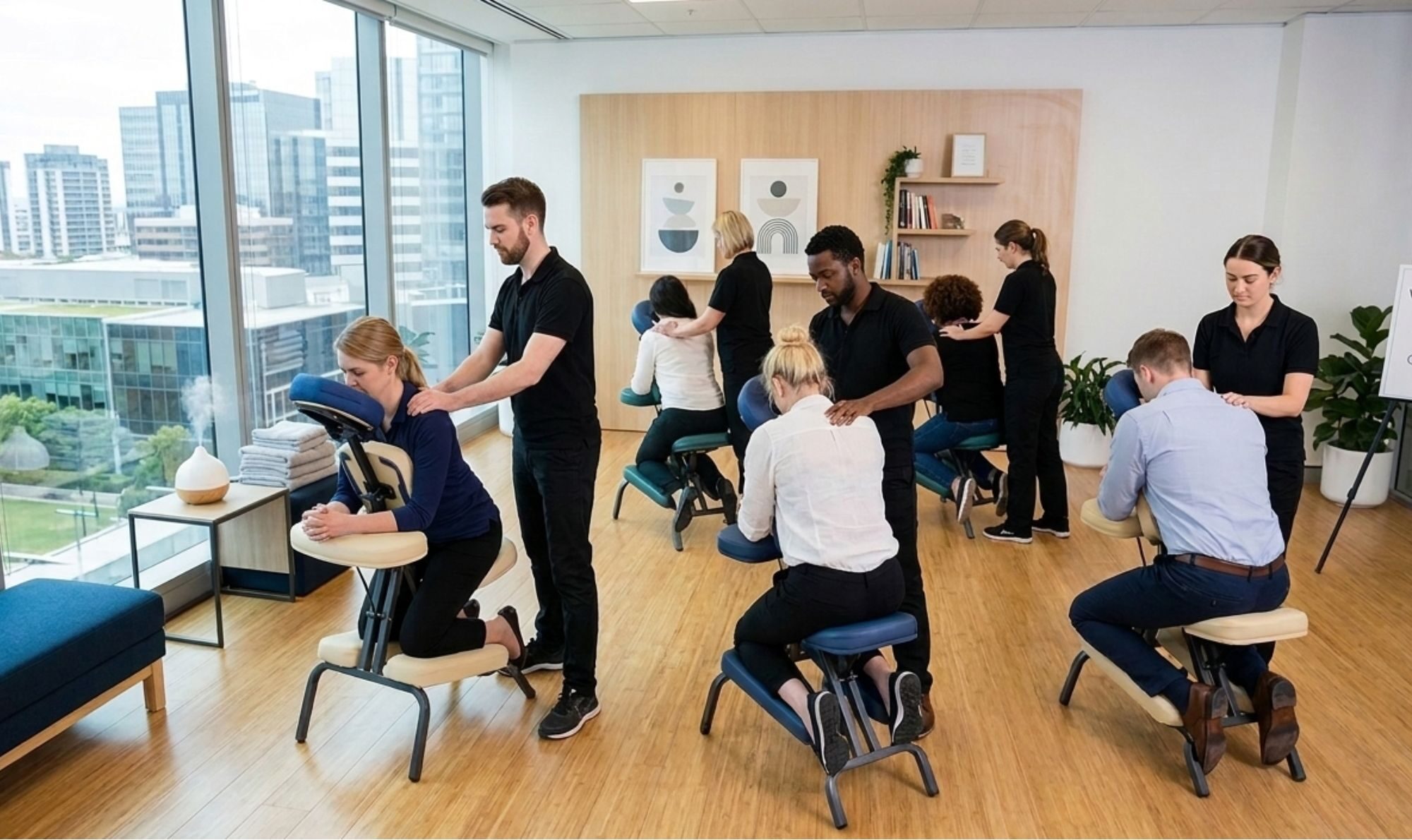
Most programs use a seated chair massage format delivered in 10 to 15 minute rotations, timed around shift handovers or rostered breaks so coverage is never compromised. A therapist can move through a team across a single visit, working through the neck, shoulders and back — the areas carrying the most tension from a combination of standing, lifting and sustained physical alertness.
For larger sites — a big-box retail floor, a hospital department, a distribution centre — sessions are often staggered across the day rather than run in one block, so the program can reach a full roster of staff working different shifts without needing everyone present at the same time.
Building this into a recurring support program
A single session provides welcome relief, but frontline intensity doesn’t let up after one good week — it’s built into the nature of the role. Folding a chair massage program into a broader corporate wellness program, on a fortnightly or monthly cadence, keeps pace with a level of physical and psychological demand that doesn’t meaningfully change from one shift to the next.
For sectors with genuinely high turnover and hard-to-fill rosters — retail, hospitality, aged care and similar frontline industries — a visible, recurring program also signals something to staff beyond the immediate physical relief: that the demands of the role are recognized, rather than simply expected as the cost of the job.
How Corporate Care Therapies supports frontline teams
Corporate Care Therapies has delivered chair massage to Australian frontline teams for over 20 years, with accredited therapists experienced in working around shift patterns, rostered breaks and limited on-site space. Programs can be booked once-off or as a recurring arrangement scaled to a retail floor, ward, warehouse or depot, with therapists able to work quietly around an active site without disrupting the flow of a shift. Further context on how Australian workplaces are approaching staff wellbeing is available in Massage at Work: why Australian businesses are prioritising workplace wellness in 2026.
Summary
Frontline work carries a physical and psychological load that most standard wellness advice doesn’t account for — the issue isn’t a lack of movement, it’s a lack of genuine rest. Chair massage offers exactly that: a short, seated pause that fits around shift patterns rather than competing with them, addressing the specific tension that standing, lifting and sustained public-facing pressure create. Run on a regular schedule rather than as a one-off, it gives frontline teams a form of recovery their roles rarely otherwise allow for.
For managers weighing up wellness options for a team that’s rarely at a desk, this distinction is worth keeping front of mind: the goal isn’t to add more activity to an already active day, but to build in a moment where staff are genuinely permitted to stop.
Ready to support your frontline team with restorative chair massage? Contact Corporate Care Therapies to set up a program built around your shift patterns and roster, wherever your team is based.