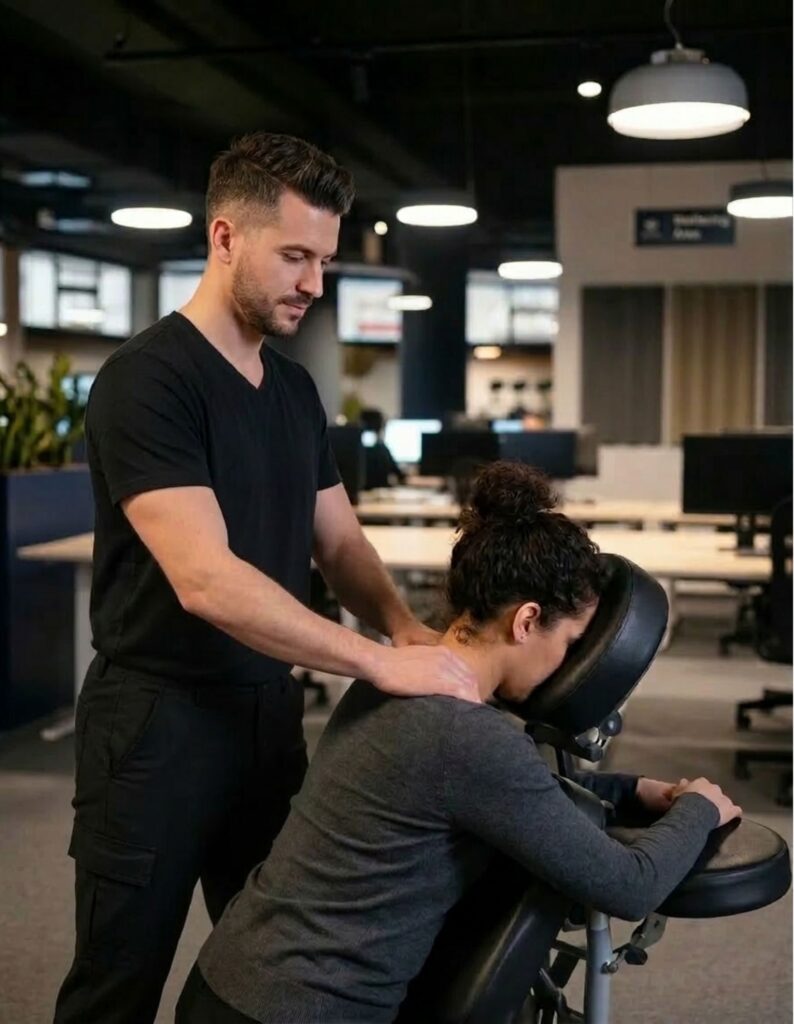
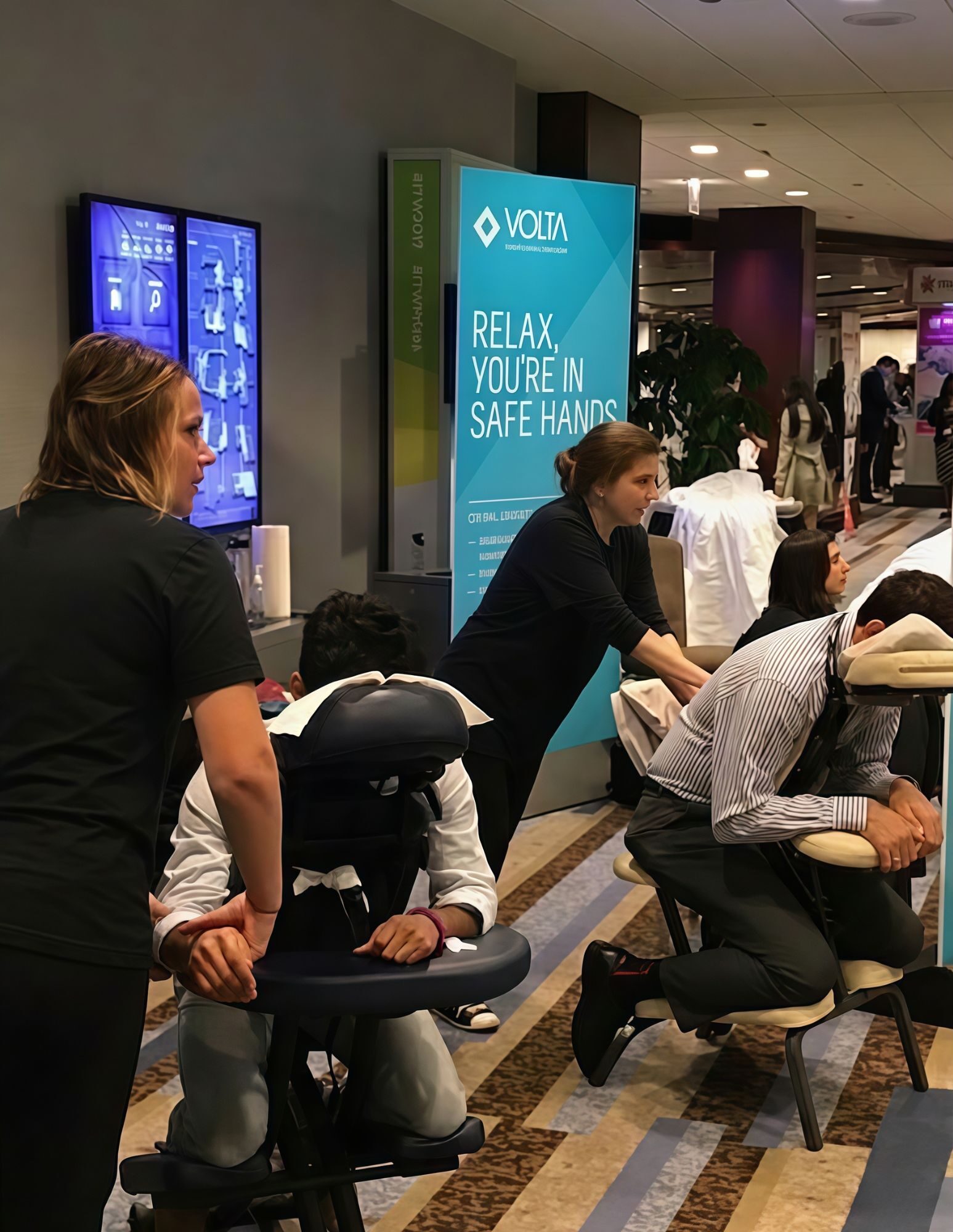
Corporate massage services bring a qualified massage therapist to your office, where they work through a roster of staff sessions during the day. No spa trip. No pre-booking by individual employees. Just a therapist, a portable chair, and a schedule — done in the time it takes the team to have a coffee break.
The concept is simple, but the Australian market now has dozens of providers ranging from solo therapists operating out of a single suburb to national networks covering Melbourne, Sydney, Brisbane, Perth, and Adelaide. Before you sign anything, it pays to understand exactly what you are getting — and what questions separate a professional provider from one that will let you down on the day.
This article covers what corporate massage services typically include, the different formats available, what credentials to look for, and the six questions every HR manager should ask before booking.
Why Australian businesses are investing in corporate massage services right now
Employee stress is not a soft issue. According to Gallup’s State of the Global Workplace: 2026 Report, only 21% of Australian employees are engaged at work in 2025 — and disengagement is estimated to cost Australian businesses over $220 billion AUD annually in lost productivity (Gallup, 2026; data collected Jan–Dec 2025).
Stress compounds the problem. Research by Safe Work Australia and industry benchmarks indicate that workplace stress and mental ill-health cost Australian employers more than $14 billion annually through stress-related presenteeism and absenteeism, with employees taking an average of 9 to 14 unplanned absence days per year. While these figures account for recent psychosocial legislation changes, independent researchers and industry groups consider them a conservative benchmark that remains directionally accurate.
In this article, onsite corporate massage services have moved from a ‘nice to have’ into a visible, recurring line item in wellbeing budgets. They are fast, measurable, and require minimal disruption to the working day.
What corporate massage services actually include
The term ‘corporate massage services’ covers several distinct service types. Providers use different terminology, so it is worth confirming the exact format before booking.
Chair massage
The most common format. The employee sits in a specially designed portable massage chair – fully clothed – while the therapist works on the neck, shoulders, upper back, and arms. Sessions typically run 10 to 20 minutes per person. No oils, no undressing, no dedicated room required.
Desk massage
A variation where the therapist works at the employee’s own workstation rather than a dedicated chair. Useful in tight spaces or open-plan offices where setting up a separate area is impractical. Sessions are usually shorter, around 10 to 15 minutes.
Event massage
A one-off booking for a company event, conference, product launch, or team day. Providers typically quote by the hour per therapist, with a minimum booking period. This is distinct from a recurring workplace program.
Recurring workplace program
A scheduled, ongoing arrangement – weekly, fortnightly, or monthly – where the same provider sends therapists to your office on a set day. Most providers offer a modest discount for recurring bookings compared to ad hoc rates.
What is and isn’t included in a standard booking
Inclusions vary by provider, but a professional corporate massage service will generally cover the following as standard:
- A qualified therapist with a minimum of Certificate IV in Massage Therapy
- All equipment: portable massage chair, face rest, clean linens
- Scheduling and rostering of employee sessions on the day
- Public liability and professional indemnity insurance
- Travel to your premises (check if metro and regional visits attract a surcharge)
What is typically not included in a base rate:
- Aromatherapy oils, hot stones, or other add-on treatments unless specifically quoted
- Staff coordination beyond a basic schedule – some providers expect HR to manage the roster
- Same-day cancellation cover if an employee fails to show
- Regional or interstate travel beyond a stated radius without a travel fee
Therapist qualifications: what to verify before you book
Massage therapy in Australia is not a licensed profession in the same way medicine or physiotherapy is. That means the burden of verifying credentials sits with the employer doing the booking.
A legitimate corporate massage provider should be able to confirm the following for every therapist they send:
- Certificate IV in Massage Therapy (minimum), issued by a registered training organisation (RTO)
- Current first aid and CPR certification
- Professional indemnity insurance — typically a minimum of $2 million per claim
- Public liability insurance — typically a minimum of $10 million per event
- Current police check
- Registered ABN
Ask any provider to confirm these in writing before you sign a contract. A reputable provider will have this documentation ready. One that cannot produce it promptly warrants caution.
The 6 questions to ask before booking a corporate massage provider
The Australian market has grown quickly, and not every provider operates to the same standard. These six questions will help you filter out underqualified operators before you commit.
1. Can you provide a certificate of currency for insurance?
Ask for a PDF of both professional indemnity and public liability insurance. A certificate of currency from the insurer confirms cover is active – not just claimed. If a provider is reluctant to share this, that is a clear signal to walk away.
2. What qualifications do your therapists hold?
Confirm that every therapist who will attend your premises holds at least a Certificate IV in Massage Therapy from an accredited RTO. Some providers use contractors; ask whether the same standard applies to subcontracted staff.
3. What is your cancellation policy?
Understand the cancellation window – 48 to 72 hours is standard – and whether you are liable for costs if an employee fails to show for their slot. Get this in writing before you book.
4. How do you handle scheduling on the day?
Some providers manage the employee roster themselves; others expect HR to coordinate. Clarify this upfront, especially for larger teams where scheduling can become a half-day task in itself.
5. What is the minimum booking?
Some providers require a minimum of 2 to 3 hours per visit or a minimum number of employees. If your team is smaller or spread across multiple floors, confirm that the provider can accommodate your setup without a surcharge.
6. Do you cover our location, and are there travel fees?
Most national providers cover capital city CBDs without a travel fee. Regional offices, outer suburbs, or interstate visits often attract a travel surcharge. Confirm this in writing before the quote stage.
Provider comparison: what to look for and what to avoid
Use this table as a quick-reference checklist when evaluating corporate massage providers:
Criteria | What to look for | Red flags |
Therapist qualifications | Cert IV in Massage Therapy minimum, plus full indemnity and public liability insurance | No stated qualifications or insurance details on website |
Session format | Chair massage (15–20 min, fully clothed) or desk massage depending on your space | Only offers full-body table massage – impractical for offices |
Minimum booking | Flexible minimums that suit your team size, from small teams of 5 upward | Requires a minimum of 50+ people per visit – unsuitable for SMBs |
Cancellation policy | Written cancellation window of 48–72 hours, clear refund policy | No written policy or vague ‘case by case’ terms |
Insurance & compliance | ABN verified, police check, professional indemnity and public liability | Unable to provide certificates on request |
Pricing transparency | Per-head or per-hour rate quoted upfront in writing | Quotes only given over phone; unwilling to confirm in writing |
How corporate massage services are typically priced in Australia
Pricing varies by city, session length, number of therapists, and whether the booking is ad hoc or recurring. The following ranges are indicative only and should be verified directly with providers, as rates change over time and vary significantly between operators.
- Per-therapist hourly rate: typically $80 to $150 per hour depending on the provider and city
- Per-session (per employee, 15–20 min): some providers quote per head rather than per hour
- Recurring program discount: many providers offer 10 to 15% off standard rates for monthly or fortnightly bookings
- Event massage: often quoted as a minimum 2 to 3-hour block per therapist, with travel included within a metro radius
When comparing quotes, check whether the rate includes GST, whether equipment hire is additional, and whether the quote is for one therapist or a team. A lower headline rate can quickly become more expensive once add-ons are included.
Who provides corporate massage services in Australia
The Australian corporate massage market includes sole traders, small studios, and national networks. Corporate Care Therapies operates across Melbourne, Sydney, Brisbane, Perth, and Adelaide, offering chair massage, event massage, and recurring workplace wellbeing programs for teams of all sizes.
When evaluating any provider, the comparison table above is a practical starting point. The questions in the previous section should form the basis of any first conversation.
Ready to book corporate massage services for your team?
Corporate Care Therapies provides professional onsite massage for Australian workplaces – from one-off events to recurring monthly programs. Our therapists are fully qualified, insured, and experienced in a wide range of office environments.
Explore our chair massage services, event massage hire, or contact us directly to discuss a workplace wellbeing program tailored to your team size and location.