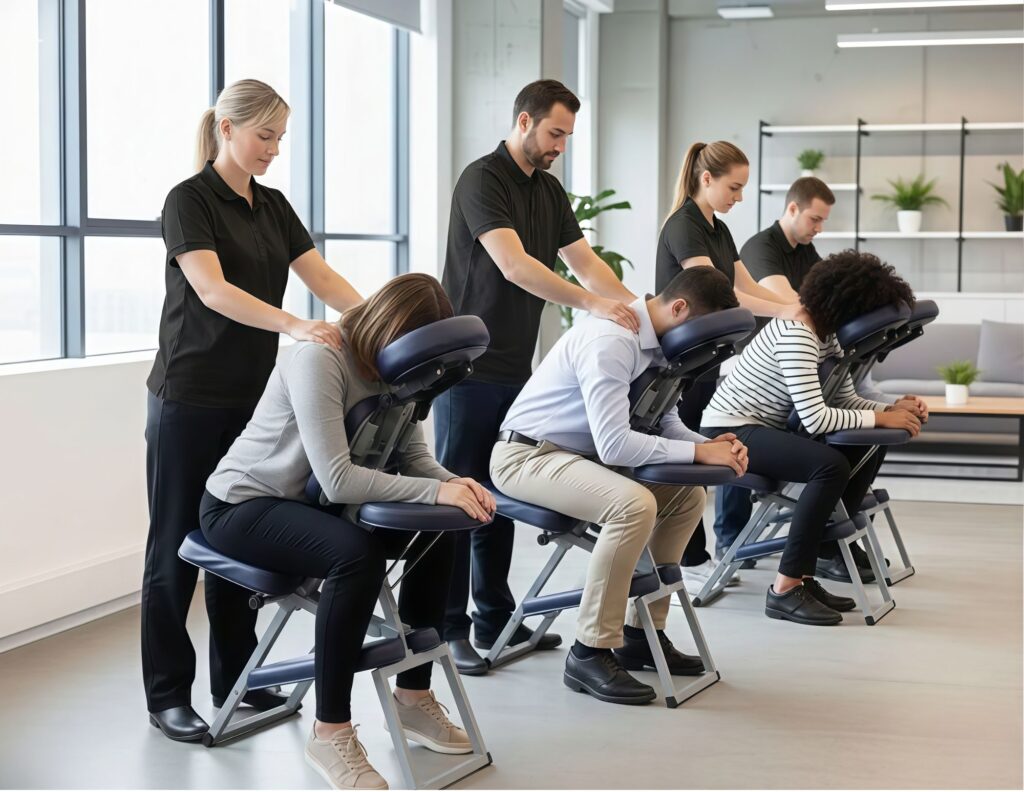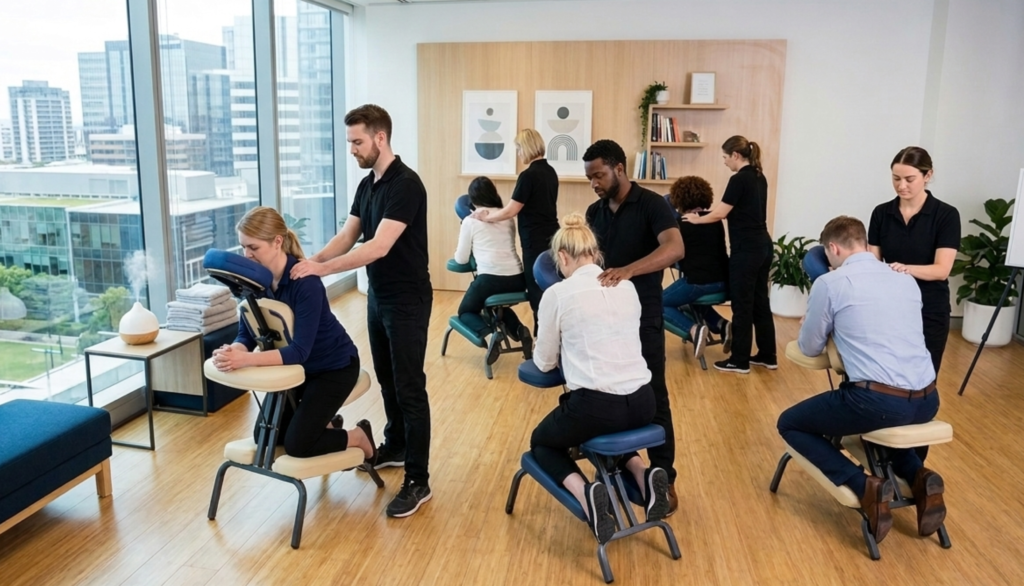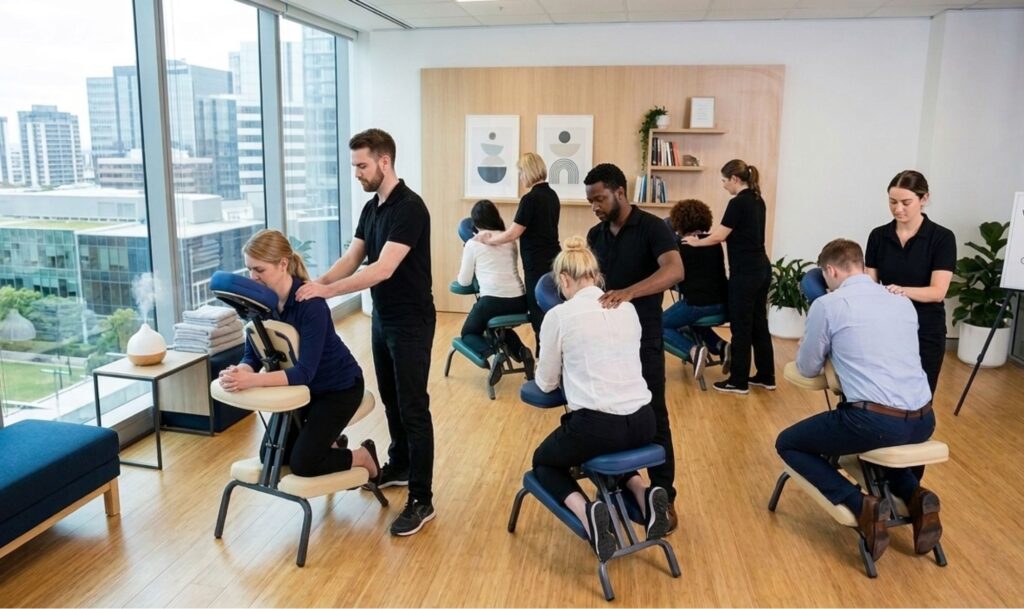

Organising an appreciation day? Discover how to run chair massage for staff across 50, 100, or 200+ attendees covering therapist ratios, room setups, and scheduling.
The Event Planner’s Playbook: How to Scale Chair Massage for Staff at Large Corporate Appreciation Events
How Do You Scale Chair Massage for 50, 100, or 200 Staff in One Day?
Scaling chair massage for staff at corporate events is governed by the Hourly Capacity Rule: one mobile practitioner treats 4 to 5 individuals per hour (10 to 12 minutes hands-on plus a 2-minute buffer for turnover and hygiene).
- For 50 staff: Book 2 therapists for 4 hours (or 1 therapist for a full 8-hour roster) using 12 to 15-minute Book nows.
- For 100 staff: Book 4 therapists for 5 hours operating on express 10-minute treatment rotations.
- For 200+ staff: Deploy 6 to 8 therapists across 5 to 6 hours, dividing attendees into regional “Wellness Lounges” with allocated departmental time slots. To prevent workflow disruption, reservations must be handled via an automated digital booking portal rather than an unmanaged walk-in queue.
The Staff Appreciation Dilemma: High Demand vs Bottleneck Disasters
When People & Culture teams plan corporate milestones—such as End of Financial Year (EOFY) celebrations, R U OK? Day, or Employee Appreciation Week—they frequently default to catered lunches, branded merchandise, or social drinks.
However, workforce expectations across Australia have shifted decisively toward personal wellbeing. Findings from the Gallup State of the Global Workplace Report (2023–2024) reveal that Australian and New Zealand workers continue to report elevated rates of daily workplace stress, with over 60% stating that practical, restorative health benefits directly increase their sense of loyalty toward leadership. Concurrently, statutory guidance published by Safe Work Australia on Managing Psychosocial Hazards at Work confirms that giving workers dedicated pauses to decompress physically is integral to a safe, positive workplace culture.
Because of this, booking professional chair massage for staff appreciation events has become one of the most requested corporate perks. Yet, for an event coordinator, managing high demand presents immediate logistical challenges.
Event Logistics: Unplanned Walk-Ins vs Structured Capacity Planning
| Event Planning Factor | Unplanned Walk-In Model (High Risk) | Structured Capacity Model (Best Practice) |
| Queue Management | Disorganised physical queues form outside rooms | Zero queues; managed via digital calendar bookings |
| Workday Impact | Unscheduled staff absence and meeting disruption | Predictable 10–12 minute dedicated micro-breaks |
| Capacity & Fair Access | First-come, first-served; popular slots vanish early | Equal departmental allocation across all teams |
| Employee Experience | High frustration and FOMO for busy staff members | 100% attendance, measurable gratitude and stress relief |
Without structured capacity modeling, even the most generous wellness initiative can quickly devolve into an administrative bottleneck where assertive team members monopolise time slots while desk-bound colleagues miss out.
The Master Capacity Matrix: Planning for 50, 100, and 200 People
To guarantee seamless scheduling, you must match your attendee numbers with the correct practitioner ratio. A professional chair massage for staff program incorporates a mandatory 2-minute changeover buffer between Book nows, giving the practitioner sufficient time to sanitize equipment and greet the next participant.
Event Planning & Capacity Calculator
| Target Headcount | Recommended Session Length | Turnover Buffer | Total Cycle Time | Therapists Required | Event Duration | Total Operational Output |
| 50 Staff | 12 minutes | 2 minutes | 14–15 mins | 2 therapists | 3.5 to 4 hours | 48–56 completed sessions |
| 100 Staff | 10 minutes | 2 minutes | 12 mins | 4 therapists | 5 to 5.5 hours | 100–110 completed sessions |
| 200 Staff | 10 minutes | 2 minutes | 12 mins | 6 to 7 therapists | 6 hours (Full day) | 180–210 completed sessions |
| 200+ Multi-Site | 10 minutes | 2 minutes | 12 mins | 8 therapists | 5 hours (Split hubs) | 200–220 completed sessions |
Scaling Chair Massage for 50 Staff (Small-to-Mid Corporate Day)
For teams of 50, a 12 to 15-minute hands-on treatment strikes the ideal balance between deep physical relief and scheduling efficiency. Two dedicated therapists can service the entire office across a single morning or afternoon block, requiring only a single converted boardroom or breakout lounge.
Scaling Chair Massage for 100 Staff (Mid-Sized Office Celebration)
Servicing 100 attendees in a single business day demands precise schedule discipline. Express 10-minute sessions are the benchmark here. By running 4 therapists simultaneously, you process 20 staff per hour, allowing your entire headcount to cycle through within a standard 5-hour operational window without disrupting key meetings.
Scaling Chair Massage for 200+ Staff (Enterprise All-Hands / Multi-Floor Summit)
For large enterprise offices across Sydney, Melbourne, Brisbane, or multi-level corporate headquarters, avoid funneling 200 people into one room. Instead, establish two distinct “Wellness Lounges” (e.g., Level 10 and Level 15) staffed by 3 to 4 therapists each. Divide the day into allocated departmental booking blocks (e.g., Finance & Legal from 10:00 AM – 12:00 PM; Sales & Marketing from 1:00 PM – 3:00 PM) to balance corporate foot traffic smoothly.
Spatial, Acoustic, and Traffic Logistics: Creating an Oasis
Even the most qualified practitioners cannot deliver an exceptional experience if their equipment is placed right next to an espresso machine, staff kitchen, or event sound system.
Spatial Footprint & Station Requirements (Per Massage Chair)
| Station Element | Minimum Specification | Purpose & Compliance |
| Dedicated Floor Area | 1.5m x 2.0m (3.0 m²) per chair | Ensures a full 360° working radius for therapist biomechanics |
| Client Entry / Exit Zone | 1.0m clearance in front of station | Allows staff to mount and dismount the seated chair comfortably |
| Hygiene & Sanitisation Table | Compact side caddy or small desk | Holds hospital-grade wipes, hand sanitiser, and fresh cradle covers |
| Acoustic Separation | Minimum 10 metres from noise zones | Shields participants from event PA systems, buffets, and espresso machines |
- Spatial Footprint: Allocate at least 1.5m x 2.0m (3m²) per station. Practitioners need sufficient clearance to step fully around the client to execute acupressure strokes and shoulder blade stretches safely.
- Acoustic Isolation: Position massage zones away from high-noise exhibition floors. If dedicated private meeting rooms are unavailable, utilize freestanding partition walls or acoustic privacy screens paired with soft ambient music.
- Traffic Flow: Establish a clear one-way navigation circuit: an entry doorway with two reception buffer chairs for incoming attendees, and a separate exit path so completed participants do not disrupt incoming sessions.
Scheduling Mechanics: Why “Drop-In” Queues Ruin Large Events
The single most common mistake in corporate event planning is treating massage as an unmanaged “drop-in” attraction.
When walk-ins are permitted:
- A physical bottleneck forms within the first 20 minutes.
- Staff hover awkwardly near the chairs, wasting productive working hours.
- Introverted or busy employees walk away rather than queueing, breeding resentment instead of gratitude.
The Solution: Use an automated digital booking portal. Prior to event day, send out a branded scheduling link. Employees reserve their designated 10 or 15-minute slot in advance, which automatically populates their corporate calendar.
For high-volume gatherings, implement a “3-minute grace policy”: if an attendee fails to arrive within 3 minutes of their start time, their slot is immediately surrendered to an employee on the department waitlist.
Therapist Endurance & High-Turnover Hygiene Management
Delivering repetitive, high-impact seated acupressure is physically demanding. To guarantee that the 100th employee receives the same standard of care as the first, practitioner welfare must be integrated into the schedule:
- Therapist Rest Cycles: Therapists require a mandatory 10 to 15-minute rest interval for every 90 to 120 minutes of continuous hands-on bodywork, plus a 30-minute lunch pause during full-day schedules.
- Rapid Clinical Hygiene: Between every single Book now, practitioners must replace single-use disposable face cradle covers and wipe down the chest pad, armrests, and face frame using hospital-grade antibacterial sanitiser.
When you partner with Corporate Care Therapies, our coordinators manage these therapist rotations seamlessly behind the scenes, ensuring uninterrupted service for your staff.
Frequently Asked Questions: Scaling Chair Massage for Staff Events
How many people can one chair massage therapist treat in a standard 4 to 6-hour event?
Operating on 10-minute express cycles with 2-minute turnover buffers, one therapist can treat 4 to 5 people per hour. Across a standard 5-hour booking (incorporating required clinical rest breaks), a single therapist comfortably treats 18 to 22 employees.
What is the ideal session duration for large crowds: 10, 15, or 20 minutes?
- 10 minutes (Express): Ideal for large corporate gatherings with 100 to 200+ staff. Targets the primary desk-fatigue regions (neck, shoulders, upper back) while maximising throughput.
- 15 minutes (Standard): The optimal balance for groups of 40 to 80 people or full-day corporate retreats.
- 20 minutes (Deep Focus): Recommended only for executive offsites or intimate team events under 30 attendees.
Exactly how much floor space is required per massage chair station?
Each station requires approximately 1.5m x 2.0m of clear floor space (3m²). A standard 6-person meeting room easily accommodates two massage chairs with full therapist mobility.
Do employees need to change clothes or remove business attire?
No. Offering seated chair massage for staff is conducted entirely over regular clothing without oils or lotions. Staff can participate wearing corporate suits, dresses, scrubs, or high-vis attire and return immediately to duties without mussed hair or stained garments.
How do we prevent empty slots caused by meeting overruns and no-shows?
Implement an automated scheduling system with automated calendar invites and a nominated Departmental Standby List. If an employee gets stuck on a client call, their immediate colleague takes their place, ensuring zero wasted practitioner time.
Are there contraindications? Can pregnant employees participate?
Yes. Professional practitioners conduct rapid health screenings prior to seating each guest. Pregnant employees (at any gestation stage) receive specialized, gentle seated support focusing on safe postural relief, while employees with recent spinal trauma or acute flare-ups receive tailored, non-invasive adjustments.
Can massage chairs be set up in an open-plan office, or do we require dedicated rooms?
Both formats function effectively. Open-plan setups suit festive, festival-style town halls, whereas dedicated meeting rooms are preferable if you wish to deliver a serene sensory escape away from office noise.
Is corporate chair massage tax-deductible or exempt from Fringe Benefits Tax (FBT) inAustralia?
In many Australian corporate instances, preventative employee health amenities designed to mitigate work-related physical strain and manage ergonomic fatigue can qualify as operational business expenses or benefit from work-related health exemptions. Organizations should consult their tax professional or financial controller for specific advice regarding FBT.
How far in advance should an organization book for an event of 100 to 200 people?
For events requiring 4 to 8 qualified therapists, we recommend booking 3 to 4 weeks in advance. This lead time guarantees practitioner availability, seamless loading dock and security access clearance, and timely delivery of your automated booking links.
Make Your Next Staff Appreciation Day Unforgettable
Organising a high-attendance corporate event does not have to be an administrative headache. When executed with clear spatial layouts, structured capacity calculations, and professional practitioner coordination, seated massage transforms from an unmanageable queue into the most celebrated highlight of your corporate calendar.
Whether you are hosting 50 team members in a single office or 200+ across a metropolitan corporate headquarters, our team provides certified, fully insured practitioners and complete logistical coordination.
Explore our tailored, scalable chair massage for staff packages to choose the right schedule for your office.
Ready to confirm therapist availability for your team?
Contact Corporate Care Therapies to request an event capacity quote today and treat your workforce to a seamless day of physical restoration.