Office massage does more than ease tension. See how it helps managers hear unspoken discomfort and build a visible culture of care. Get a quote.
Office massage: what employees won’t say and why it gets them talking
Office massage is a short, fully clothed massage delivered at the workplace, usually at a desk or in a portable chair. This article explains what employees tend to keep to themselves, why a ten-minute session can bring it to the surface, and how to turn an office massage program into a simple feedback loop.
Office massage as a feedback loop: hearing what employees don’t say
Office massage is a short, on-site massage delivered at an employee’s desk or in a portable ergonomic chair, typically lasting 10 to 20 minutes per person. Most managers see it as a perk. Fewer see it as a way to listen.
That distinction matters, because much of what affects focus and morale never gets said out loud. A stiff neck that has lingered since the desks were rearranged. Headaches that arrive every afternoon. Tension that has more to do with workload than posture. Employees rarely raise these things in a one-on-one, and they almost never put them in a survey.
The numbers suggest the silence is widespread. The Haleon Pain Index, as reported by HR Leader in November 2023, found that 93 per cent of Australians experience everyday pain. Yet among those living with pain, just 24 per cent said they had shared it with a manager, and 40 per cent said discussing it felt taboo.
This article looks at what employees tend to keep quiet, why office massage creates a different kind of conversation, and how HR teams and managers can build a feedback loop around it without compromising anyone’s privacy.
What your employees aren’t telling you
Pain is common, but talking about it is not
Discomfort at work is rarely dramatic. It shows up as tight shoulders, tired eyes or a sore lower back by mid-afternoon. Because it is so common, employees often treat it as something to put up with rather than something to mention.
The same Haleon research shows how deep that habit runs. According to HR Leader’s coverage of the 2023 findings, 38 per cent of those in pain said their employer did not take their pain seriously, 36 per cent had told co-workers and only 24 per cent had told their manager. Haleon is a consumer health company, so the data should be read with that in mind. Even so, the gap between how common pain is and how rarely managers hear about it is hard to ignore.
In short, most employees live with everyday discomfort and keep it to themselves. When pain is seen as taboo, or as unlikely to be taken seriously, managers lose the early signals that a desk setup, a workload or a deadline needs attention.
Why small problems never reach HR
Formal channels capture only the serious end of the spectrum. Safe Work Australia’s Key Work Health and Safety Statistics 2025 report recorded 146,700 serious workers’ compensation claims in 2023–24 (preliminary data), more than 400 every day. Body stressing, the category that covers muscular strain and overuse, was the most common cause at 34.5 per cent of those claims.
Those are claims that involved at least a week off work. The same report notes that, in the Australian Bureau of Statistics survey of work-related injuries for 2021–22, only 3 in 10 workers (30.5 per cent) who experienced a work-related injury or illness received workers’ compensation. The most common reason for not claiming was that a claim was not considered necessary for a minor injury.
In other words, the everyday aches that wear down focus rarely enter any system a manager can see. They stay with the employee.
The same silence surrounds mental load. A 2023 Wayahead survey, reported by SBS News, found that seven in 10 Australians would not tell their employer about a mental health condition. Just 7 per cent felt workplaces always provided a safe environment for people with mental health concerns.
Why unspoken discomfort costs more than managers expect
When people say nothing, managers lose the early warning. Small problems have time to grow. Safe Work Australia’s data shows how costly that can become: mental health conditions accounted for 12.0 per cent of serious claims in 2023–24. In the latest finalised year (2022–23), the median time lost was 35.7 weeks, almost five times the 7.4-week median across all serious claims.
That does not mean every case could have been caught early. It does show why waiting for a formal complaint is an expensive way to find out how people are doing.
Day to day, the effect is quieter. An employee who is uncomfortable and feels unable to say so is still at their desk, still in meetings and still carrying it. Managers see the symptoms, such as a dip in energy or a shorter fuse, but not the cause.
So the question is not how to make employees speak up more in meetings. It is how to give them a lower-stakes moment to say what is on their mind.
Why office massage gets employees talking
Office massage gets employees talking because it is voluntary, brief, one-to-one and physical. A therapist asking “where are you holding tension today?” is a natural question, not a performance review. People answer honestly because answering feels like part of the treatment, not a disclosure to their employer.
A low-stakes setting
Sessions typically run 10 to 20 minutes per person, fully clothed, and one-to-one. There is no agenda, no audience and no form that goes back to HR. For many employees, it may be the first time in the working week that anyone asks how their body feels.
It can also become a team conversation. One client, GU Health, described its seated chair massages as a big talking point in the office. When a benefit is something colleagues talk about, it becomes easier to mention what prompted them to book.
A question that feels natural
Massage starts with questions about the body: where it hurts, what feels tight and what to avoid. For many people, naming a sore shoulder is far easier than naming stress. Once the first answer is out, others tend to follow. An employee might mention that their monitor sits too low, that lunch breaks have disappeared or that a deadline has been keeping them awake.
This is not therapy, and therapists are not there to diagnose. But the setting makes honest answers easier to give, and honest answers are exactly what managers rarely get.
How to turn an office massage program into a feedback loop
Office massage only becomes a feedback loop if what employees say leads somewhere. Five simple steps keep the process useful and respectful.
Add one optional question at sign-up. A single free-text prompt works well, such as “Is there anything you’d like the therapist to focus on or avoid?” A short pre-session preference form also helps employees who find it hard to speak up in the moment.
Keep individual information private. What an employee tells a therapist stays with the therapist. If an organisation wants themes, it should ask employees directly and share only de-identified, team-level patterns.
Ask two or three questions after the session. A quick pulse, such as “Did you feel comfortable raising anything you wanted to?” and “What is one thing that would make your workday more comfortable?”, gives HR an anonymous picture without putting anyone on the spot.
Act on one thing, visibly. If several people mention the same issue, such as monitor height, long unbroken stretches of sitting or a noisy corner, fix it and say so. Small, visible changes show employees that speaking up leads somewhere. Our article on employee benefits that include chair massage has ideas for building care into the wider culture.
Keep the rhythm. Trust builds over repeated visits, not a one-off event. Our guide to how often to book explains how frequency shapes what a program can achieve.
The table below shows how common signals can be turned into practical responses. These are prompts for conversation, not diagnoses.
| What you hear | What it might mean | A practical response |
| Several people mention neck and shoulder tension | Desk setups, screen height or long periods of sitting may need attention | Review workstation set-ups and encourage short movement breaks |
| Headaches or tiredness come up in the afternoon | Breaks, meeting schedules or workload may be a factor | Check break patterns and the spacing of meetings |
| Employees mention pressure rather than pain | Stress or deadlines may be driving the tension | Raise workload in team check-ins |
| Few people in one team sign up | Format, timing or trust may be the barrier | Ask the team what would make taking part easier |
Keeping it safe: privacy, consent and limits
A feedback loop only works if employees trust it. Three principles protect that trust.
Opt in, never opt out. Participation should always be a choice. An employee who feels pressured to attend, or to explain why they declined, will say less, not more.
Treat disclosures as confidential. Individual comments should never be passed to managers. Share patterns only, and only when they cannot be traced to a person.
Know the limits. Office massage is not a substitute for an ergonomic assessment or medical care. Employees with persistent or worsening pain should be encouraged to see their GP or a physiotherapist. And a program backed by no follow-through can feel like a gesture rather than care, so pair it with genuine listening.
Which office massage format suits your team?
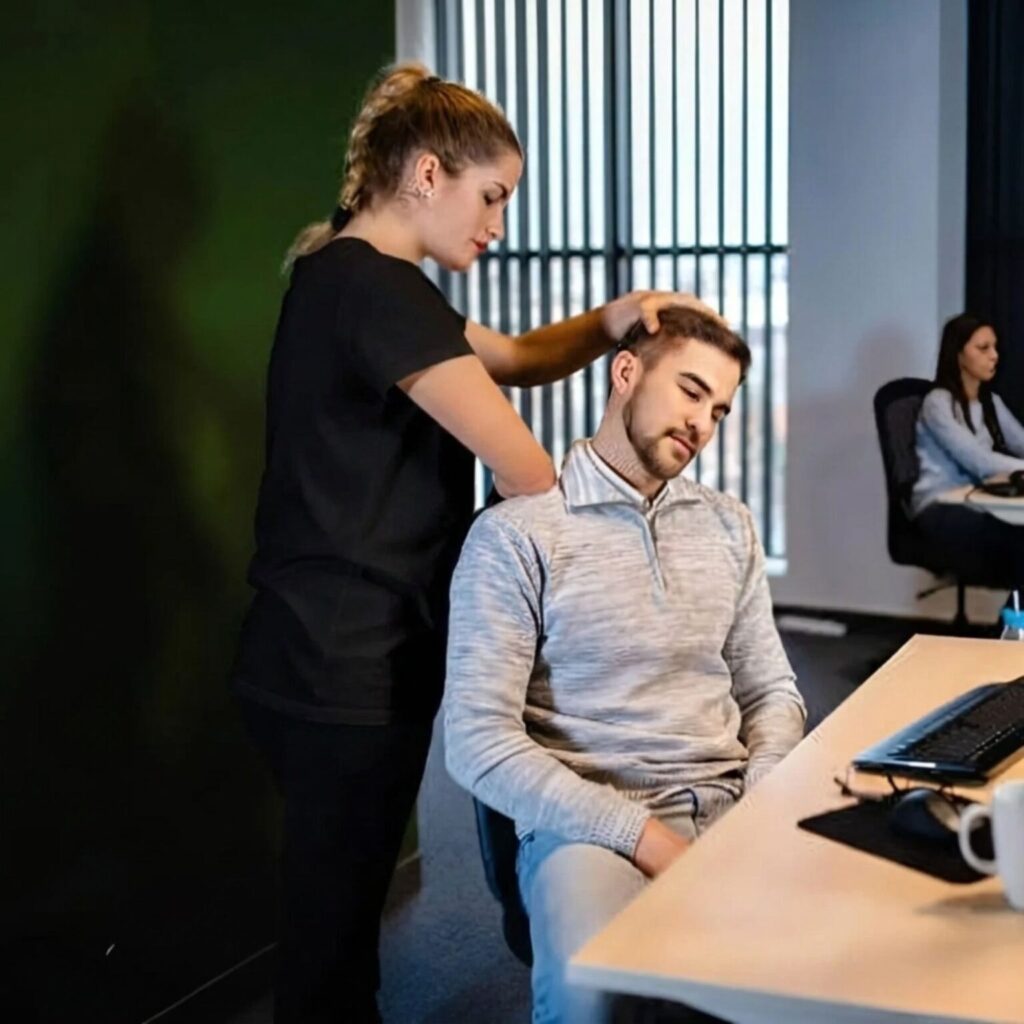
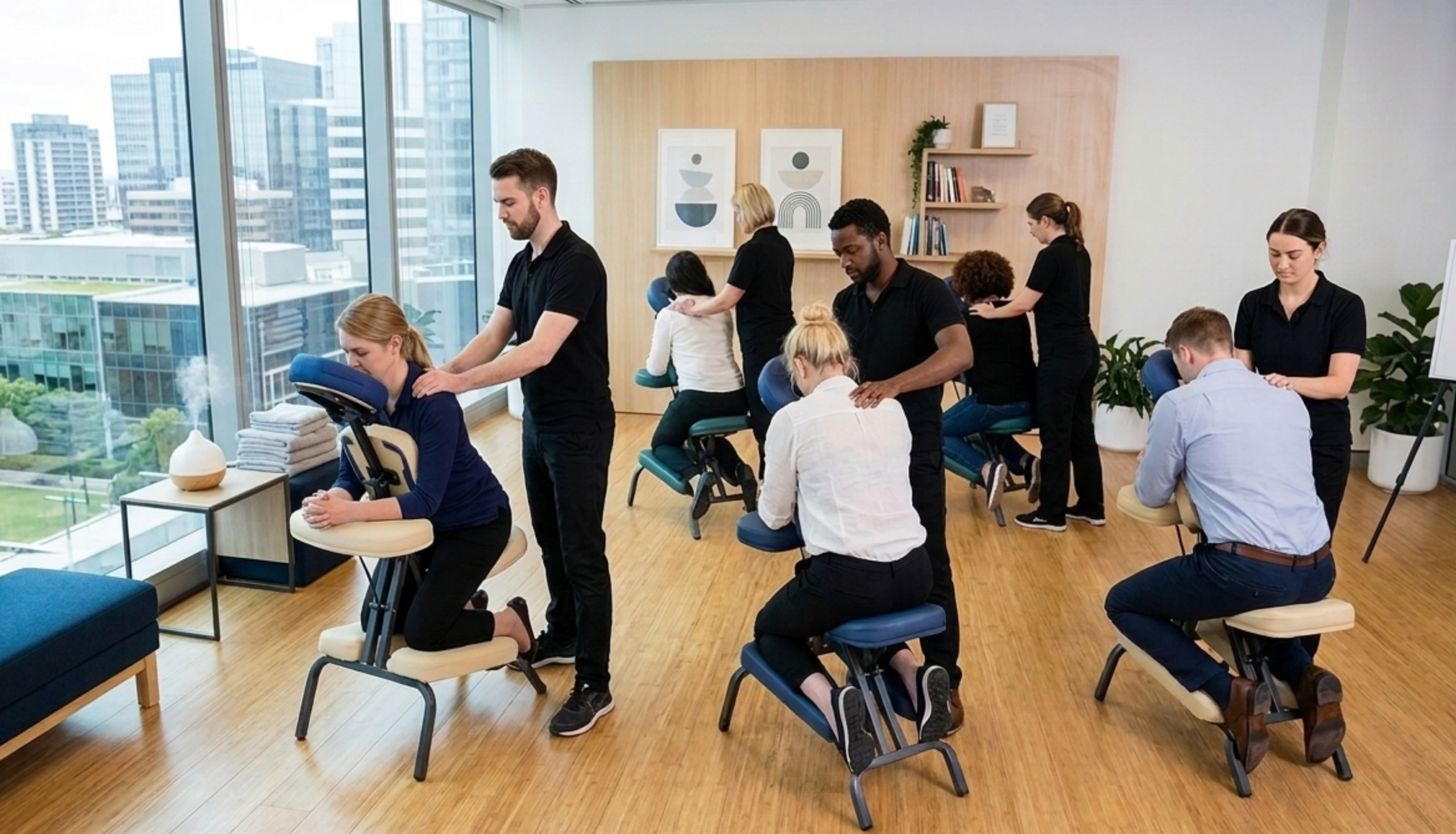
Different formats create different kinds of conversation. Desk massage is quick and happens at the workstation, while seated chair massage allows a little more time in a quieter, one-to-one setting.
| Format | Typical session length | Best suited to |
| Desk massage | 5 to 10 minutes at the workstation | Busy teams and compact or shared workspaces, with no need to leave the desk |
| Seated chair massage | 10 to 30 minutes on an ergonomic chair | Teams that want more time and a calmer, fully clothed, one-to-one experience |
For a closer comparison, see our guide to desk massage or seated chair massage for different office setups. Whichever format you choose, we recommend booking one to two weeks ahead.
Frequently asked questions about office massage
What is office massage?
Office massage is a short, fully clothed massage delivered at the workplace, either at the employee’s desk or in a portable ergonomic chair. Sessions typically run 10 to 20 minutes per person, and the therapist brings the equipment. It is designed to ease neck, shoulder and upper back tension without disrupting the workday.
How long does an office massage session take?
Sessions typically range from 10 to 20 minutes per person. Desk massage can be as short as five minutes, while seated chair massage can run up to 30 minutes where equipment is used. The right length depends on team size, schedule and how much time employees can step away.
Does office massage replace an ergonomic assessment?
No. Office massage can ease tension, but it does not change the workstation that may be causing it. It works best alongside ergonomic reviews and regular movement breaks. Employees with persistent or worsening pain should see their GP or a physiotherapist.
How can HR use office massage to understand employee wellbeing?
HR can add an optional question at sign-up, run a short anonymous survey after sessions and share only de-identified themes with the team. The aim is to learn where employees are uncomfortable, then act on one or two issues visibly, without ever reporting on individuals.
Start the conversation with an office massage program built for your team
For over 20 years, Corporate Care Therapies has provided massage to businesses and events across Australia, including Melbourne, Sydney, Brisbane, Perth, Adelaide and the Gold Coast, as well as regional areas. Whether your team is 10 people or 500, an office massage program can be planned around your space, schedule and culture, with equipment and therapist allocation taken care of.
Explore our corporate massage programs for full service details, or request a quote to discuss how to structure a session that helps your team feel heard.